
Access Daytona Beach Property Records
Property records for Daytona Beach, Florida are held by Volusia County offices and are available to the public without charge for most searches. Daytona Beach has a population of about 86,015 and serves as the county seat of Volusia County. The Volusia County Property Appraiser maintains ownership and assessment data for all parcels within the city. The Volusia County Clerk of Circuit Court holds recorded instruments such as deeds, mortgages, and liens. This guide covers where to find Daytona Beach property records, what they contain, how to file for the homestead exemption, and how the annual property tax calendar works for Volusia County property owners.
Daytona Beach Property Records Quick Facts
How Daytona Beach Property Records Are Managed
Daytona Beach is an incorporated city and the county seat of Volusia County. All property assessment and recording functions for city parcels are handled by county offices. The Volusia County Property Appraiser, Larry Bartlett, maintains the official parcel database. The website is at vcpa.vcgov.org. The contact page at vcpa.vcgov.org/contact has phone numbers and office locations for reaching the appraiser's staff.
Under Chapter 193, Florida Statutes, the property appraiser must assess all real property at just value each January 1. The appraiser's office reviews sales data, field inspection reports, and permits throughout the year to keep assessments current. Ownership records are updated when recorded deeds come in from the Volusia County Clerk. Exemption applications are processed each spring, with the March 1 deadline each year.
The Volusia County Clerk of Circuit Court holds all recorded instruments for Daytona Beach property. Deeds, mortgages, releases, and liens are recorded there under Chapter 28, Florida Statutes. These records are public and available to anyone through the clerk's online search portal or in person at the clerk's office in Daytona Beach.
The Volusia County Property Appraiser's information page explains how property assessment works in the county, what data is available online, and how to contact the office for Daytona Beach parcel questions.
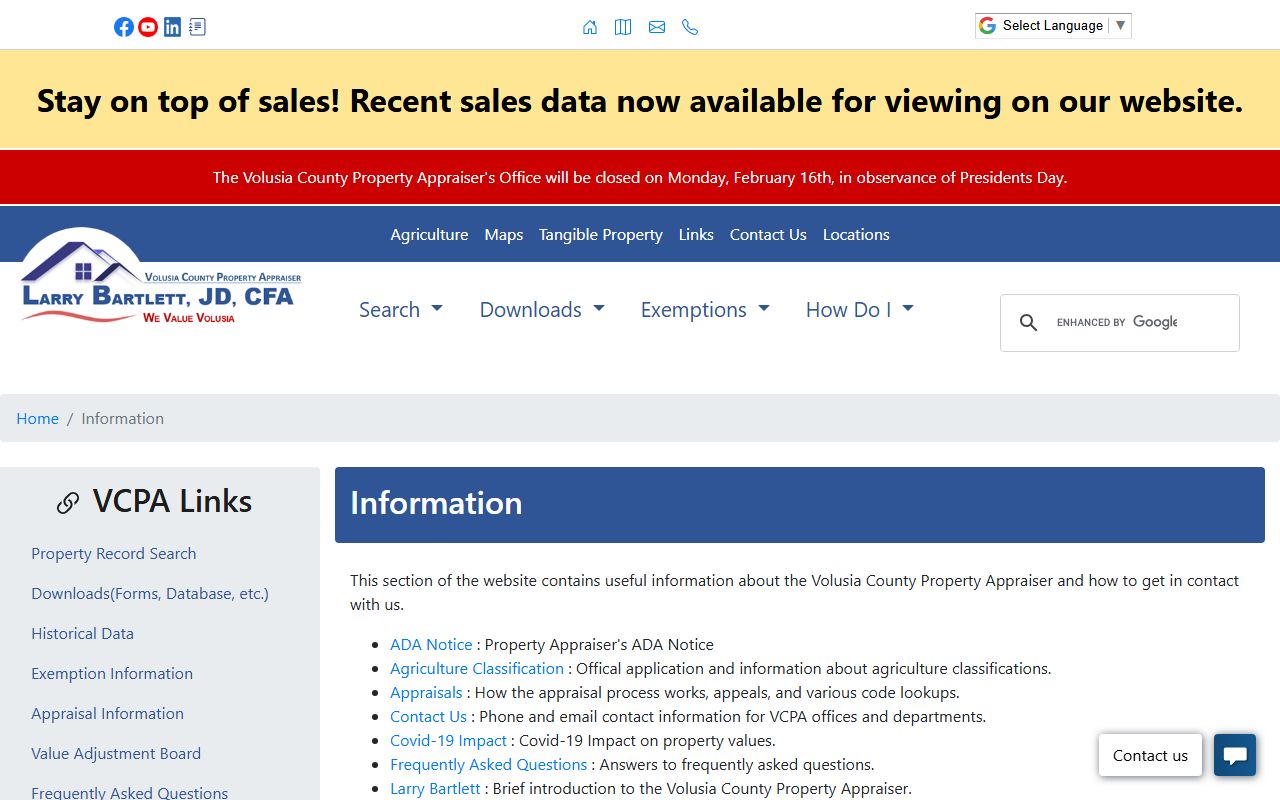
Visit vcpa.vcgov.org/info for an overview of Volusia County property records and links to the parcel search tool.
Search Daytona Beach Property Records Online
The Volusia County Property Appraiser's parcel search at vcpa.vcgov.org is the main tool for looking up Daytona Beach property data. You can search by owner name, street address, or parcel ID number. Each result shows the current owner, mailing address, legal description, land and building details, and assessment history for the current and prior years. The search is free and requires no account or registration.
Sales history is included in each parcel record. Prior sales show the buyer and seller names, sale date, price, and deed type. Qualified sales that reflect market value are noted separately from non-qualified transfers. The appraiser uses qualified sales to support value determinations for similar properties. This data is drawn from recorded deeds and is updated regularly as new instruments come in from the clerk's office.
For copies of recorded instruments, the Volusia County Clerk of Courts maintains an online official records portal. You can search by grantor or grantee name, document type, or recording date. Deeds, mortgages, judgments, lis pendens, and other instruments are available as image downloads. Certified copies require a fee and can be ordered from the clerk's office, which is in Daytona Beach at the county courthouse.
The Florida Department of Revenue also provides county-level property tax data through its public data portal, which can be useful for broader market research or comparing Volusia County assessments and tax rates to other Florida counties.
The Florida Department of Revenue's county officials locator helps you find contact information for all Volusia County property-related offices, including the appraiser, tax collector, and clerk.
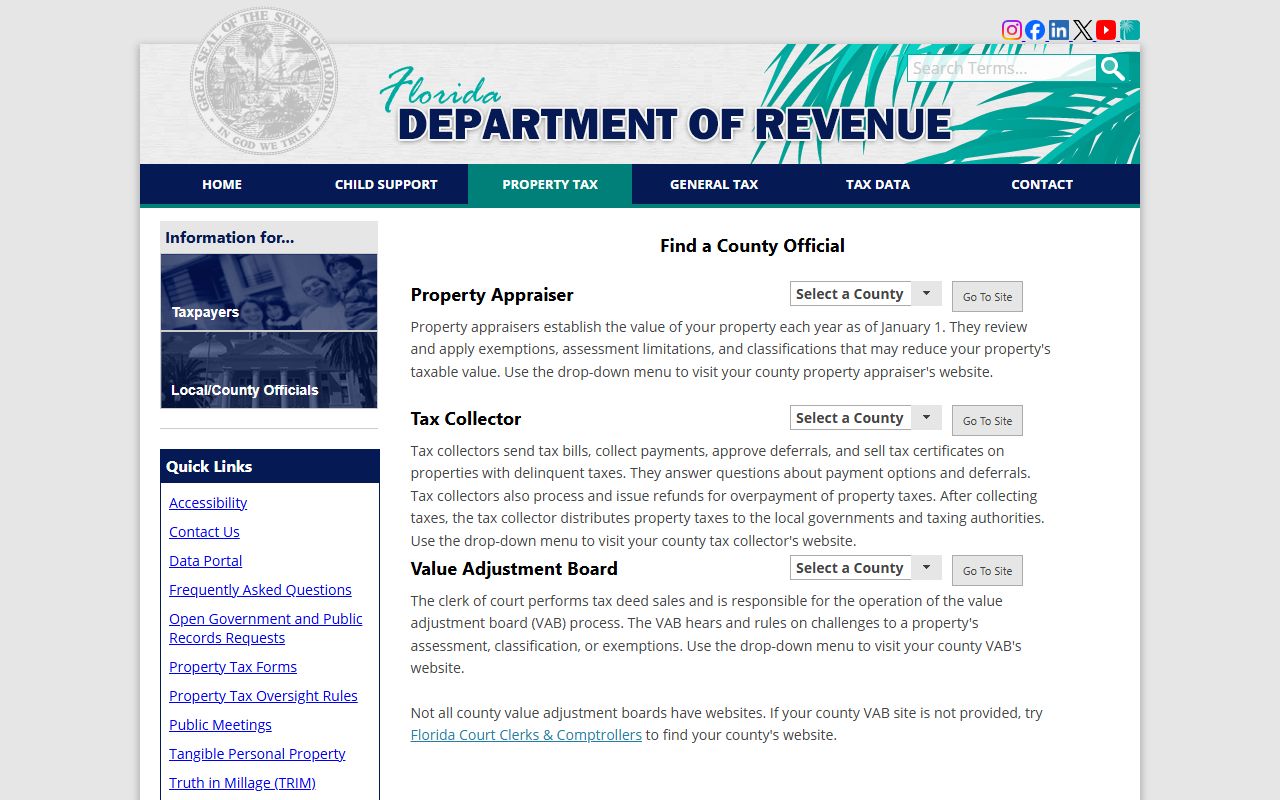
Find Volusia County and Daytona Beach property officials at floridarevenue.com/property/Pages/LocalOfficials.aspx.
What Daytona Beach Property Records Show
A Daytona Beach property record from the Volusia County Property Appraiser covers ownership information, assessment data, and physical details of the parcel. The ownership section lists the current legal owner's name and mailing address. For recently sold properties, the record is updated once the new deed has been recorded with the clerk and processed by the appraiser's office. That update usually takes a few weeks.
Assessment data shows the just value, assessed value, and taxable value for the current year and several prior years. For homestead properties, the assessed value is capped by the Save Our Homes rule, which limits annual increases to 3% or the CPI, whichever is lower. For Daytona Beach homeowners who have held their property for many years, assessed value can be well below market value. The taxable value is what remains after subtracting all applicable exemptions.
Building characteristics include the year the structure was built, construction type, total living area, number of bedrooms and bathrooms, and any secondary structures on the parcel. Land data shows lot size, frontage, and land use classification. For properties near the ocean, Intracoastal Waterway, or Halifax River, waterfront status is noted because it affects value. Daytona Beach has a mix of oceanfront condominiums, residential neighborhoods, and commercial parcels, and the records reflect that variety.
All property appraiser data is public under Chapter 119, Florida Statutes. You can search and view records online at no cost, and no stated reason is required to access the data.
Homestead Exemption for Daytona Beach Residents
Florida's homestead exemption is available to Daytona Beach homeowners who use their property as a primary residence. The exemption reduces taxable value by up to $50,000. The first $25,000 applies to all taxing authorities, including Volusia County, the City of Daytona Beach, and the school district. The second $25,000 applies to all taxes except school taxes. Together, these exemptions can reduce a property's tax bill by several hundred dollars or more each year.
To qualify, you must own the home, live in it as your permanent residence, and be a legal Florida resident on January 1 of the tax year. A Florida driver's license or ID card with the Daytona Beach address is the standard proof of residency. You apply with the Volusia County Property Appraiser, not with the City of Daytona Beach. The March 1 deadline is firm each year. Late applications are not accepted in normal circumstances.
Once the exemption is approved, the Save Our Homes cap begins limiting how much the assessed value can grow each year. Over time, this produces a gap between the assessed value and the property's current market value. That gap represents the accumulated Save Our Homes benefit. When you sell your Daytona Beach home and buy another Florida property, you can transfer up to $500,000 of that benefit to the new home through portability.
Portability is applied by filing a portability application with the property appraiser in the county where your new home is located, at the same time you apply for homestead on the new property. The portability application deadline matches the homestead deadline: March 1. The Volusia County Property Appraiser handles portability for properties where the new home is in Volusia County, and coordinates with other counties for transfers into or out of the county.
Daytona Beach City Government Resources
The City of Daytona Beach manages local permits, zoning, and code enforcement for properties inside city limits. City Hall is at 301 S Ridgewood Avenue, Daytona Beach, FL 32114. The main phone is 386-671-8400. The city website is www.codb.us. City records for permits and business licenses are separate from the county property records maintained by the Volusia County Property Appraiser.
The Building Division processes construction permits and inspections for Daytona Beach properties. Their number is 386-671-8730. Permit information is available at codb.us/building-division. Before purchasing a Daytona Beach property, it is worth reviewing permit history to confirm that all work on the property has been properly permitted and that inspections were completed. Open or failed permits can create complications at closing or trigger required repairs.
Daytona Beach has active planning and zoning processes. If you need a variance, rezoning, or special exception, or if you want to know what uses are permitted on a specific parcel, the city's Planning Division at City Hall is the starting point. Daytona Beach also has a significant number of commercial parcels along US-1, A1A, and other corridors, and zoning classifications vary widely across the city. The city's online GIS system shows current zoning maps and parcel data.
Official Records at the Volusia County Clerk
Deeds, mortgages, releases, judgments, and liens for Daytona Beach property are recorded with the Volusia County Clerk of Circuit Court. The clerk's main office is in Daytona Beach at the courthouse on South Beach Street. Under Chapter 28, Florida Statutes, the clerk must maintain and index all recorded instruments and make them available to the public at no charge for viewing.
The Volusia County official records search is available online. You can search by grantor or grantee name, document type, or date range. Document images for recorded instruments are available to view and download in most cases. Certified copies of any recorded instrument can be ordered online or in person at the clerk's office for a per-page fee.
Documentary stamp tax is collected when a deed is recorded. In Volusia County, the rate is $0.70 per $100 of consideration. The amount of documentary stamps on a deed gives you a way to calculate the sale price. For example, $700 in stamps means the consideration was approximately $100,000. Federal tax liens, mechanics liens, and contractor's liens are also recorded with the Volusia County Clerk. Any serious title research for a Daytona Beach property should cover all recorded instruments through the clerk's official records system.
TRIM and the Property Tax Calendar
Volusia County mails TRIM notices to all property owners each August. For Daytona Beach properties, the TRIM notice lists the proposed assessed value, any exemptions on file, and the proposed tax rates from Volusia County, the City of Daytona Beach, the Volusia County School District, and applicable special districts. The TRIM notice is a preview, not a bill. If the proposed rates are adopted, the taxes shown will be what you owe.
You have 25 days from the TRIM mailing date to file a petition with the Volusia County Value Adjustment Board if you believe your assessed value is wrong or if an exemption was denied. The VAB is an independent administrative body. A special magistrate hears evidence and issues a recommendation. The full board votes on recommendations. Filing a petition is free, and you do not need an attorney, though many owners hire tax professionals for contested commercial assessments.
Tax bills are mailed in early November. Under Chapter 192, Florida Statutes, the state sets the property tax administration framework for all Florida counties. The early-payment discount schedule is 4% in November, 3% in December, 2% in January, and 1% in February. The full amount without discount is due by March 31. After April 1, taxes are delinquent. Delinquent taxes accrue interest and penalties, and unpaid tax certificates can eventually lead to a tax deed action that places the property up for public sale.
Nearby Cities
Deltona is the other major Volusia County city with a property records page.