
Jacksonville Property Records
Jacksonville property records are maintained by the Duval County Property Appraiser and the Duval County Clerk of Courts. This guide explains how to search ownership data, sales history, assessed values, and exemptions for any parcel inside Jacksonville, Florida's largest city by land area and the only consolidated city-county government in the state.
Jacksonville Property Records Quick Facts
How Jacksonville Property Records Are Maintained
Jacksonville is unique in Florida. In 1968, the City of Jacksonville and Duval County merged into a single consolidated government. That means there is no separate county government layer here. The Duval County Property Appraiser's office serves all of Jacksonville and handles every parcel record for the city.
The Property Appraiser is Joyce Morgan. Her office is located at 231 E Forsyth Street, Suite 270, Jacksonville, FL 32202. The phone number is (904) 255-5900 and you can reach the office by email at pacustserv@coj.net. Office hours run Monday through Friday, 7:30 a.m. to 5:30 p.m. The main website for the office is jacksonville.gov/departments/property-appraiser.
Florida law, specifically Chapter 193, requires every county property appraiser to assess all real property annually at just value. The Duval office meets this requirement and also notes that Florida law mandates a physical inspection of every property in the county at least once every five years. That inspection cycle keeps parcel data current.
All recorded documents such as deeds, mortgages, and liens are filed with the Duval County Clerk of Courts, not the Property Appraiser. The Clerk's official records are governed by Chapter 28 of Florida Statutes. Public access to those documents is provided through the Duval County Clerk's online portal at duvalclerk.com.
How to Search Jacksonville Property Records
The Duval County Property Appraiser offers a free online property search tool at jacksonville.gov/departments/property-appraiser/property-search. You can look up any parcel by:
- Owner name (last name first works best)
- Property address or street name
- Parcel identification number (RE number)
- Subdivision or legal description
Search results will show the current owner of record, the property address, parcel boundaries, land use codes, and all assessed and taxable values. You can also see the full sales history for any parcel, which shows every arm's-length transfer recorded in Duval County going back many years.
The screenshot below shows the Jacksonville City tax collector portal, which is a useful secondary resource once you have the parcel data from the Property Appraiser.
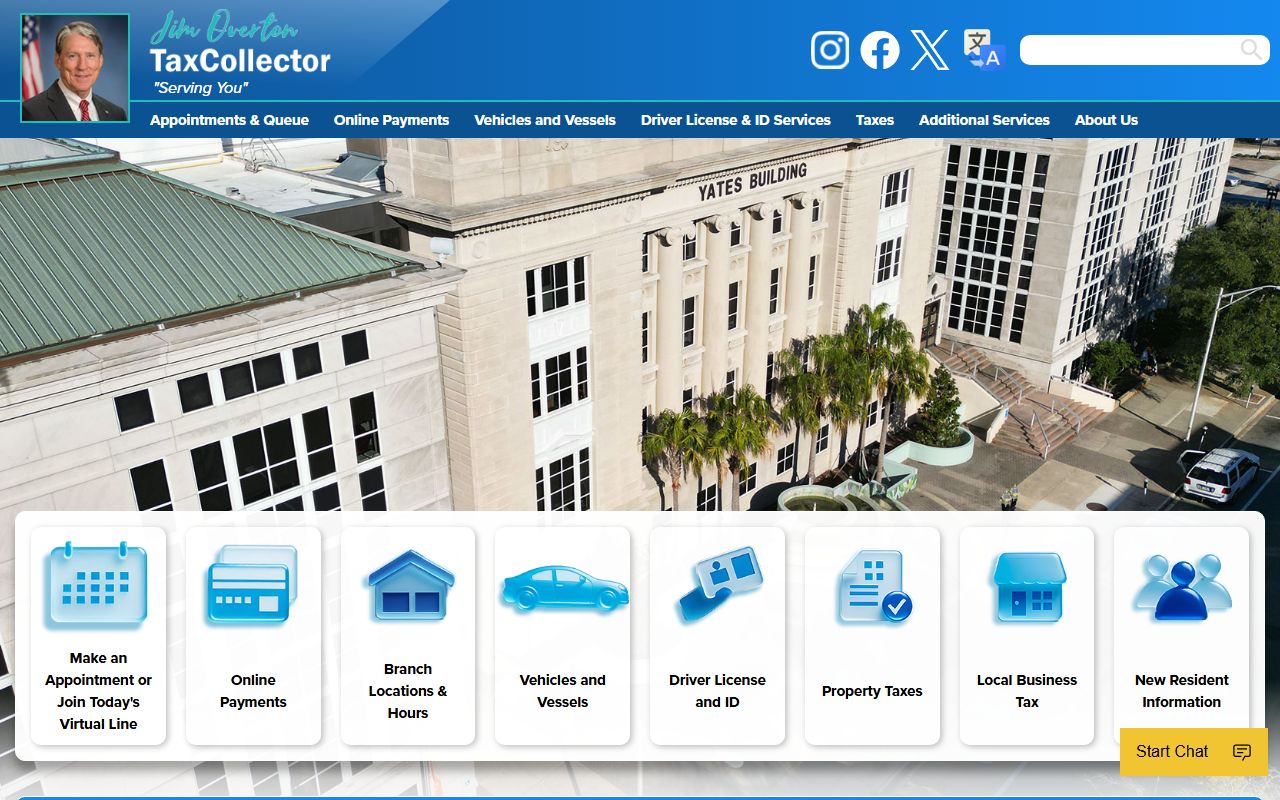
The Duval County Tax Collector handles property tax billing and payments. Once you find a parcel through the Property Appraiser's search, you can cross-reference tax payment status at the Tax Collector's website. The Tax Collector's phone is (904) 255-5700 and the email is taxcollector@coj.net.
If you need recorded documents like a specific deed or a lien release, those come from the Clerk of Courts, not the Property Appraiser. The Clerk's online system lets you search by grantor or grantee name, document type, and recording date range. You can view many documents at no charge through the public access portal.
What Jacksonville Property Records Show
A full property record in Duval County contains several layers of data. Here is what you will typically find when you pull up a parcel through the Property Appraiser's search:
- Owner of record - the current legal owner and mailing address
- Parcel ID (RE number) - the unique identifier for the parcel
- Legal description - the formal description from the recorded deed
- Land use and zoning classification
- Land area and building area in square feet
- Year built and construction type
- Just value - the assessed market value set each year
- Assessed value - may be lower than just value if Save Our Homes cap applies
- Taxable value - after exemptions are deducted
- Exemptions on file (homestead, senior, disability, veteran)
- Sales history - dates, prices, and instrument types for prior transfers
The distinction between just value, assessed value, and taxable value matters. If a homeowner has had the homestead exemption in place for years, their assessed value can be significantly lower than market value because of the Save Our Homes cap. Buyers should note this because the cap resets to just value when ownership changes.
Homestead Exemption for Jacksonville Residents
Florida's homestead exemption reduces the taxable value of a primary residence by up to $50,000. The first $25,000 applies to all taxing authorities. The second $25,000 applies to assessed values between $50,000 and $75,000 and does not apply to school taxes.
To qualify, you must own and occupy the property as your permanent residence as of January 1 of the tax year. You must also be a Florida resident. The deadline to file is March 1 each year. Late applications are generally not accepted for the current tax year.
You can file your homestead exemption application through the Duval County Property Appraiser's office. The exemptions page is at jacksonville.gov/departments/property-appraiser/exemptions. Applications can be submitted online, in person at 231 E Forsyth Street, or by mail.
The Save Our Homes cap limits annual increases in the assessed value of a homesteaded property to 3% or the rate of inflation, whichever is less. Over time this can mean your assessed value falls well below just value. When you move, you can transfer this accumulated benefit to a new Florida home through a process called portability. Portability must also be applied for by the March 1 deadline.
Other exemptions available in Duval County include additional homestead for low-income seniors, a $500 disability exemption, veteran exemptions, and a widow/widower exemption. Each has its own eligibility rules. Contact the Property Appraiser's office at (904) 255-5900 to ask about specific exemption eligibility.
City of Jacksonville Resources
Jacksonville's consolidated government provides city and county services through the same departments. The screenshot below is from the city's planning and development portal.

The Planning and Development Department handles zoning changes, variances, and land use applications. If you need to know the current zoning on a parcel or want to understand what can be built on a site, this is the right office.
City Hall is located at 117 W Duval Street, Suite 175, Jacksonville, FL 32202. The general city phone line is 904-630-1776 and the city website is jacksonville.gov.
The Building Inspection Division handles permits for construction, renovations, and demolition. The office is at 214 N Hogan Street, Jacksonville, FL 32202, phone 904-255-8500. Their website is jacksonville.gov/departments/building-inspection-division. Permit history for a property is often a useful part of due diligence research because it shows what work was done and whether inspections were completed.
Official Records at the Duval County Clerk
Property-related documents that are legally recorded in Duval County are held by the Duval County Clerk of Courts. Under Chapter 28 of Florida Statutes, clerks maintain the Official Records index for their county. In Duval County, this includes:
- Warranty deeds and quitclaim deeds
- Mortgages and satisfactions of mortgage
- Mechanic's liens and lien releases
- Judgment liens
- Lis pendens notices
- Easements and plats
The Duval County Clerk also operates a Property Fraud Alert program. This is a free service that monitors recorded documents for any name you register. If a document is recorded in Duval County under your name or a business name you register, you get an alert. The FBI has called property fraud one of the fastest-growing white-collar crimes in the country. The alert program lets you catch unauthorized transfers or fake liens early. Sign up at duvalclerk.gov/services/property-fraud-alert.
To get copies of recorded documents, you can search and view many records online at no cost through the Clerk's public portal. Certified copies and physical copies carry a small per-page fee set by Florida law under Chapter 119.
TRIM Notice and Property Tax Timeline
Every August, Duval County property owners receive a TRIM notice. TRIM stands for Truth in Millage. This notice is not a tax bill. It is a preliminary statement showing your proposed assessed value for the coming year, any exemptions on file, and the proposed millage rates from each taxing authority that levies on your parcel.
If you disagree with your assessed value, the TRIM notice is your prompt to act. The deadline to file a petition with the Value Adjustment Board is typically 25 days from the date on the TRIM notice. The VAB is an independent body that hears appeals from property owners who believe the Property Appraiser's value is too high or that an exemption was wrongly denied. Filing fees are small and the process is open to any property owner.
After the August TRIM period, county commissioners and other taxing bodies hold public hearings in September to set final millage rates. Tax bills are then sent out in November. The discount schedule rewards early payment: 4% if paid in November, 3% in December, 2% in January, and 1% in February. Taxes paid by March 31 are on time. After April 1, unpaid taxes become delinquent and the county begins the tax certificate sale process under Chapter 192.
Nearby Cities
Jacksonville sits in the northeast corner of Florida. As the only consolidated city-county in the state, it covers a large geographic area. Other qualifying cities in Florida are located further south and west.