
Escambia County Property Records Search
Escambia County property records are kept by the Escambia County Property Appraiser and the Clerk of Courts in Pensacola. These public records cover all real estate in the county and include ownership details, assessed values, sales history, deed filings, and parcel characteristics for homes, commercial buildings, and land throughout Escambia County, Florida.
Escambia County Property Records Quick Facts
Escambia County Property Appraiser Office
The Escambia County Property Appraiser is located at 213 Palafox Place, 4th Floor, Pensacola, FL 32502. The office phone is 850-434-2737. Online parcel searches are available through the appraiser's website at escambiacopa.com. The office manages assessment records for all real and tangible personal property in Escambia County, including residential, commercial, industrial, and vacant land parcels.
All property assessments in Escambia County follow Florida Statute Chapter 193, which requires every property to be assessed at just value as of January 1 each year. Just value represents the fair market value of the property, which the appraiser determines based on comparable sales, income data, and property characteristics. The appraiser's office must also physically inspect every parcel in the county at least once every five years under Florida law.
Escambia County sits at Florida's western edge along the Gulf Coast. The county includes a mix of urban Pensacola, coastal properties on Pensacola Beach and Perdido Key, suburban areas in unincorporated Escambia County, and military installations including Naval Air Station Pensacola. This geographic range means the property roll covers a wide variety of parcel types with very different value profiles.
Online Property Record Searches
The Escambia County Property Appraiser's website provides free public access to parcel data. Search options include owner name, parcel ID number, street address, and subdivision. Results show the current owner, legal description, land area, building details, land use classification, and assessed and just values for the current tax year. Prior year values are also available for most parcels.
Sales history is shown for most parcels and displays past transactions with the sale price and date. Real estate professionals, buyers, and property owners use this data to gauge fair market value and verify ownership chains. The database is updated regularly as new transactions are recorded and new construction is added to the roll.
The Florida Department of Revenue data portal provides statewide property tax data that includes Escambia County. This state-level resource offers downloadable tax roll data and county-level statistics. The DOR portal also links to local county offices, making it a useful starting point for statewide or multi-county research.
The Florida DOR's statewide property records portal, shown below, provides data for all 67 Florida counties including Escambia County.
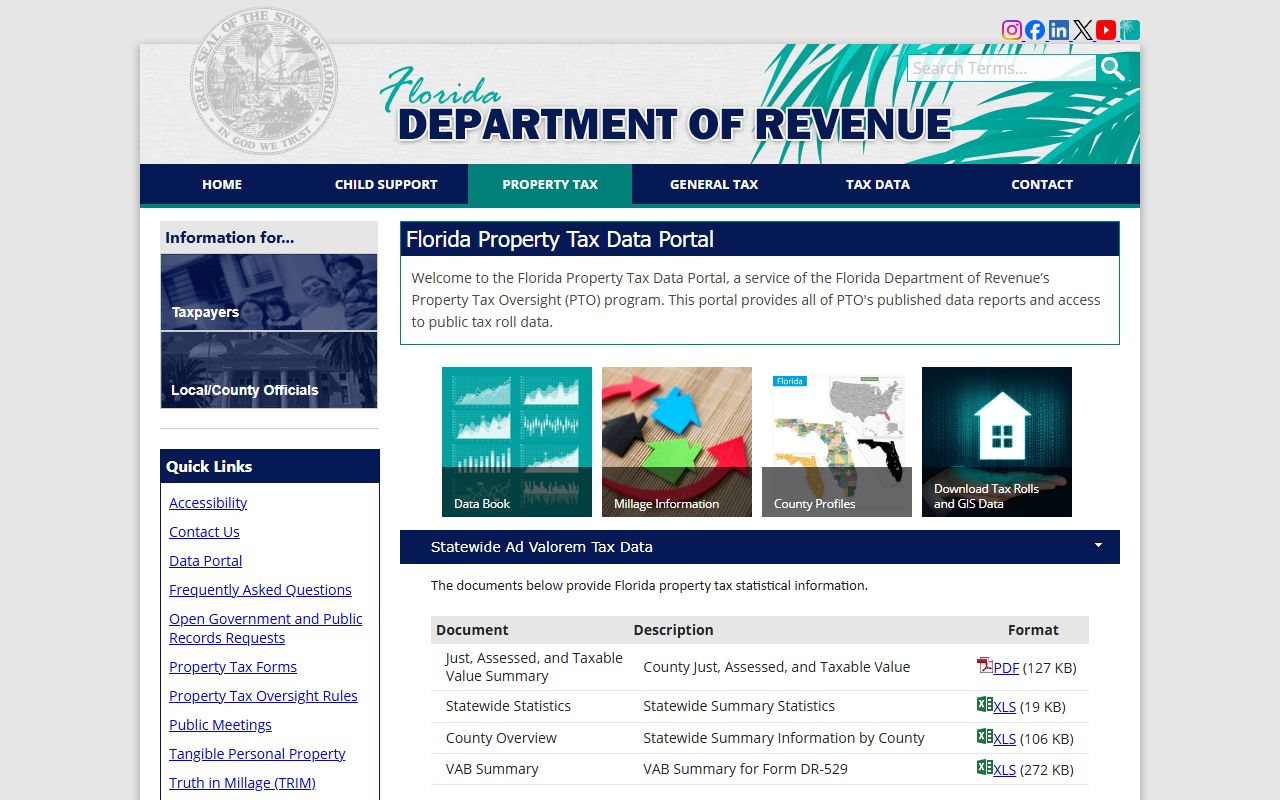
This portal links to the Escambia County Property Appraiser's website and provides context on how local values compare to state averages across northwest Florida.
Note: The online parcel database reflects the most recently certified assessment roll. Very recent deed changes or pending appeal outcomes may not yet be reflected in the online data.
Florida Public Records Law
Escambia County property records are public under Florida Statute Chapter 119. This law gives any person the right to inspect or copy records held by government agencies. You do not need a reason or a legal interest in the property. The law covers both the assessment records held by the Property Appraiser and the deed records held by the Clerk of Courts.
The general property tax framework that governs all assessments in Escambia County is found in Florida Statute Chapter 192. That chapter defines just value, assessed value, and taxable value, and sets the timelines for certifying the assessment roll each year. Chapter 192 applies to every county in Florida, including Escambia.
Homestead Exemption in Escambia County
Florida's homestead exemption reduces the taxable value of a qualifying primary residence by up to $50,000. In Escambia County, applications are filed with the Property Appraiser at 213 Palafox Place, Pensacola, or through the appraiser's online portal at escambiacopa.com. The March 1 deadline is firm. If you miss it, you have to wait until the next year.
To qualify, you must own the property and live in it as your primary Florida residence as of January 1. You cannot claim homestead on a vacation home, investment property, or a property that is not your main legal residence. Proof of residency is required, typically in the form of a Florida driver's license or voter registration card showing the property address.
Homesteaded properties in Escambia County benefit from the Save Our Homes cap, which limits the annual increase in assessed value to the lower of three percent or the Consumer Price Index. In a rising market, this cap can be very valuable for long-term residents. Properties that lose homestead eligibility, such as when the owner moves out or rents the property too long, lose the cap and are reassessed at full market value.
Additional exemptions available in Escambia County include those for veterans with service-connected disabilities, surviving spouses of veterans and first responders, persons with total and permanent disabilities, and low-income seniors. The Florida DOR's taxpayer information page describes all statewide exemptions and the documentation needed to apply in Escambia County.
Deed Records and the Escambia County Clerk
Recorded documents affecting real property in Escambia County, including deeds, mortgages, liens, easements, and judgments, are maintained by the Escambia County Clerk of Courts in Pensacola. The Clerk's records are governed by Florida Statute Chapter 28, which requires the Clerk to record and index all qualifying documents in the Official Records.
Copies of recorded documents can be obtained in person at the Clerk's office or through the Clerk's online records portal. Fees are set by state law and vary by document type and number of pages. Certified copies cost more than uncertified copies but may be required for certain legal purposes.
Recording a deed in Escambia County is essential to protect the buyer's ownership. An unrecorded deed is not effective against third parties who later pay value for the same property without notice. This is why recording happens at closing in nearly every real estate transaction. The chain of recorded deeds in the Official Records is the primary evidence of ownership history for any parcel in Escambia County.
The Florida DOR local officials directory lists contact information for the Escambia County Clerk of Courts and Property Appraiser, along with all other county property offices across the state.
Property Tax Billing in Escambia County
The Escambia County Tax Collector sends property tax notices in November of each year. The bill covers the current tax year and is based on the taxable value set by the Property Appraiser and the millage rates adopted by Escambia County's taxing authorities. These authorities include the county commission, the school board, and various special districts serving different parts of Escambia County.
Taxes are due in full by March 31 of the following year. Paying early earns discounts: four percent off in November, three in December, two in January, one in February. Delinquent taxes after March 31 accrue interest and are eventually sold as tax certificates. If the tax remains unpaid for years, the certificate holder can apply for a tax deed, which may transfer the property.
The Florida DOR maintains a statewide directory of county property officials, including the Escambia County Tax Collector. The screenshot below shows that directory page.
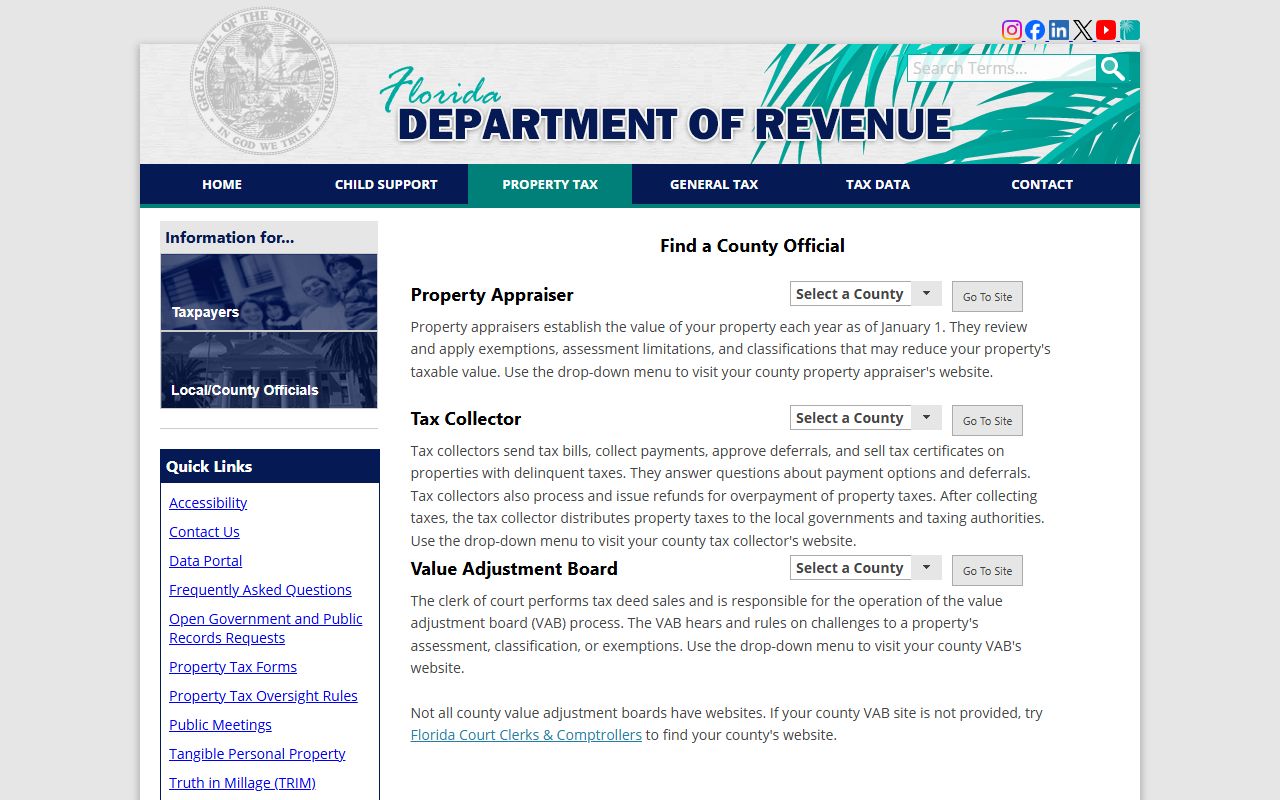
This directory is a reliable reference for finding contact information for any county property office in Florida, including all Escambia County offices.
Tangible Personal Property in Escambia County
Businesses in Escambia County are required to file a Tangible Personal Property Tax Return with the Property Appraiser by April 1 each year. The return covers business equipment, furniture, machinery, and other non-real-property assets. Business assets with a total value under $25,000 are exempt from tax, but the return must still be filed to claim that exemption.
Late filing results in a penalty equal to a percentage of the tax that would have been due. Businesses that fail to file at all may be subject to an estimated assessment. If you operate a business in Pensacola, Pensacola Beach, or anywhere else in Escambia County, contact the Property Appraiser's office at 850-434-2737 to get the required forms and filing instructions.
Coastal and Military Property Considerations
Escambia County includes significant coastal areas on Pensacola Beach and Perdido Key, as well as major federal installations. Coastal properties face unique assessment challenges because of their high market values and the potential effects of flood zones and storm risk on that value. The Property Appraiser's office considers flood zone designations and other factors when valuing coastal properties.
Federal property, including Naval Air Station Pensacola and Eglin Air Force Base land within Escambia County, is generally exempt from property tax. This reduces the county's taxable base and affects how millage rates are set for the rest of the roll. The appraiser's office tracks exempt properties separately from taxable ones in the annual assessment roll.
Cities in Escambia County
Escambia County includes Pensacola as the county seat, along with the smaller municipalities of Century and Pensacola Beach (a resort island). None of these cities currently meet the population threshold for a dedicated city page on this site. All property records for Pensacola and the surrounding unincorporated areas of Escambia County are maintained through the Property Appraiser at 213 Palafox Place and the Clerk of Courts, both in Pensacola.
Nearby Counties
Escambia County shares its eastern border with Santa Rosa County. To the north and west, the county borders Alabama. If you are researching property near the Santa Rosa County line, both county property appraiser websites may be relevant.