
Find Port St. Lucie Property Records
Port St. Lucie property records are managed by the St. Lucie County Property Appraiser and the St. Lucie County Clerk of Court. This page covers how to search ownership data, assessed values, sales history, and homestead exemptions for parcels inside Port St. Lucie, Florida's largest city by population on the Treasure Coast.
Port St. Lucie Property Records Quick Facts
How Port St. Lucie Property Records Are Maintained
Port St. Lucie is located within St. Lucie County. Property appraisal and assessment for all Port St. Lucie parcels is performed at the county level by the St. Lucie County Property Appraiser. The city does not run its own property assessment system. Instead, every parcel inside city limits is tracked, valued, and documented by the county office.
The St. Lucie County Property Appraiser's main office is at 2300 Virginia Avenue, Fort Pierce, FL 34982. The county seat is Fort Pierce, so the main PA office is there rather than in Port St. Lucie. Phone is 772-462-1000 and the website is stluciepa.org.
Florida law under Chapter 193 requires the Property Appraiser to assess all property at just value each year as of January 1. The St. Lucie County office follows this process and publishes its findings annually. For homesteaded properties, the Save Our Homes cap limits annual increases in assessed value.
Recorded instruments including deeds and mortgages are kept by the St. Lucie County Clerk of Court under Chapter 28 of Florida Statutes. The Clerk maintains the Official Records that establish chain of title and document encumbrances on Port St. Lucie properties.
How to Search Port St. Lucie Property Records
The St. Lucie County Property Appraiser offers a free online property search at stluciepa.org. You can search by owner name, property address, or parcel ID. The search returns matching records and clicking any result shows the full parcel detail page with all assessed values, exemptions, and sales history.
The Florida Department of Revenue also maintains statewide property tax data at its online portal. The screenshot below shows the DOR's Florida property tax data portal, which provides context on property tax data across all 67 counties including St. Lucie.
The Florida Department of Revenue Property Tax Data Portal provides statewide property tax data, roll information, and resources for property owners across Florida.
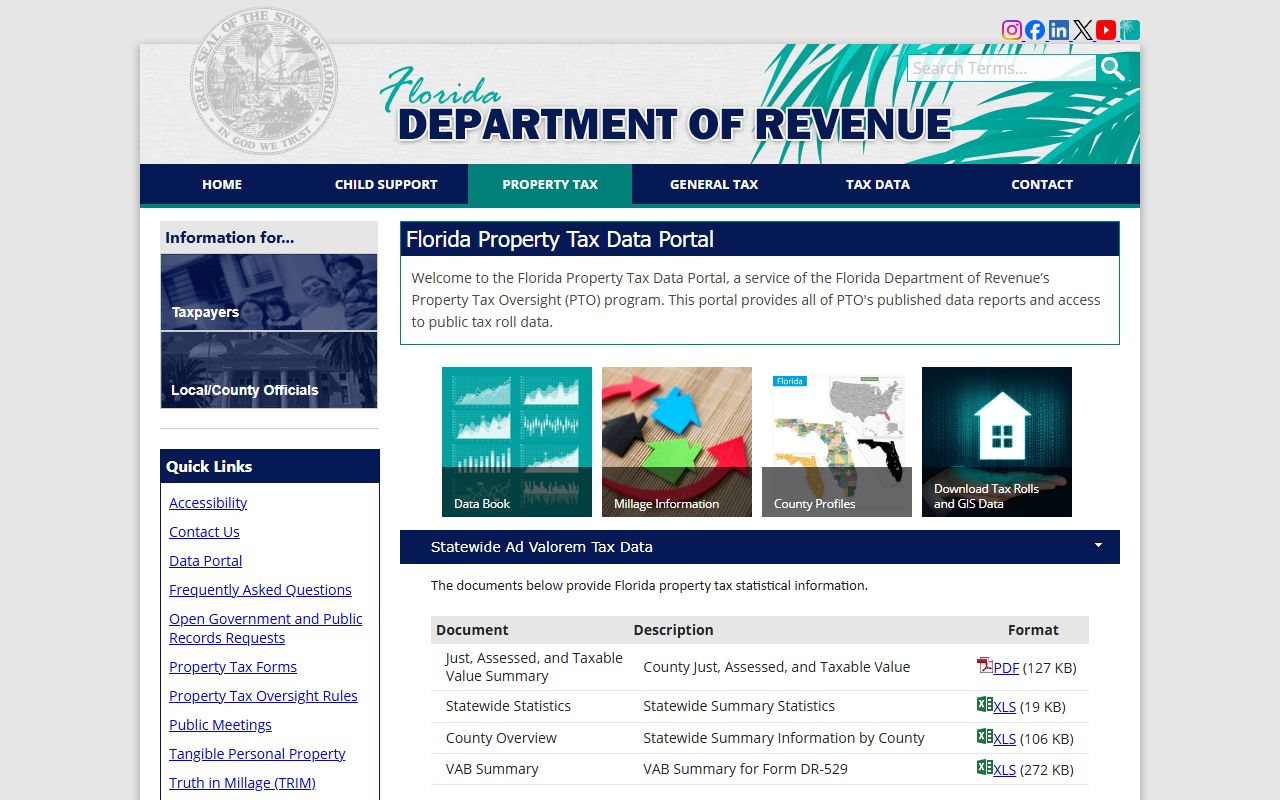
The DOR oversees the Property Tax Oversight program statewide. It does not handle individual parcel lookups, but it provides guidance on property tax rules, forms, and procedures that apply to Port St. Lucie property owners.
For the most direct parcel lookups, always start at the St. Lucie County Property Appraiser's website at stluciepa.org. Owner name searches work best when you enter the last name first. If you have a parcel ID number, that search returns results without ambiguity.
The Florida DOR also maintains a taxpayer information section with guidance on exemptions, appeals, and property tax obligations that applies to Port St. Lucie residents.
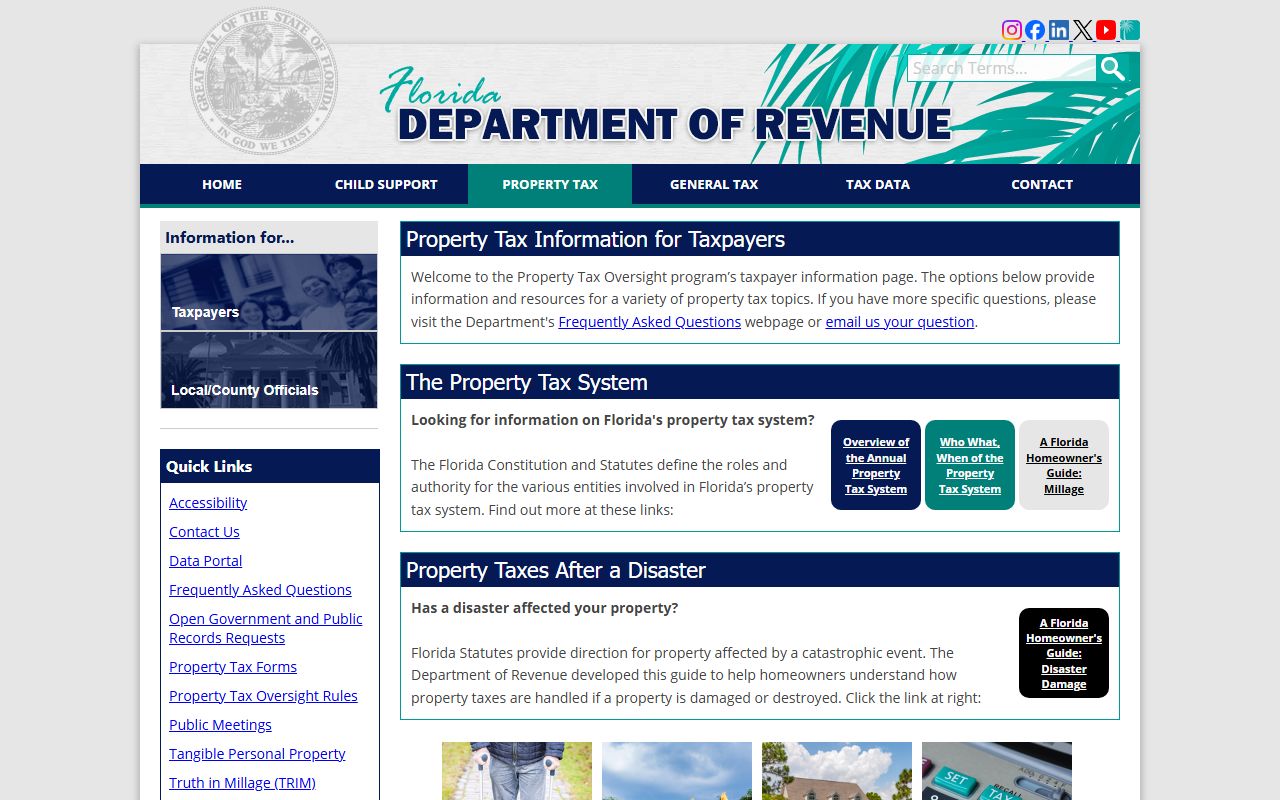
This resource explains how Florida's property tax system works at the state level. It covers the annual assessment cycle, exemption types, TRIM notices, Value Adjustment Board appeals, and the discount schedule for early tax payment.
For recorded documents, the St. Lucie County Clerk's Official Records search is available at stlucieclerk.gov. You can search by grantor or grantee name, document type, or recording date range. Many documents are available as free PDFs. Certified copies require a per-page fee under Chapter 119.
What Port St. Lucie Property Records Show
A standard parcel record from the St. Lucie County Property Appraiser contains comprehensive data on any Port St. Lucie property. Here is what to expect:
- Owner name and mailing address
- Parcel ID number
- Legal description from the recorded deed
- Land use classification and zoning code
- Lot dimensions and total area
- Building data: year built, living area, total area, construction type, quality grade
- Just (market) value
- Assessed value (may be lower due to Save Our Homes cap)
- Taxable value after all exemptions
- Exemptions on file
- Sales history with transfer dates and prices
Port St. Lucie has a large number of single-family planned communities, many of which were built by General Development Corporation starting in the 1960s. Many homes in these older planned areas have similar floor plans, which makes the Property Appraiser's comparable sales data especially useful for understanding value trends. If you are looking at a Port St. Lucie home, pull up nearby parcels on the SLCPA site to see recent sales prices for comparable properties.
Homestead Exemption for Port St. Lucie Residents
Florida's homestead exemption is available to property owners who use a home as their permanent primary residence. The exemption reduces taxable value by up to $50,000. You must own the property and occupy it as a Florida resident as of January 1 of the tax year you are claiming. The application deadline is March 1.
Applications for Port St. Lucie properties are filed with the St. Lucie County Property Appraiser. You can apply online at stluciepa.org or in person at the office at 2300 Virginia Avenue in Fort Pierce. The application asks for proof of Florida residency such as a Florida driver's license, voter registration card, and declaration of domicile. Social Security numbers for all owners and their spouses are required.
Once the homestead is approved, the Save Our Homes cap begins in the second year. It limits assessed value increases to 3% or the CPI change, whichever is less. Over time this creates a gap between assessed value and market value. For buyers, this means the current owner's low tax bill does not reflect what a new owner will pay. The cap resets to just value when the property transfers.
Portability allows a Port St. Lucie homeowner to move the accumulated Save Our Homes benefit to a new Florida homestead. You apply for portability at the same time as your new homestead application. Both applications must be filed by the March 1 deadline. Other exemptions available in St. Lucie County include additional senior homestead, disability, veteran, and surviving spouse exemptions. Contact the Property Appraiser at 772-462-1000 to ask about eligibility for any of these.
City of Port St. Lucie Resources
The City of Port St. Lucie operates its own departments for permits, building, and planning. City Hall is at 121 SW Port St. Lucie Boulevard, Port St. Lucie, FL 34984. The main city number is 772-871-5159 and the city website is cityofpsl.com.
The Building Department handles permits and inspections for construction inside Port St. Lucie city limits. Phone is 772-871-5133 and you can access permit information at cityofpsl.com/departments/building-department. Permit records are public and useful for researching what improvements have been made to a property and whether all work was inspected and approved by the city.
Port St. Lucie has grown rapidly in recent decades and the city continues to see active new construction and permitting. For properties in newer sections of the city, permit records can be extensive and detailed. For older General Development Corp neighborhoods, permit records may be thinner since those homes predate modern digital records systems.
Zoning inside Port St. Lucie city limits is set by the city's land development regulations. The city's planning division can answer questions about allowable uses, density, setbacks, and development standards for any parcel inside city limits. For parcels in unincorporated St. Lucie County, contact the county's planning department instead.
Official Records at the St. Lucie County Clerk
The St. Lucie County Clerk of Court is the custodian of Official Records for all documents recorded in St. Lucie County. Under Chapter 28 of Florida Statutes, the Clerk records, indexes, and preserves all instruments affecting real property in the county. For Port St. Lucie properties, this includes every deed, mortgage, lien, and plat that has been recorded in connection with the parcel.
Common recorded documents you can find through the Clerk's system include:
- Warranty deeds
- Quitclaim deeds
- Mortgages and satisfaction of mortgage
- Mechanic's liens and releases
- Judgment liens
- Lis pendens notices
- Plats and surveys
When the Property Appraiser's record shows a prior sale, the OR Book and Page reference on that entry tells you exactly where to find the corresponding recorded deed in the Clerk's system. You can search by those references, or by the names of the buyer and seller from the sale entry.
TRIM Notice and Property Tax Timeline
St. Lucie County sends TRIM notices to all property owners each August. The Truth in Millage notice shows your proposed assessed value, exemptions on file, and proposed millage rates from the county, city, school board, and other districts. For Port St. Lucie properties, the City of Port St. Lucie levies its own millage on top of the county and school rates. The TRIM notice shows all of these separately so you can see how each taxing body contributes to your total bill.
If you think your assessed value is too high, the TRIM notice period is when you act. You have 25 days from the TRIM notice date to file a petition with the St. Lucie County Value Adjustment Board. The VAB reviews appeals independently and can adjust values if the evidence supports a lower assessment. Filing fees are small. You can represent yourself or hire a licensed tax agent.
Millage rates are finalized in September after public budget hearings. Tax bills go out in November. Pay in November to get a 4% discount, December for 3%, January for 2%, or February for 1%. Full payment by March 31 keeps the property current. After April 1, taxes become delinquent. Under Chapter 192, the county then proceeds with tax certificate sales to collect unpaid amounts.
Nearby Cities
Port St. Lucie is located on Florida's Treasure Coast. It is the largest city in St. Lucie County. Nearby qualifying cities are primarily in Palm Beach County to the south.