
Search Clay County Property Records
Clay County property records are maintained by the Clay County Property Appraiser and are open to the public under Florida law. Whether you need ownership information, assessed values, deed history, or parcel details for land in Green Cove Springs or elsewhere in Clay County, the appraiser's office and its online tools give you fast access to the data you need.
Clay County Property Records Quick Facts
Clay County Property Appraiser Office
The Clay County Property Appraiser is located at 477 Houston Street in Green Cove Springs, FL 32043. The office can be reached by phone at 904-284-6300. Property data for all parcels in Clay County is maintained here, including residential homes, commercial properties, agricultural tracts, and vacant lots. The appraiser's website at claycountygov.com/property-appraiser provides free online access to parcel records.
The office operates under Florida Statute Chapter 193, which requires the appraiser to assess all property at just value each year. Just value is essentially fair market value, the price a willing buyer would pay a willing seller with no pressure on either side. Assessments drive property tax calculations throughout Clay County.
Clay County has grown significantly over the past two decades, driven by its location between Jacksonville and St. Augustine. That growth means a larger and more complex property roll for the appraiser's office to manage. The database is updated regularly to reflect new construction, sales transactions, and ownership changes.
Understanding Clay County Property Records
Property records in Clay County include two distinct types of data. First, there are assessment records kept by the Property Appraiser, which cover values, exemptions, parcel characteristics, and owner names. Second, there are Official Records kept by the Clay County Clerk of Courts, which cover recorded documents such as deeds, mortgages, easements, and liens.
Both types of records are public. Florida Statute Chapter 119, the Public Records Law, guarantees that any person can inspect or copy public records. Government agencies cannot charge you simply for looking at records, though they can charge reasonable fees for copies or staff time spent on large requests.
Assessment records are tied to the tax roll, which is governed by Florida Statute Chapter 192. That chapter defines how property is classified, what constitutes taxable value, and when the assessment roll must be certified each year. For Clay County, the certified roll forms the basis for all tax bills mailed by the Tax Collector.
Searching Parcels Online
The Clay County Property Appraiser's online search tool lets you look up any parcel in the county for free. Search options include owner name, parcel identification number, street address, and subdivision or plat name. Results display the current owner of record, the legal description, property class, building details, lot dimensions, and assessed values for the current and prior years.
Sales history is also available for most parcels, showing prior transactions, sale prices, and dates going back several years. This data is commonly used by buyers, sellers, and real estate professionals to gauge market value and verify ownership chains. The online tool is available around the clock, so you don't need to visit the office during business hours for basic research.
The Florida Department of Revenue data portal supplements local searches with statewide context. It includes property tax statistics broken down by county, which lets you compare Clay County figures to state averages or neighboring counties. The DOR also provides links to each county appraiser's website for easy navigation.
The Florida DOR's statewide property records portal is shown below, accessed from the department's website.
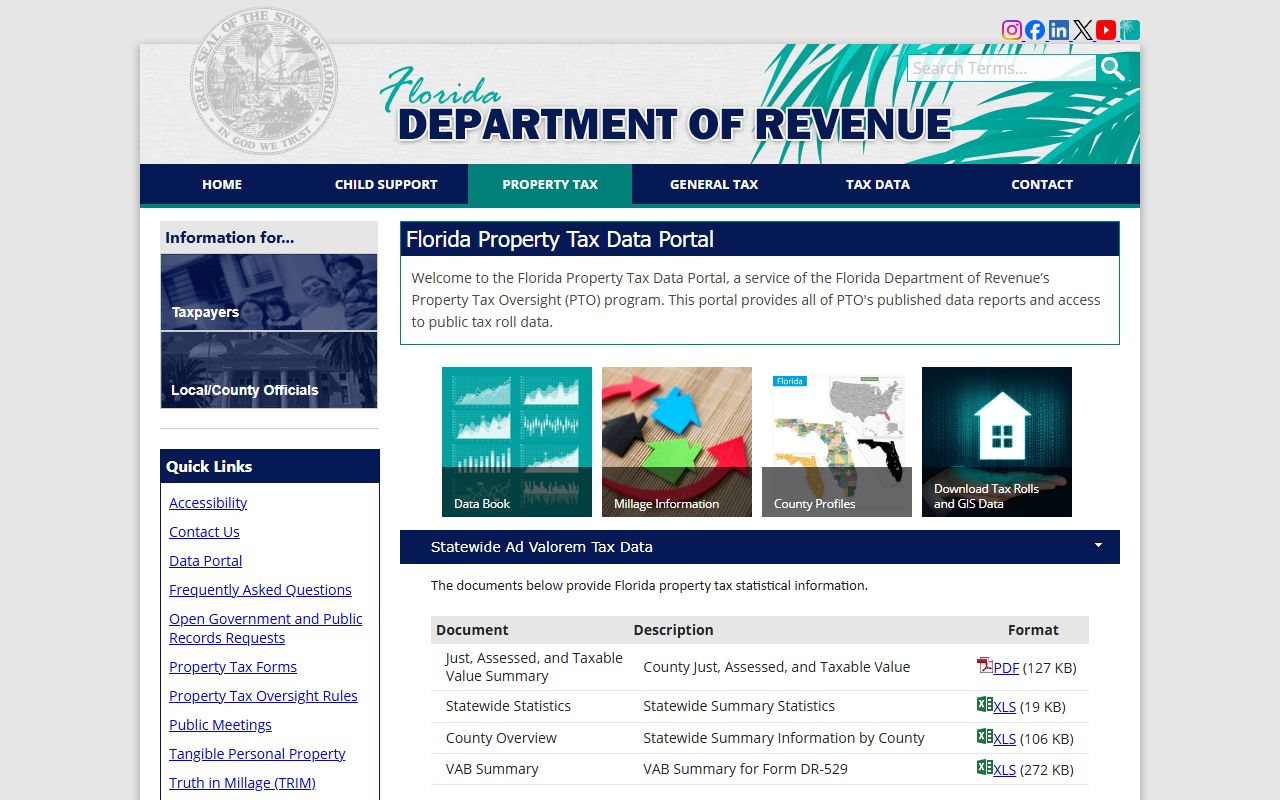
This portal links directly to local county resources, including Clay County's appraiser database, for seamless research across county lines.
Note: Online parcel data reflects the most recently certified assessment roll, which may lag behind very recent deed recordings or pending value changes from appeals.
Homestead Exemption in Clay County
Florida's homestead exemption is one of the most valuable tax benefits available to property owners. Clay County residents who own and occupy their home as a primary residence as of January 1 are eligible to apply. The exemption reduces the assessed value of the property by up to $50,000 for tax purposes. The March 1 filing deadline is firm; late applications are generally not accepted for the current year.
Applications are filed with the Clay County Property Appraiser's office. You can apply in person at 477 Houston Street, Green Cove Springs, or through the online portal at claycountygov.com/property-appraiser. Supporting documents typically include proof of Florida residency, such as a Florida driver's license or voter registration card, along with proof of ownership.
Beyond the basic homestead exemption, additional exemptions are available for veterans with service-related disabilities, surviving spouses of first responders killed in the line of duty, low-income seniors, and persons with total and permanent disabilities. Each has its own set of criteria. The Florida DOR's taxpayer information page lists all available exemptions statewide, and the Clay County appraiser's office can answer questions about which ones apply in your situation.
Deed and Official Records in Clay County
Recorded documents in Clay County are maintained by the Clay County Clerk of Courts under Florida Statute Chapter 28. This includes warranty deeds, quitclaim deeds, mortgage recordings, satisfactions, and judgment liens. Copies of recorded documents are available through the Clerk's online portal or in person at the courthouse in Green Cove Springs.
Deeds and other instruments affecting real property must be recorded with the Clerk to be effective against third parties. This is a basic rule of Florida property law. Recording puts the public on notice that a transaction has taken place, which protects buyers and lenders who rely on a clear chain of title. When you research Clay County property records, checking both the appraiser's database and the Clerk's Official Records gives you a complete picture.
Property Tax Process in Clay County
Each year, the Clay County Property Appraiser certifies the assessment roll and sends it to the Tax Collector and the county's taxing authorities. The taxing authorities, including the county commission, the school board, and various special districts, then set their millage rates based on their budget needs. Those rates are applied to the taxable value of each parcel to calculate the annual tax bill.
Tax notices go out in November and are due by March 31 of the following year. Discounts apply for early payment: four percent if paid in November, three percent in December, two percent in January, and one percent in February. Missing the March 31 deadline results in the property becoming delinquent, which can eventually lead to a tax certificate sale if the tax remains unpaid.
The Florida DOR provides a directory of all county property and tax officials across the state. The screenshot below shows that page, which includes links to Clay County's appraiser and tax collector offices.
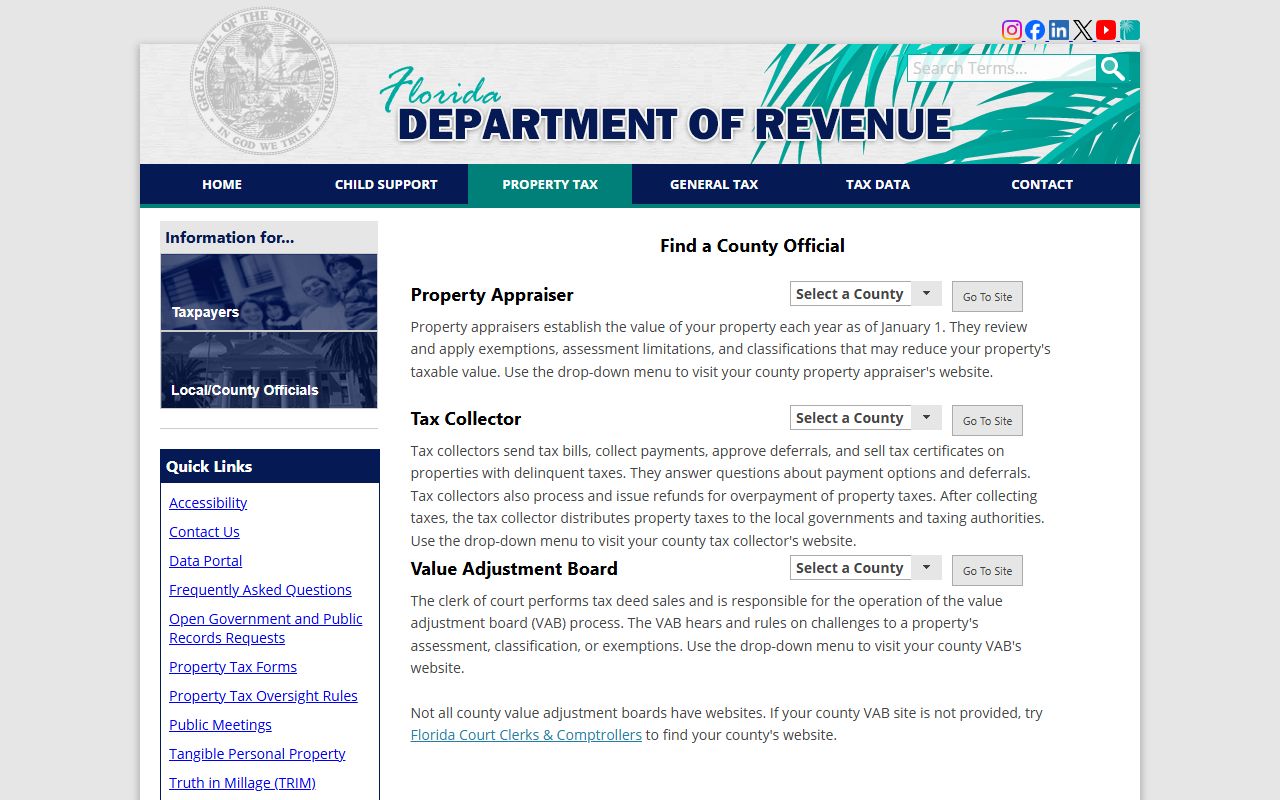
Use this directory if you need to find contact information for any county office involved in the Clay County property tax process.
Tangible Personal Property
Businesses in Clay County must file a Tangible Personal Property Tax Return with the Property Appraiser by April 1 each year. The return covers business equipment, fixtures, machinery, and other non-real-property assets. The $25,000 tangible personal property exemption means businesses with total assets below that value pay no tangible property tax, but they must still file to claim the exemption.
Failure to file on time results in a penalty under Florida law. The appraiser's office can provide blank return forms and filing guidance. If you own a business in Orange Park, Fleming Island, Middleburg, or anywhere else in Clay County, you are subject to this filing requirement unless your business assets fall below the exemption threshold.
Cities in Clay County
Clay County includes several incorporated municipalities. Green Cove Springs is the county seat. Orange Park, Fleming Island, Middleburg, Keystone Heights, and Penney Farms are other communities in the county. None of these currently meet the population threshold for a dedicated city page, but property records for all of them are maintained through the Clay County Property Appraiser and Clerk of Courts offices in Green Cove Springs.
Nearby Counties
Clay County shares borders with seven other Florida counties. Properties near county lines may have records split between jurisdictions, so it is worth checking the neighboring appraiser's database if a parcel is close to a border.