
Alachua County Property Records
Alachua County property records are managed by the county property appraiser and the clerk of court, giving residents and researchers a clear path to ownership data, assessed values, deed history, and tax exemption status. Whether you are buying property in Gainesville, checking a parcel near the University of Florida, or reviewing a lien filed against real estate anywhere in the county, these records are available to the public under Florida law.
Alachua County Property Records Quick Facts
Alachua County Property Appraiser
The Alachua County Property Appraiser (ACPA) operates from its main office at 515 N Main Street, Suite 200, in Gainesville. The office handles property valuation, homestead exemptions, tangible personal property assessments, and related functions for all real estate in the county. You can reach the office by phone at 352-374-5230 or by fax at 352-374-5278. The main website is acpafl.org, where you can access the property search portal, exemption forms, and contact information.
The office follows the requirements set out in Florida Statutes Chapter 193, which governs how property is assessed across all 67 counties in the state. Staff work each year to update tax rolls, review new construction, and process exemption applications before the annual certification deadline.
The Alachua County Property Appraiser website at acpafl.org is the starting point for most online record lookups. The site lets you search by owner name, property address, or parcel ID number. Results show current ownership, legal description, assessed value, tax history, and any exemptions in place.
The homepage links directly to the search portal and lists office hours and contact details for the Gainesville location.
How to Search Alachua County Property Records
The fastest way to search is through the online portal at acpafl.org/search. You can look up a parcel using the owner's name, the property address, or the parcel identification number. The system returns a full record that includes the legal description, ownership chain, assessed and taxable values, exemption status, and prior sales data.
The search portal is updated regularly as new sales data and assessment changes are processed by the appraiser's office.
For in-person searches, visit the office at 515 N Main Street, Suite 200, Gainesville. Staff can assist with lookups that are hard to complete online, such as locating records for parcels with complex legal descriptions or older properties that predate the digital database. Bring whatever information you have: an address, a previous owner's name, or a rough location in the county is enough to start a search.
Deed records and other recorded instruments are kept at the Alachua County Clerk of Courts, not at the property appraiser. If you need a copy of a deed, a mortgage document, or a recorded lien, you will need to search the clerk's official records system. The clerk's office indexes documents under Florida Statutes Chapter 28, which establishes the duties of the clerk in maintaining public records. Note: Tangible Personal Property returns for businesses are due April 1 each year and are filed separately through the appraiser's office, not the clerk.
What Alachua County Property Records Show
A standard property record from the Alachua County Property Appraiser includes several layers of information. The parcel summary shows the current owner's name and mailing address, the physical property address, the parcel identification number, and the legal description taken from the deed. The value section shows the just (market) value, the assessed value after any applicable caps, and the taxable value after exemptions are removed.
Sales history is one of the most useful parts of the record. You can see the date of each prior sale, the recorded selling price, and the deed book and page reference for each transaction. This data helps buyers, appraisers, and lenders understand how a property's market value has changed over time. Florida law under Chapter 192 requires that all property be listed on the tax roll, so the appraiser maintains records for every parcel regardless of whether it has sold recently.
Extra features such as pools, barns, or outbuildings are listed separately from the main structure. Land data shows acreage, zoning class, and in some cases soil classifications or flood zone designations. Sketch data shows the dimensions of buildings as measured by the appraiser's field staff.
Homestead Exemption in Alachua County
Florida's homestead exemption reduces the taxable value of a primary residence by up to $50,000. The first $25,000 applies to all taxing authorities. The second $25,000 applies only to non-school taxes and covers assessed values between $50,000 and $75,000. To qualify, you must own the property, make it your permanent residence, and apply by March 1 of the tax year in which you want the exemption to take effect.
Applications are available at acpafl.org/exemptions, where you can also find details on other exemptions including those for seniors, veterans with service-connected disabilities, widows, widowers, and people with total disabilities.
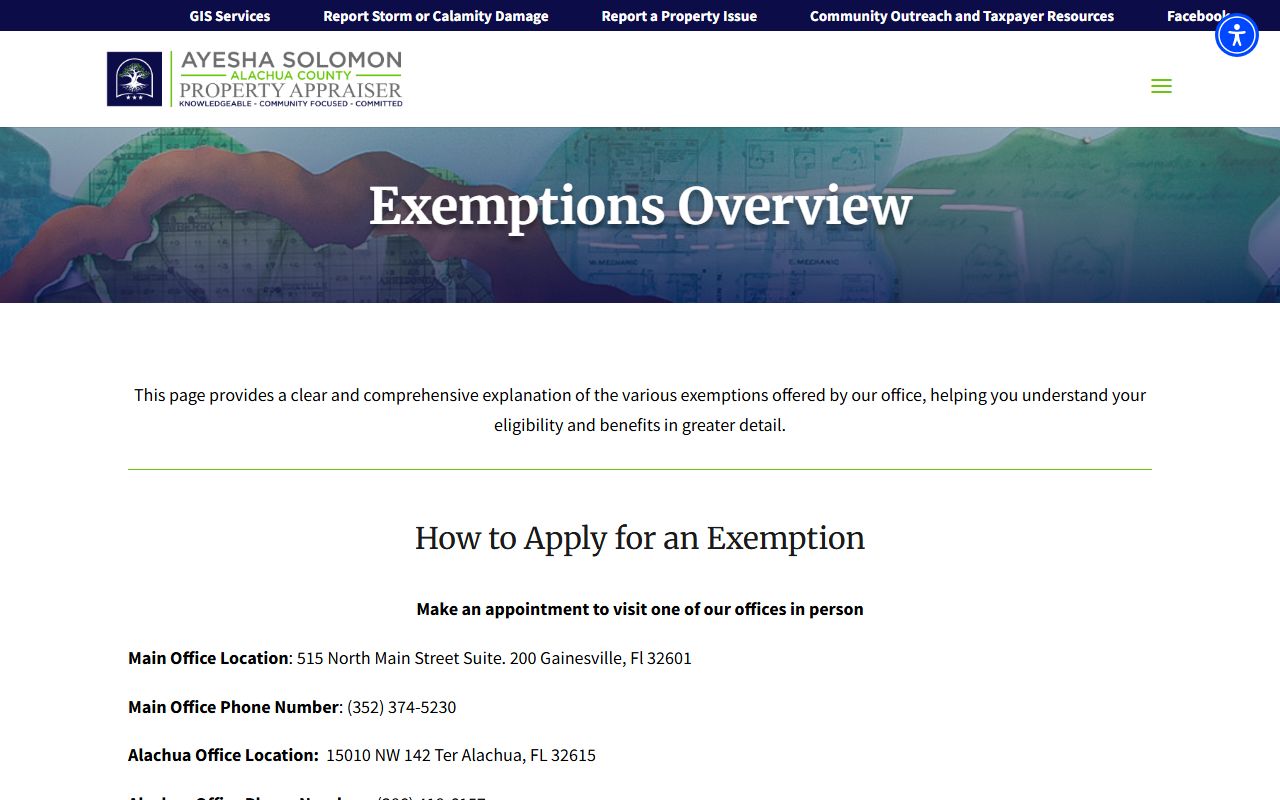
The exemptions page lists eligibility requirements, required documents, and instructions for submitting your application either online or at the office.
Once you have homestead status, the Save Our Homes cap under Florida Statutes Section 193.155 limits how much your assessed value can increase each year. The cap is set at 3% or the rate of inflation, whichever is lower. This protection stays in place as long as you keep the homestead exemption. If you sell and buy a new home, you may be able to transfer part of the accumulated benefit through a process called portability. The appraiser's office can walk you through that process if you have questions.
Note: If you move and forget to notify the appraiser, you may owe back taxes on any exemption you received after your eligibility ended, so keep the office informed of any changes to your primary residence status.
Alachua County Property Tax Process
Each August, property owners in Alachua County receive a Truth in Millage (TRIM) notice in the mail. This is not a tax bill. It shows your proposed assessed value, the exemptions applied, and the proposed tax rates from each taxing authority that levies taxes on your property. It also tells you when and where budget hearings are scheduled so you can attend and comment on proposed rate changes.
If you believe the proposed assessed value is wrong, the TRIM notice is your notice that you have the right to challenge it. You can first try to resolve the issue informally by contacting the property appraiser's office. If that does not work, you can file a petition with the Value Adjustment Board (VAB). The VAB is an independent board made up of county commissioners, school board members, and citizen appointees. It hears appeals and can lower values if the evidence supports it. Petitions must be filed by the deadline printed on the TRIM notice, which is usually in mid-September.
Actual tax bills go out in November. The full amount is due by March 31 of the following year. Early payment discounts apply: 4% in November, 3% in December, 2% in January, and 1% in February. Paying on time or early avoids interest and eventually avoidance of a tax certificate sale, which can put your property at risk if taxes remain unpaid for multiple years.
Official Records at the Alachua County Clerk
Deeds, mortgages, liens, satisfactions, and other instruments affecting title to real property in Alachua County are recorded and maintained by the Clerk of the Circuit Court. The clerk's official records system is the authoritative source for these documents. When a deed is recorded, it becomes part of the public record and gives constructive notice to anyone who later searches for ownership information.
Florida's Chapter 119 (the Public Records Law) makes most of these documents available to any member of the public. You can search the clerk's online system, request copies in person, or ask for certified copies by mail if you need documents for legal purposes. Recording fees and copy fees apply. The clerk's office is located in the same general area of Gainesville as the courthouse complex.
Lis pendens notices, judgment liens, and code enforcement liens also appear in the official records and can affect the title to a property. Before buying real estate in Alachua County, a title search through the clerk's records is standard practice to identify any outstanding claims. The Chapter 28 framework governs how the clerk indexes and preserves these records for public access.
Note: The Florida Department of Revenue provides a statewide resource for property owners at floridarevenue.com, which includes guides on exemptions, appeals, and the general tax process that apply across all counties including Alachua.
Cities in Alachua County
Gainesville is the largest city in Alachua County and the only one that meets the population threshold for a dedicated page on this site. Other municipalities in the county include Alachua, Archer, High Springs, Hawthorne, Micanopy, and Newberry, but those cities are smaller and do not have separate city pages here.
Nearby Counties
Alachua County borders several other counties in north-central Florida. Each has its own property appraiser and official records system.