
Find Monroe County Property Records
Monroe County property records are kept by the Monroe County Property Appraiser at 500 Whitehead Street in Key West, covering all parcels throughout the Florida Keys from Key Largo to Key West and the surrounding island communities. You can search ownership data, assessed values, exemption status, and sales history online through the appraiser's public portal at monroecopa.com, or contact the office directly at 305-292-3420.
Monroe County Property Records Quick Facts
Monroe County Property Appraiser Office
The Monroe County Property Appraiser is located at 500 Whitehead Street, Suite 101, Key West, FL 33040. The main phone number is 305-292-3420. The office's public website at monroecopa.com provides access to the free parcel search tool, exemption information, and forms. The appraiser's office is responsible for assessing all real property in Monroe County at just value, maintaining the tax roll, and processing exemption applications.
Monroe County has a unique geography. It is composed almost entirely of the Florida Keys, a chain of islands stretching roughly 125 miles from the mainland to Key West. The only land connection to the rest of Florida is through Miami-Dade County via US Highway 1. This geography shapes the property market and the types of parcels the appraiser must value, which include oceanfront homes, canal-front properties, vacation rentals, commercial fishing operations, and undeveloped island tracts.
Property values in Monroe County tend to be high relative to Florida averages because of the limited land area and strong demand for Keys properties. This makes accurate assessment especially important for property owners who want to ensure they are not overpaying taxes on inflated values. The appraiser's office is the right place to start if you have questions about your assessed value or want to apply for an exemption.
Note: The Property Appraiser does not collect taxes. Contact the Monroe County Tax Collector for payment information and delinquent tax questions.
How to Search Monroe County Property Records
The Monroe County Property Appraiser's website gives you a free public search tool. You can look up any parcel by owner name, address, or parcel ID number. Results include the current owner, mailing address, legal description, land use classification, and all valuation data including just value, assessed value, and taxable value. Sales history is part of the record, showing prior transfer dates, prices, and deed recording references.
Because Monroe County properties are spread across many small islands, searching by address sometimes requires knowing which key or community the property is in. Using the parcel ID is the most reliable search method if you have it from a prior deed or tax bill. The appraiser's site also lets you browse by map, which is useful for properties on smaller, less well-known keys.
Florida law requires that property records be open to the public. The DOR's public records page explains the framework for accessing government records across the state.
The Florida DOR's Public Records Requests page outlines the process for requesting property and tax records from state and county agencies in Florida.
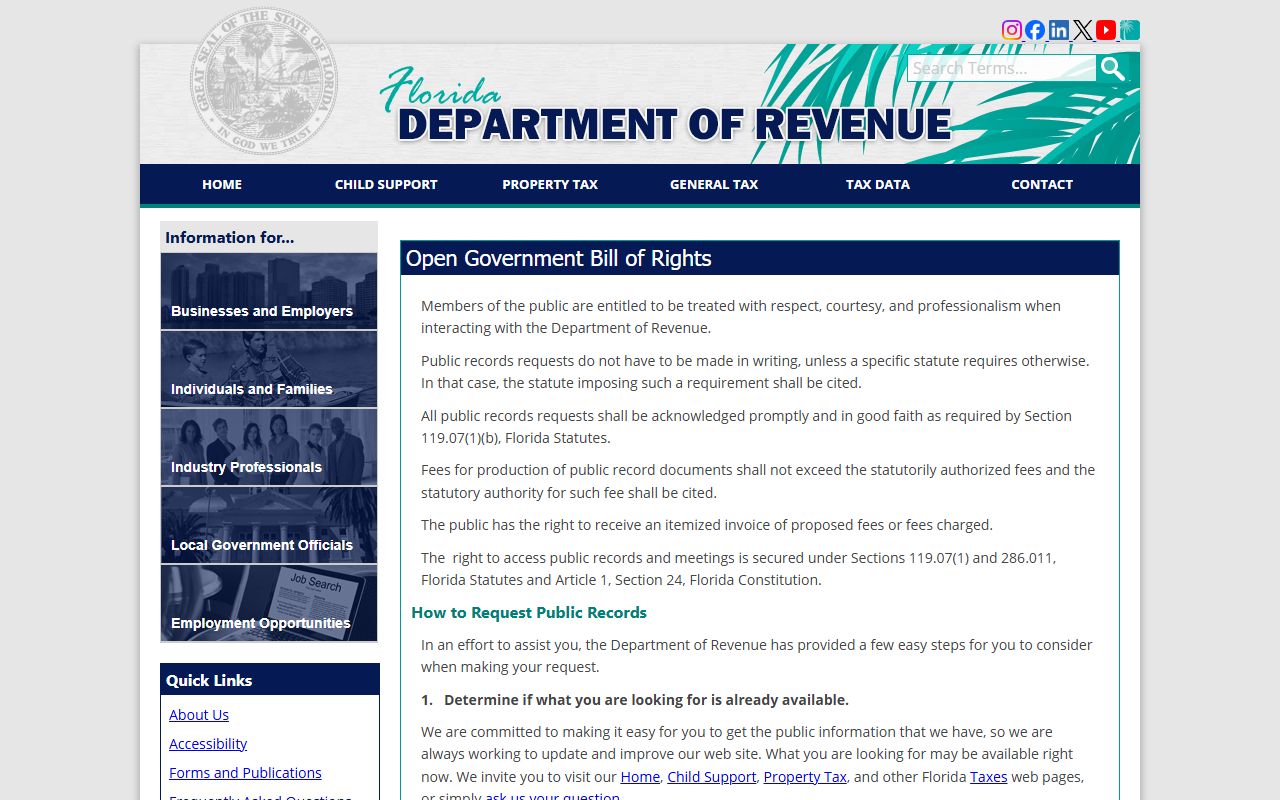
If you need records that are not available online, you can submit a written public records request to the Monroe County Property Appraiser's office under Chapter 119, Florida Statutes.
What Monroe County Property Records Show
A Monroe County parcel record includes the owner's name, mailing address, situs address, legal description, parcel identification number, and land use code. Valuation fields show just value, assessed value with any Save Our Homes cap, and taxable value after exemptions. The record also flags whether a homestead exemption or other exemption is active.
Residential records show the year built, heated living area, number of bedrooms and baths, and construction details such as foundation type and roof material. Foundation type matters a lot in Monroe County because many homes are built on pilings due to flood zone requirements. These elevated structures are assessed differently from slab-on-grade construction common on the mainland.
Commercial records show building type, gross area, occupancy, and any auxiliary structures. Vacant land records show the lot dimensions, frontage type (oceanfront, bayfront, canal-front, or upland), and the current land use designation under the county's comprehensive plan. Frontage type plays a large role in land value in the Keys.
Sales history ties each property to its recorded deed through official records book and page numbers. Monroe County's small population means the parcel count is relatively low compared to other Florida counties, but individual property values are often quite high, which means the tax roll represents significant assessed wealth for a county of its size.
Homestead Exemption and Save Our Homes in Monroe County
Florida's homestead exemption is available to Monroe County property owners who own and occupy their home as a primary residence on January 1 of the tax year. The exemption reduces assessed value by up to $50,000, split into two $25,000 tiers that apply to different taxing levies. You must file an application with the Monroe County Property Appraiser by March 1 to get the exemption for that year.
The Save Our Homes cap is especially valuable in Monroe County, where property values have historically appreciated faster than the statewide average. The cap limits annual assessment increases to 3% or the rate of inflation, whichever is lower. A homeowner who bought a Keys property years ago and has held the homestead exemption continuously may have an assessed value far below current market value, resulting in substantially lower taxes than a new buyer would pay on the same property.
When a homesteaded Monroe County property is sold, the buyer loses the seller's Save Our Homes benefit because the cap resets on change of ownership. The new owner must apply for a new homestead exemption if they intend to use the property as their primary residence. Properties used as vacation rentals or second homes do not qualify for the homestead exemption under Florida law.
Additional exemptions are available for qualifying seniors with limited income, widows and widowers, veterans with service-connected disabilities, and persons with total and permanent disability. Contact the Monroe County Property Appraiser's office to find out which exemptions apply to your situation and what documentation you need to provide.
Official Records and the Monroe County Clerk
The Monroe County Clerk of Circuit Court records all legal instruments that affect real property in the county, including warranty deeds, quit-claim deeds, mortgages, satisfactions, and liens. These records are maintained under Chapter 28, Florida Statutes, which governs Florida clerks and requires that official records be open to the public. The clerk's office is located in Key West.
Recorded deeds and other instruments are indexed by grantor and grantee name, document type, and recording date. Most Monroe County official records from recent decades are available online through the clerk's website. The appraiser's database links each parcel record to the relevant deed instruments through book and page or instrument number references, so you can cross-reference between the two systems.
Because the Florida Keys have been a popular destination for decades, Monroe County's deed records contain a rich history of property transfers. You can trace the ownership chain for most parcels back through many prior sales and conveyances using the clerk's online index. For very old records, you may need to request paper or microfilm copies from the clerk's office directly.
The Florida DEP's Bureau of Survey and Mapping maintains title and land records that are relevant for properties near state-owned submerged lands, which is a significant category in Monroe County given its island geography.
The DEP's Title and Land Records page covers state land boundaries, which can affect Monroe County properties that border the ocean, bay, or other state-owned water bodies.
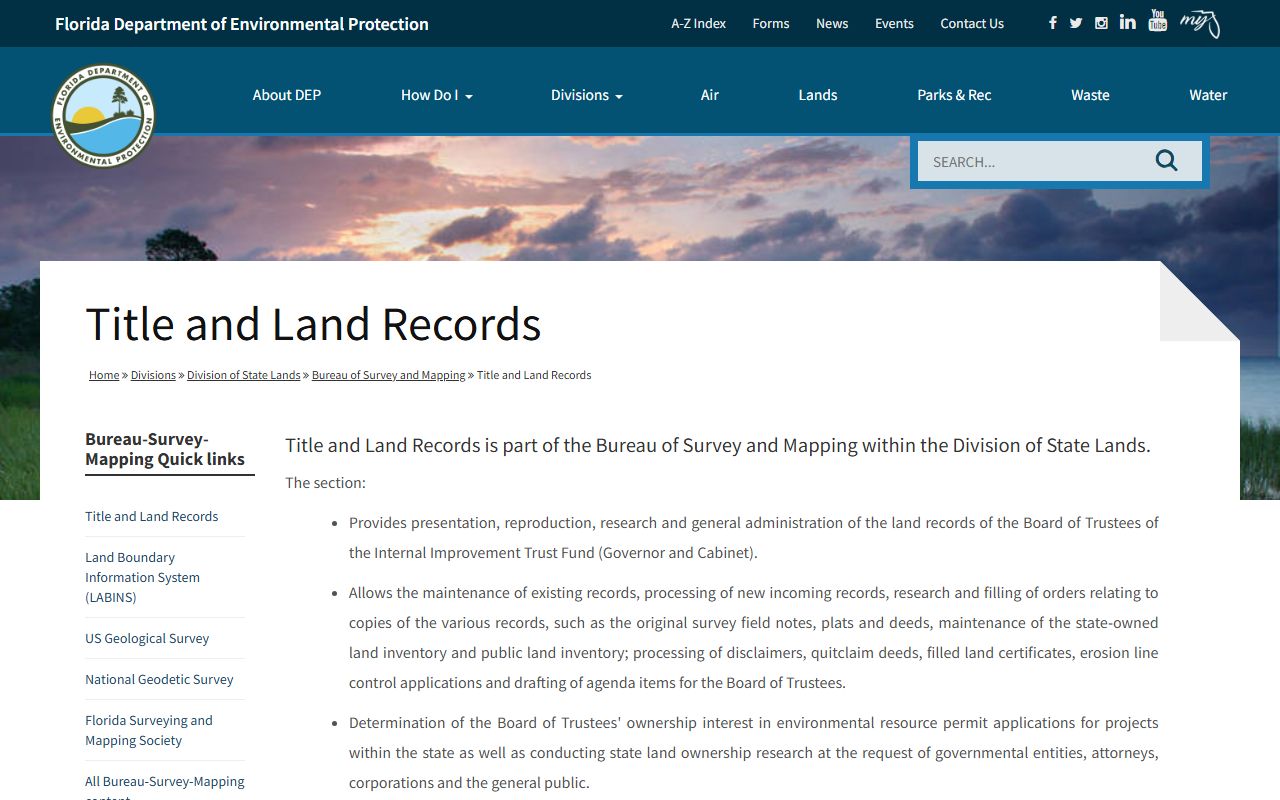
This is particularly relevant for Monroe County because many parcels sit adjacent to state-owned submerged lands, and the boundary between private and state-owned bottom land can affect what owners can build or access.
Florida Statutes and Property Tax Oversight in Monroe County
Monroe County property assessment follows the same state laws that apply to all Florida counties. Chapter 192, Florida Statutes defines just value, the foundational standard for all property assessments in the state. Chapter 193 sets detailed assessment rules for residential, agricultural, and other property types. The Florida Department of Revenue monitors all county assessors to ensure compliance with these standards.
The right to inspect and copy Monroe County property records is guaranteed by Chapter 119, Florida Statutes. Any person can request access to property records held by the Monroe County Property Appraiser, the Monroe County Clerk, or any other county agency. Requests must be fulfilled promptly, and agencies can only charge the actual cost of copying.
TRIM notices go out each August. Monroe County property owners who disagree with their proposed assessed value should act quickly, since the deadline to file a Value Adjustment Board petition is 25 days from the TRIM mailing date. The VAB in Monroe County follows the same procedures as other Florida counties, and property owners have the right to present evidence and be heard before a special magistrate.
Cities in Monroe County
Key West is the county seat and the largest city in Monroe County, with a population of roughly 25,000. Marathon and Islamorada are incorporated cities in the Keys as well, but all of Monroe County's cities and communities fall below the 100,000 population threshold for dedicated city pages on this site. Property records for any address in Monroe County are accessible through the county property appraiser's online search tool or through the Monroe County Clerk of Courts official records system.
Nearby Counties
Monroe County connects to the Florida mainland only through Miami-Dade County, making it geographically unique among Florida counties.