
Miami-Dade County Property Records
Miami-Dade County property records are maintained by the Miami-Dade Property Appraiser, led by Tomas Regalado, at the Stephen P. Clark Center in downtown Miami. The office manages hundreds of thousands of parcels across one of the largest and most diverse real estate markets in the United States. You can search ownership data, assessed values, exemptions, and sales history online at miamidadepa.gov, or reach the main office by phone at 305-375-4712.
Miami-Dade County Property Records Quick Facts
Miami-Dade Property Appraiser Office and Contact Information
The Miami-Dade Property Appraiser's main office is at the Stephen P. Clark Center, 111 NW 1st Street, Suite 710, Miami, FL 33128. The office is open Monday through Friday from 8:00 a.m. to 5:00 p.m. The main phone line is 305-375-4712. Specific divisions have direct lines: Tangible Personal Property at 305-375-4070, South Dade office at 305-232-3810, Real Estate Residential at 305-375-4050, Real Estate Commercial at 305-375-4580, and Agriculture at 305-234-1454. Exemptions for residential applicants can be reached at 305-375-4712, and for institutional exemptions at 305-375-5845.
For written inquiries, you can reach the office by email. General questions go to PAWebmail@MiamiDadePA.gov. Ownership change questions go to OwnershipChanges@MiamiDadePa.gov. Tangible personal property questions go to TPP@MiamiDadePA.gov. Public records requests go to RecordsRequest@MiamiDadePA.gov. If you need fax access, the Public Service fax number is 305-679-7940. TTY users can call 305-375-3607.
During peak seasons, particularly the Homestead Exemption filing period from January through March and the TRIM notice distribution in August, office traffic increases significantly. Residents are encouraged to arrive early or use the online contact form to schedule an appointment in advance. For time-sensitive filings such as TPP returns or Homestead Exemption applications, it is recommended to mail them using a trackable service to confirm timely delivery before the stated deadline.
The Miami-Dade Property Appraiser does not send tax bills and does not set or collect taxes. For tax payment questions, contact the Miami-Dade Tax Collector at mdctaxcollector.gov.
The appraiser's homepage at miamidadepa.gov gives you direct access to the property search tool, exemption applications, forms, and contact information.
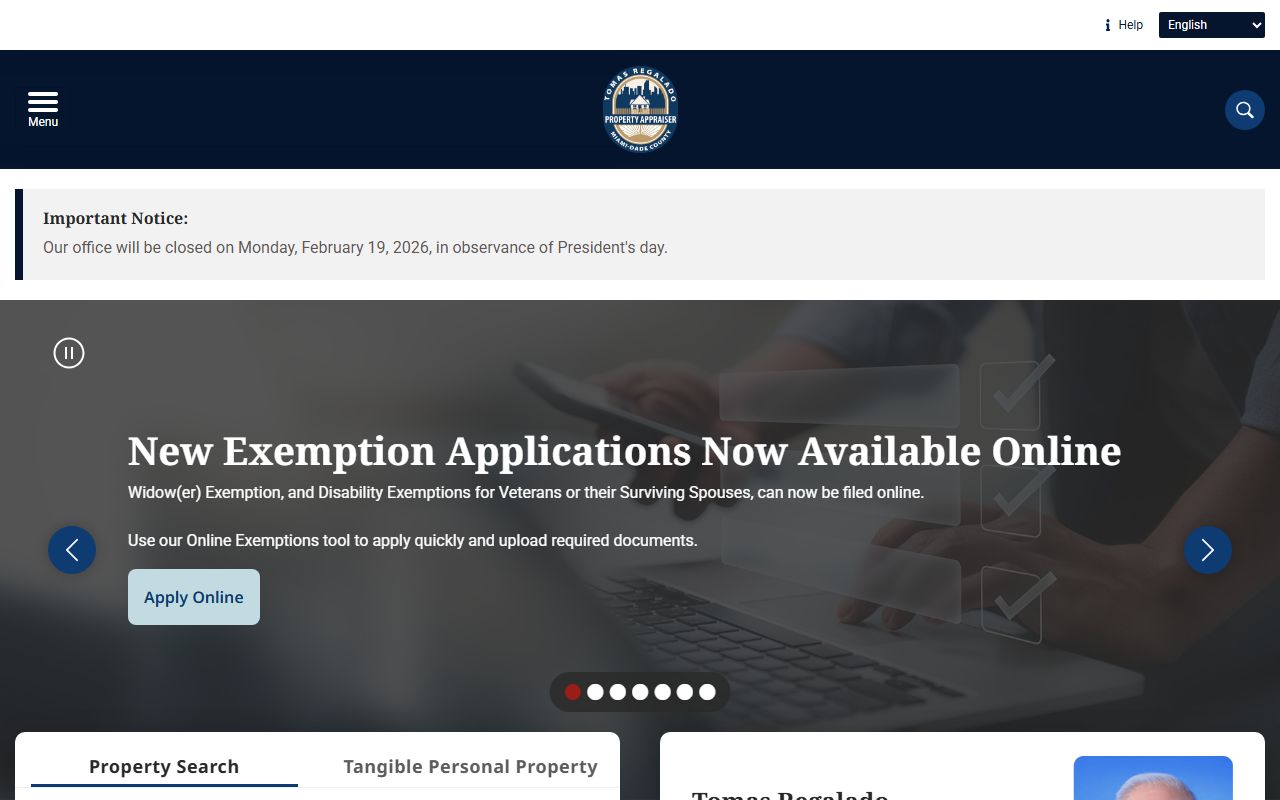
The homepage provides quick links to the most-used tools, including the property search portal, exemption filing, and TPP return submission.
How to Search Miami-Dade Property Records Online
Miami-Dade's public property search is available through the appraiser's website at no cost. You can search by owner name, parcel folio number, address, or subdivision name. Each result shows the current owner, mailing address, legal description, land use code, assessed value, taxable value, and any exemptions applied to the parcel. The site also shows the full sales history with deed recording references.
The contact page on the appraiser's website lists the full directory of division contacts, which is helpful if you have a question that falls under a specific department.
The Contact the Miami-Dade Property Appraiser page provides direct contact details for each division, including the records request coordinator.
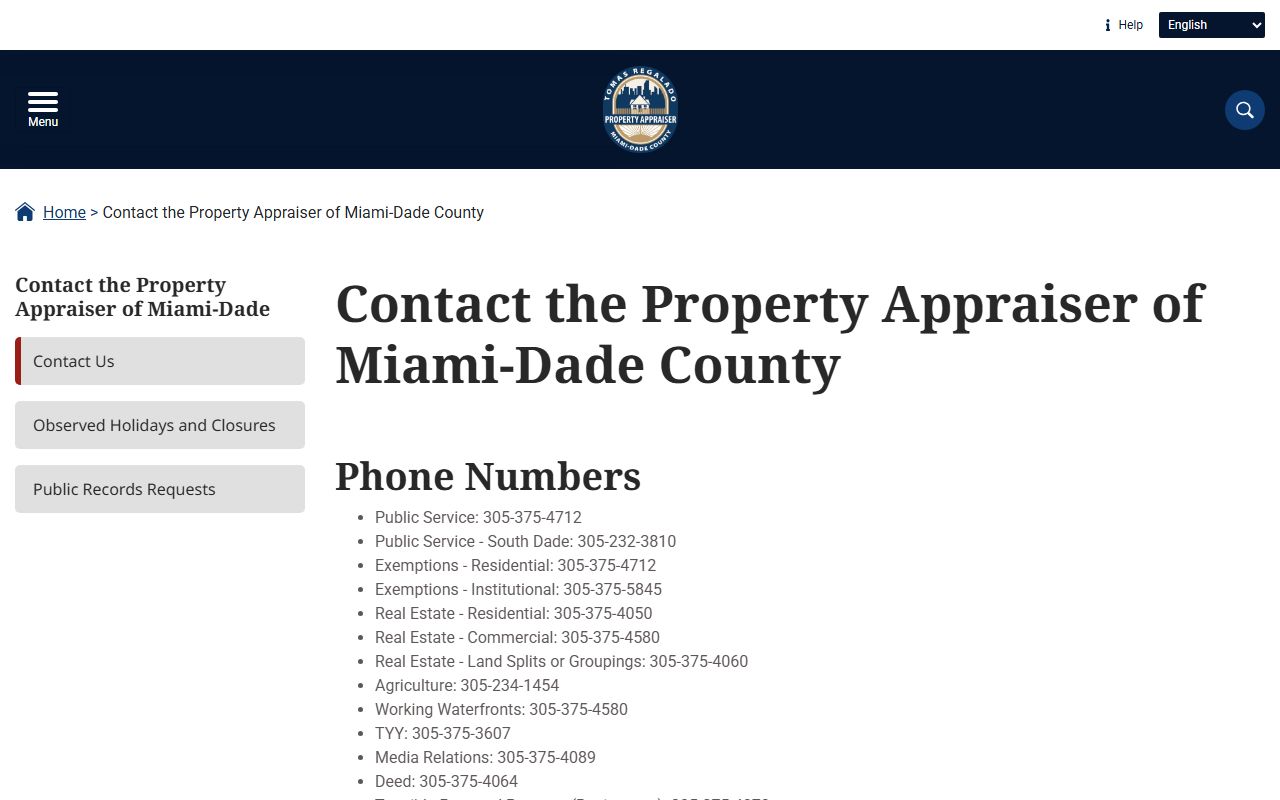
Public Records Custodian Sidalia Lopez can be reached at 305-375-2480 or at RecordsRequest@miamidadepa.gov for formal public records requests under Chapter 119. ADA accommodation requests go to ADA@miamidadepa.gov or 305-375-4014.
Forms for exemptions, portability applications, and address changes are available at miamidadepa.gov/pa/forms.page. Most forms can be downloaded, completed, and submitted online or by mail.
What Miami-Dade Property Records Contain
Miami-Dade County has one of the most complex property tax rolls in Florida. The tax roll includes a large number of real property parcels across many property types: single-family homes, condominium units, commercial and industrial properties, and agricultural land. Parcel records contain the owner name, mailing address, situs address, legal description, folio number, land use code, land value, improvement value, and total just value. The record also shows the assessed value and taxable value after the Save Our Homes cap and any exemptions are applied.
Residential records show construction details including year built, living area square footage, number of bedrooms and baths, pool status, and exterior finish. Condominium records include the unit number, floor level, and the building's total unit count. Commercial records show the building class, gross area, and occupancy type. These details come from field inspections and building permit data that the appraiser's staff compile and update on a regular schedule.
Sales history is part of every parcel record. Each sale shows the transfer date, recorded sale price, deed type, and the official records instrument number from the Miami-Dade Clerk. You can use this to track a property's history back through multiple ownership changes. Miami-Dade's market is active, so sales data is frequently updated as new transactions close and get recorded.
The tax roll administration page explains how Miami-Dade processes and certifies the annual tax roll, including how data flows from the appraiser to the tax collector.
The Tax Roll Administration page describes how Miami-Dade County's property assessment data is compiled, certified, and used to generate tax bills.
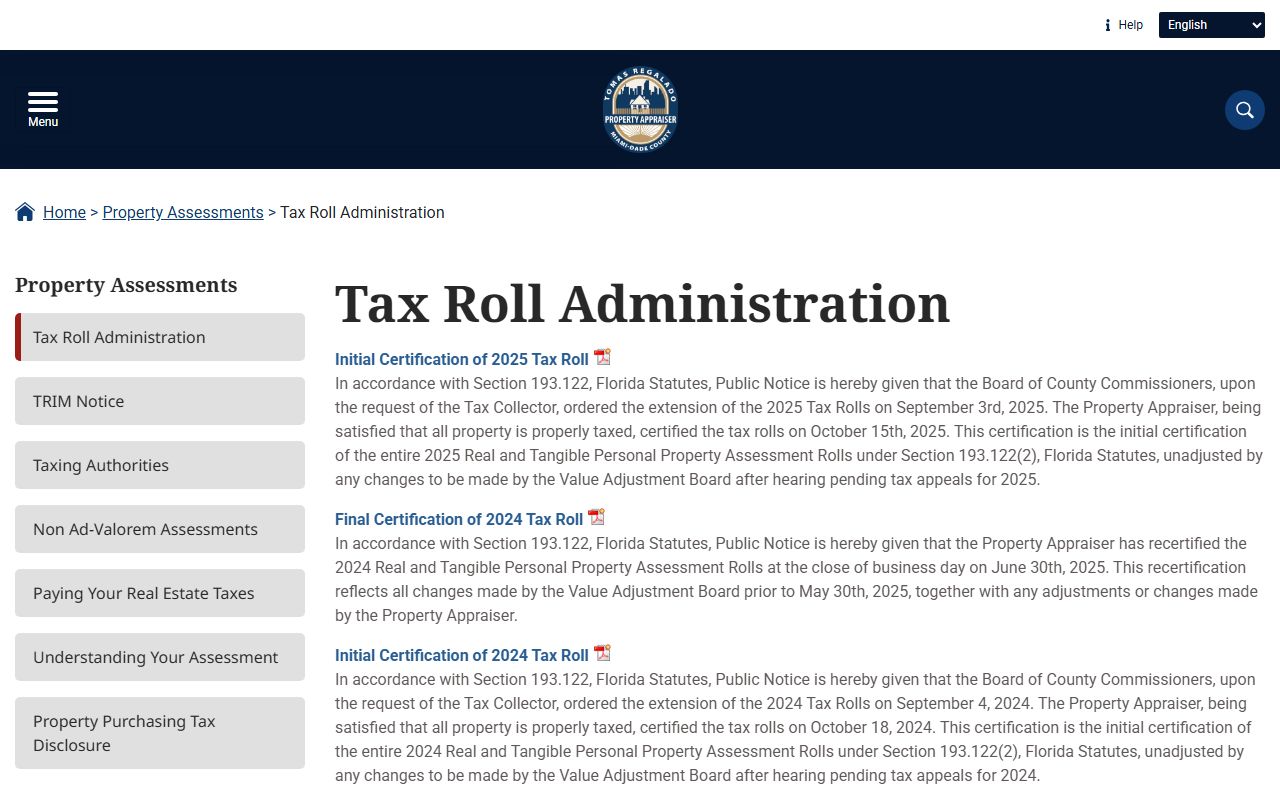
In accordance with Section 193.122, Florida Statutes, the Board of County Commissioners ordered the extension of the 2025 Tax Rolls on September 3, 2025. The Property Appraiser certified the tax rolls on October 15, 2025, confirming that all property is properly taxed for that cycle.
Homestead Exemption and Save Our Homes in Miami-Dade
The homestead exemption is available to Miami-Dade County property owners who own and occupy their home as their primary residence on January 1 of the tax year. The exemption reduces assessed value by up to $50,000: the first $25,000 applies to all tax levies, and the second $25,000 applies to all levies except school taxes. You must file with the Miami-Dade Property Appraiser by March 1.
Once granted, the Save Our Homes cap limits annual increases in assessed value to 3% or the rate of inflation, whichever is lower. Miami-Dade's real estate market has seen substantial appreciation in recent years. Long-term homeowners with the cap in place have often seen significant savings compared to what they would owe if the property were assessed at full market value each year.
Portability allows you to transfer the benefit accumulated under Save Our Homes when you move to a new Florida home. You apply for portability along with your new homestead exemption. The Miami-Dade Property Appraiser's office can calculate your portability benefit and explain how to apply it to your new property.
Additional exemptions in Miami-Dade include those for seniors with limited income, widows and widowers, persons with total and permanent disability, veterans with service-connected disabilities rated at 10% or higher, and surviving spouses of first responders killed in the line of duty. Each exemption has specific eligibility requirements and supporting documentation. The exemptions page and forms page on the appraiser's website list current programs and how to apply.
Note: All exemption applications must be filed by March 1. Applications submitted after that date will generally apply to the following tax year.
TRIM Notices and the Miami-Dade Tax Calendar
Miami-Dade property owners receive their Truth in Millage (TRIM) notice each August. The TRIM notice shows the proposed assessed value, all exemptions, and the proposed tax rates from every taxing authority that covers the property. In Miami-Dade, taxing authorities include the county government, Miami-Dade Public Schools, municipal governments for the 34 cities and towns in the county, and various special districts. The TRIM notice is not a tax bill; it is a preview of what your bill will look like if proposed rates are adopted.
If you believe the assessed value on your TRIM notice is wrong, you have two main options. First, call or visit the property appraiser's office for an informal review. Staff can often resolve errors quickly. Second, if the informal review does not settle the issue, file a petition with the Miami-Dade Value Adjustment Board within 25 days of the TRIM notice mailing date. The VAB process allows you to present evidence that the assessed value should be lower.
After final millage rates are set, the Miami-Dade Tax Collector mails actual tax bills in November. Discount periods apply: 4% if paid in November, 3% in December, 2% in January, and 1% in February. Full payment is due by March 31 to avoid delinquency.
Official Records at the Miami-Dade Clerk and Public Access Law
The Miami-Dade Clerk of Courts records all instruments that affect real property title, including deeds, mortgages, satisfactions, liens, and lis pendens notices. These official records are kept under Chapter 28, Florida Statutes, which governs the duties and powers of Florida clerks. All recorded documents are part of the public record and are searchable through the clerk's online system.
Florida's Public Records Law, codified in Chapter 119, Florida Statutes, gives every person the right to inspect and copy public records held by government agencies, including the Miami-Dade Property Appraiser. The public records custodian at the appraiser's office is Sidalia Lopez. To make a formal public records request, contact her at 305-375-2480 or RecordsRequest@miamidadepa.gov. The office must respond promptly and provide records at the cost set by statute.
Property assessment in Miami-Dade follows state requirements set in Chapter 192 and Chapter 193, Florida Statutes. The Florida Department of Revenue provides oversight to ensure Miami-Dade's assessments comply with just value standards statewide.
Cities in Miami-Dade County
Miami-Dade County contains 34 municipalities. The following cities have dedicated pages on this site because they meet the population threshold.
Other municipalities in Miami-Dade, including Coral Gables, North Miami, and Aventura, are below the threshold and do not have separate city pages. Property records for those cities are still available through the Miami-Dade Property Appraiser's countywide search tool.
Nearby Counties
Miami-Dade borders Broward to the north and Monroe to the south. Both have their own property records systems.