
Cape Coral Property Records
Cape Coral property records are maintained by the Lee County Property Appraiser and the Lee County Clerk of Court. This page explains how to search ownership, assessed values, sales history, deed documents, and homestead exemptions for parcels in Cape Coral, Florida, one of the largest canal-front cities in the United States by land area.
Cape Coral Property Records Quick Facts
How Cape Coral Property Records Are Maintained
Cape Coral lies within Lee County. Property appraisal for all parcels inside Cape Coral is handled at the county level by the Lee County Property Appraiser (LEEPA). The city does not maintain its own appraisal database. Every parcel in Cape Coral has a record in the LEEPA system with its own parcel ID, assessed value, and ownership history.
The Lee County Property Appraiser's office is at 2480 Thompson Street, 4th Floor, Fort Myers, FL 33901. The county seat is Fort Myers, so the PA office is located there, not in Cape Coral. The phone number is 239-533-6100 and the website is leepa.org.
Florida law under Chapter 193 requires the Property Appraiser to assess all real property at just value each year. The Lee County office applies this requirement to all Cape Coral parcels, which include a large number of canal-front residential lots in addition to standard residential, commercial, and vacant parcels. Canal frontage, access to saltwater vs. freshwater canals, and location within the city all affect how properties are valued.
Deeds, mortgages, and other recorded instruments are held by the Lee County Clerk of Court under Chapter 28. The Clerk's Official Records are the legal source for chain of title and encumbrance information on Cape Coral properties.
How to Search Cape Coral Property Records
The Lee County Property Appraiser's search tool at leepa.org is the primary free resource for Cape Coral parcel lookups. You can search by owner name, property address, or parcel ID number. Results show the current owner, parcel details, all assessed values, and the full sales history.
The Lee County Property Appraiser's website is shown below. This is the starting point for any Cape Coral property records search.
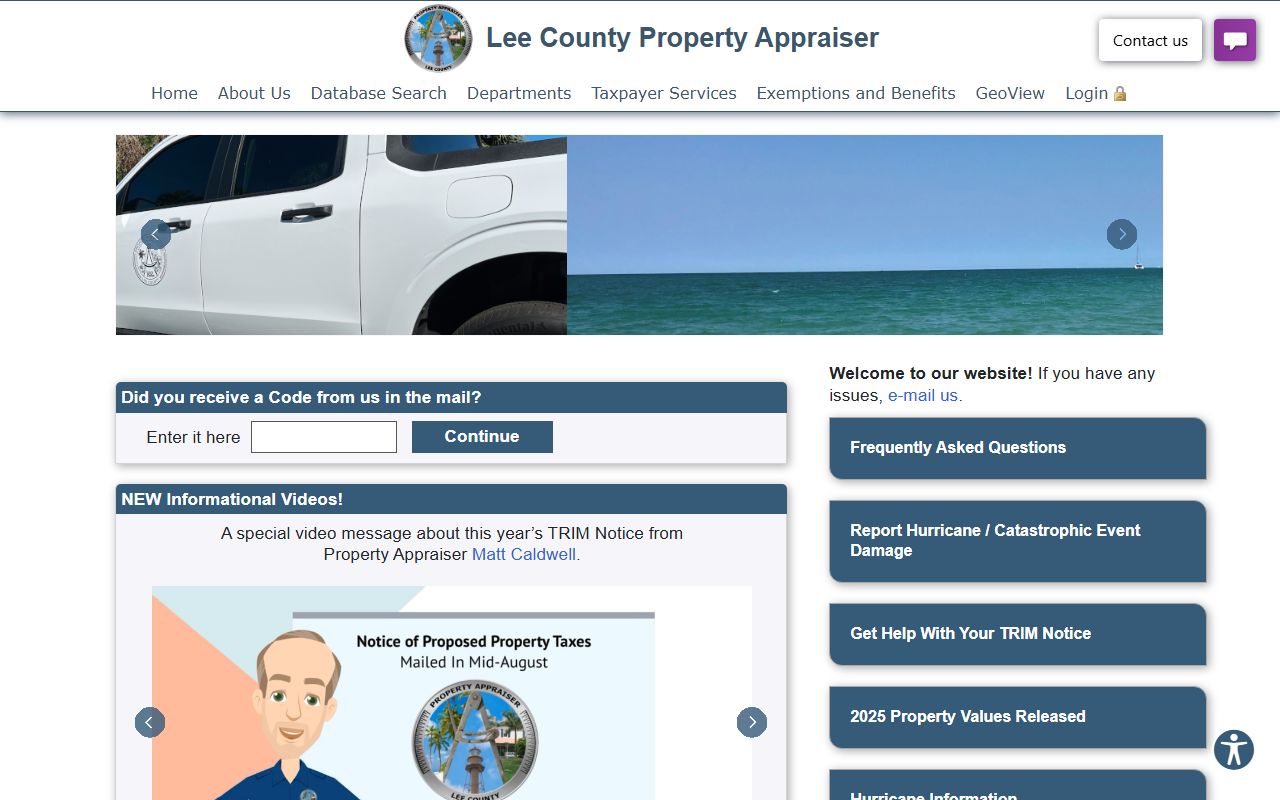
The LEEPA search interface lets you look up any Cape Coral parcel by address or owner name. For canal-front properties, the record will note the canal type and frontage, which affects the just value assigned by the office.
Cape Coral uses a unit/block/subdivision system for many of its lots, especially in the planned sections developed by the Rosen brothers starting in the late 1950s. If a standard address search does not return results, try searching by the subdivision name and unit number instead. The LEEPA system supports subdivision-based searching.
Cape Coral has a large number of vacant lots, many of which are on canal systems. Vacant land records show the lot size, frontage type, and land value separately from any improvements. If you are researching a vacant lot for potential purchase or development, the LEEPA record will show the current assessed value, any exemptions (though few apply to vacant land), and the full sales history for that specific parcel.
The Florida Department of Revenue maintains a statewide resource at its official portal. The screenshot below shows the DOR's county officials directory, which can help you find the right Lee County office if you need direct contact information.
The Florida DOR's county officials directory shows contact information for property appraisers, tax collectors, and clerks across all 67 Florida counties including Lee County.
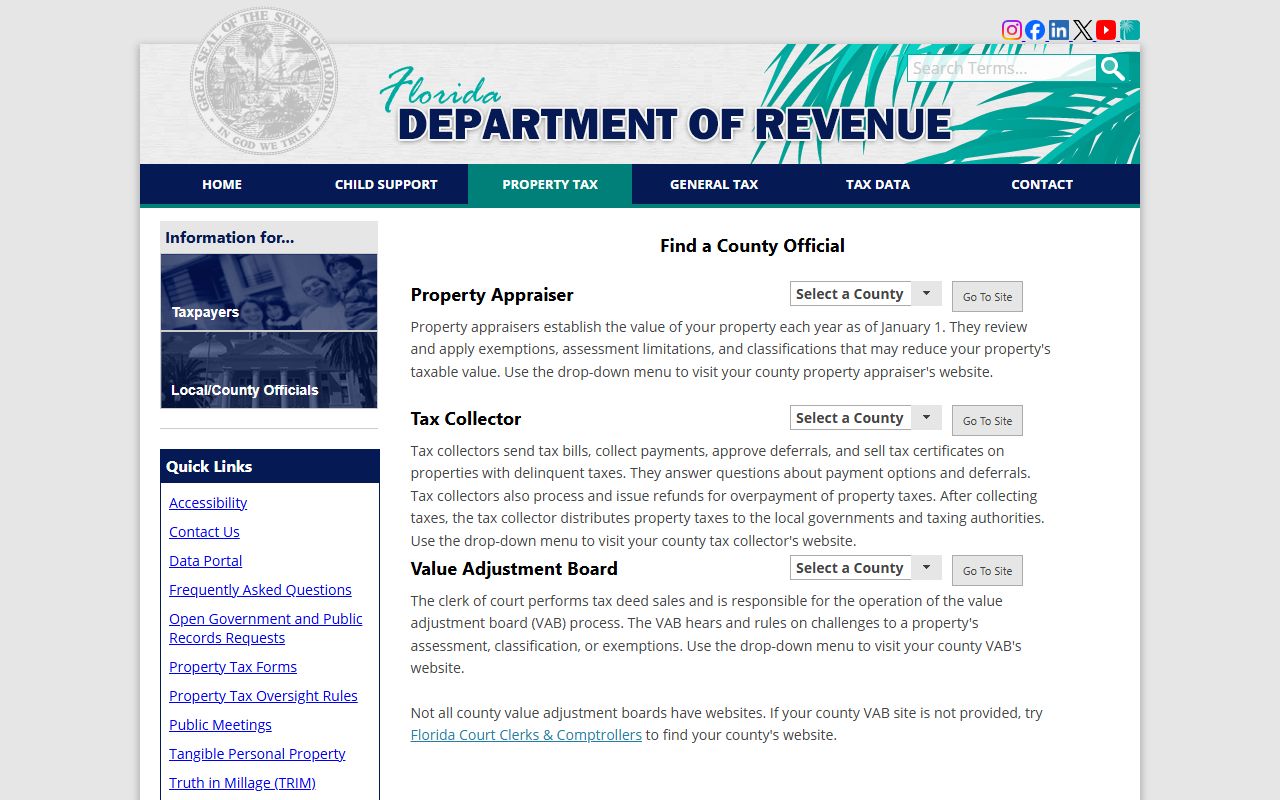
This directory is useful if you are looking for the Lee County Tax Collector, the Lee County Clerk of Court, or other local officials who handle property-related records and payments in the county.
For recorded documents, the Lee County Clerk's Official Records search is at leeclerk.org. You can look up deeds, mortgages, and liens by grantor or grantee name, document type, or recording date. Many documents are available as free PDFs. Certified copies require a per-page fee under Chapter 119.
What Cape Coral Property Records Show
A LEEPA parcel record for a Cape Coral property includes ownership and valuation data needed for most due diligence purposes. Here is what you will typically find:
- Owner name and mailing address
- Parcel ID number
- Legal description from the recorded deed
- Subdivision, unit, block, and lot numbers
- Land use classification
- Lot size and canal frontage (where applicable)
- Building data: year built, living area, construction type, pool, number of bedrooms
- Just (market) value broken into land and building components
- Assessed value (may be lower than just value for homesteaded properties)
- Taxable value after all exemptions
- Exemptions on file
- Full sales history with dates and prices
Cape Coral's canal system is a defining feature of many properties in the city. The LEEPA record notes whether a parcel has canal frontage, what type of waterway it fronts, and whether there is gulf access via the canal system. These factors affect just value. Two lots on the same street may have different assessed values if one has direct gulf access and the other is in a landlocked freshwater canal system. Check the land component of the just value breakdown to see how much canal access contributes to the valuation.
Homestead Exemption for Cape Coral Residents
Cape Coral homeowners who occupy their property as a permanent Florida residence as of January 1 can file for a homestead exemption. The exemption cuts taxable value by up to $50,000. The application deadline is March 1 each year.
Applications are submitted to the Lee County Property Appraiser at leepa.org. You can file online, in person at the office at 2480 Thompson Street in Fort Myers, or at a satellite office in Cape Coral if the LEEPA maintains one during filing season. Check leepa.org for current satellite office locations and hours. Required documents include a Florida driver's license or ID showing the property address, voter registration, Social Security numbers for all owners and spouses, and proof of ownership.
After the first year, the Save Our Homes cap applies automatically. It limits assessed value increases to 3% or the annual CPI change, whichever is lower. In Cape Coral, where property values rose significantly in the early 2020s, long-time homeowners with the cap in place have assessed values that may be substantially below the market. When a property sells, the cap resets to just value for the new owner, which typically means a much higher first-year tax bill.
Portability lets Cape Coral homeowners transfer their accumulated Save Our Homes savings to a new homestead in Florida. Apply for portability along with the new homestead application by the March 1 deadline. Other exemptions available in Lee County include additional senior homestead for low-income residents, disability exemptions, totally and permanently disabled veteran exemptions, surviving spouse exemptions, and a first responder exemption. Contact the LEEPA at 239-533-6100 with specific eligibility questions.
City of Cape Coral Resources
The City of Cape Coral provides building permits, development services, and planning functions that are distinct from the county-level property appraisal. Cape Coral City Hall is at 1015 Cultural Park Boulevard, Cape Coral, FL 33990. The main city phone is 239-574-0401 and the city website is capecoral.gov.
Development Services is the primary department for building permits and inspections. The office address for Development Services is 815 Nicholas Parkway E, Cape Coral, FL 33990. Phone is 239-573-3108. The Development Services portal is at capecoral.gov/department/development_services. All building permits issued in Cape Coral are public records. You can research permit history to find out what construction or renovation work has been done on any property, which permits were pulled, and whether final inspections were completed.
Zoning in Cape Coral is governed by the city's land development code. The city uses a mix of residential zones from single-family to multi-family, plus commercial and industrial zones. Some areas near the canals have waterfront-specific overlay regulations that govern dock permits and seawall construction. If you are buying or building in Cape Coral, verifying the zoning and any overlay district rules through the Development Services department is an important step.
Official Records at the Lee County Clerk
The Lee County Clerk of Court holds the Official Records for all documents recorded in Lee County. Under Chapter 28 of Florida Statutes, the Clerk records and indexes all instruments affecting real property in the county, including every deed and mortgage recorded for Cape Coral properties. These records are the legal foundation for chain of title and lien research.
Types of documents in Lee County's Official Records:
- Warranty deeds and quitclaim deeds
- Mortgages and satisfactions of mortgage
- Mechanic's liens and releases
- Judgment liens
- Lis pendens notices
- Plats, surveys, and subdivision maps
- Declaration of Condominium documents
Cape Coral has a large number of recorded plats, since the entire city was originally platted by General Development Corporation and its successor Rose Printing Company. Plats can be searched through the Clerk's system and show lot lines, easements, and utility rights-of-way. If you are buying a Cape Coral lot and want to see the original plat, the Clerk's system is where to find it.
TRIM Notice and Property Tax Timeline
Lee County sends TRIM notices to all property owners each August. The Truth in Millage notice shows the proposed assessed value for your Cape Coral parcel, exemptions on file, and the proposed millage rates from Lee County, the City of Cape Coral, the school board, and any applicable special districts. Cape Coral properties may also be subject to special assessments for utility expansions in areas where the city has extended water and sewer services.
If you disagree with the assessed value shown on your TRIM notice, you have 25 days from the notice date to file a petition with the Lee County Value Adjustment Board. The VAB process is independent of the Property Appraiser. It is open to all property owners. You can appear on your own or hire a licensed tax agent to represent you. Filing fees are small.
Final millage rates are adopted in September after public hearings by Lee County and the City of Cape Coral. Tax bills go out in November. The discount schedule is 4% in November, 3% in December, 2% in January, 1% in February. Taxes are due in full by March 31. After April 1, taxes are delinquent. Under Chapter 192, Lee County then holds tax certificate sales to recover unpaid taxes from delinquent parcels.
Nearby Cities
Cape Coral is located on the southwest coast of Florida in Lee County. The closest qualifying city is Fort Myers, just across the Caloosahatchee River.