
Fort Myers Property Records
Property records for Fort Myers, Florida are handled by Lee County offices, not the city. Fort Myers serves as the Lee County seat and has a population of about 99,918. The Lee County Property Appraiser maintains all parcel, ownership, and assessment data, and the Lee County Clerk of Circuit Court and Comptroller holds recorded instruments such as deeds and mortgages. Both offices make their data available online 24 hours a day, seven days a week, with no fee to search. This guide explains where to look for Fort Myers property records, what those records contain, how the homestead exemption works, and what the annual tax calendar looks like for Lee County property owners.
Fort Myers Property Records Quick Facts
How Fort Myers Property Records Are Managed
All property assessment and record functions for Fort Myers parcels fall under Lee County jurisdiction. The Lee County Property Appraiser's office is located at 2480 Thompson Street, 4th Floor, Fort Myers, FL 33901. The main phone number is 239-533-6100. The official website is leepa.org. The Lee County Property Appraiser's online system is available around the clock, seven days a week, giving property owners and researchers constant access to parcel data.
Under Chapter 193, Florida Statutes, the property appraiser must assess all real property at just value each January 1. The office also processes exemption applications, handles tangible personal property (TPP) filings, and prepares the county's assessment roll each year. The TPP filing deadline for businesses is April 1. Late filings are penalized 5% per month, up to a maximum of 25%.
Recorded documents such as deeds and mortgages are filed with the Lee County Clerk of Circuit Court and Comptroller, not the property appraiser. Under Chapter 28, Florida Statutes, the clerk is the official keeper of all recorded public instruments. Both offices are located in Fort Myers, making in-person access convenient for city residents.
The Lee County Property Appraiser's website provides 24/7 online access to Fort Myers parcel records, including ownership data, assessed values, sales history, and exemption details.

Search Fort Myers property records any time at leepa.org by owner name, parcel ID, or street address.
Search Fort Myers Property Records Online
The Lee County Property Appraiser's parcel search at leepa.org is free and available 24/7. You can search by owner name, parcel ID number, or street address. Each result shows the current owner, mailing address, legal description, land use classification, building details, and multi-year assessment history. The site also shows a parcel map with aerial imagery.
Sales data is included in every parcel record. The sales table lists each prior transfer, showing the buyer and seller, sale date, sale price, and deed type. Arm's length sales that appear to reflect market value are marked as qualified sales. Non-qualified sales, such as transfers between family members or sales under duress, are also shown but noted separately.
For recorded documents, the Lee County Clerk's Official Records search is the tool to use. It is available online and lets you search by name, instrument type, or date range. Deeds, mortgages, lis pendens, judgments, and other recorded instruments appear in the results. Images of most documents recorded since the 1980s are available to view and download.
Tangible personal property records, which cover business equipment and furnishings, are also managed by the Lee County Property Appraiser. Businesses in Fort Myers that own tangible personal property must file a TPP return each year by April 1. Those filings are not public, but the assessed values that result are part of the public tax roll.
The Florida Department of Revenue taxpayer information page covers property tax rules, exemption types, and homeowner rights under Florida law, with information that applies to Fort Myers and Lee County property owners.
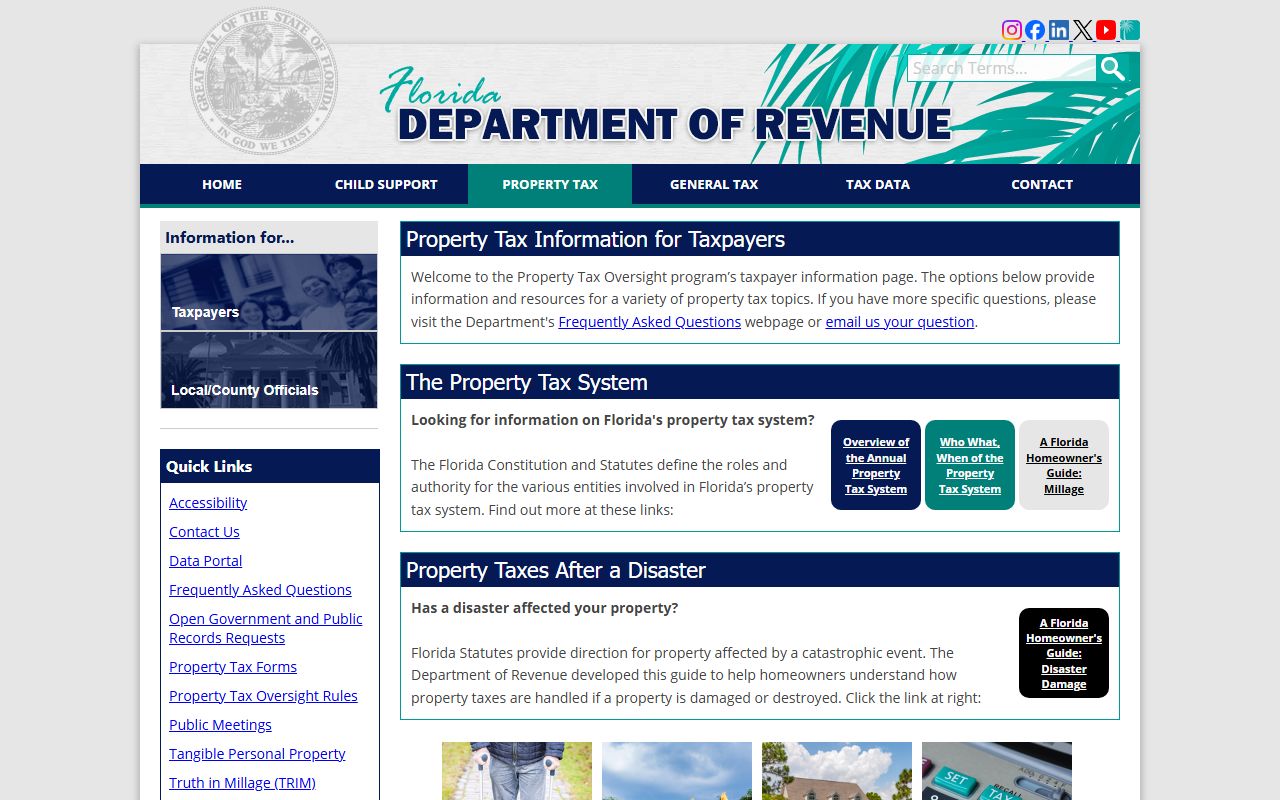
Visit floridarevenue.com/property/Pages/Taxpayers.aspx for statewide guidance on property taxes and owner rights in Florida.
What Fort Myers Property Records Show
A Fort Myers property record from the Lee County Property Appraiser includes ownership information, assessment data, and physical property details. The ownership section lists the current owner's name and mailing address. If a property was recently transferred, the record updates within a few weeks of the deed being recorded with the county clerk.
Assessment data covers the just value, assessed value, and taxable value. For homestead parcels, the assessed value is capped under the Save Our Homes rule, which limits annual increases to 3% or the consumer price index, whichever is lower. Over time, long-held homestead properties in Fort Myers can have assessed values well below their market value. The taxable value is the assessed value minus any exemptions, and it is what the millage rates are applied to when calculating the tax bill.
Building details show the year the structure was built, the construction type, living area in square feet, number of bedrooms and bathrooms, and any outbuildings or accessory structures on the parcel. Land details show lot size and shape, waterfront status, and land use code. These details come from field inspections and permit records maintained by the county and city building departments.
All of this data is public under Chapter 119, Florida Statutes. You do not need to give a reason or register an account to search parcel records online.
Homestead Exemption for Fort Myers Residents
Florida's homestead exemption is available to Fort Myers homeowners who use their property as a primary residence. The exemption reduces taxable value by up to $50,000. The first $25,000 applies to all taxing authorities, including the county, city, and school district. The second $25,000 applies to all taxes except school taxes.
To qualify, you must have owned the home and lived in it as your permanent residence on January 1 of the tax year. A Florida driver's license or ID card with the Fort Myers address is required. You must also be a legal resident of Florida. Green card holders can qualify in most cases. You file with the Lee County Property Appraiser's office, not with the City of Fort Myers. The March 1 deadline is firm. Late applications are not accepted except in limited circumstances involving death of an owner or similar hardship.
Once the exemption is in place, the Save Our Homes cap begins limiting how much your assessed value can increase each year. For Fort Myers properties that have been homesteaded for many years, the gap between assessed value and market value can be significant. That gap represents the accumulated Save Our Homes benefit, and it can be transferred to a new Florida home through the portability process.
Portability allows homeowners to move up to $500,000 of Save Our Homes benefit from one Florida homestead to another. You apply for portability at the same time you apply for homestead on the new property. The Lee County Property Appraiser's office handles portability calculations for properties moving into Lee County, and coordinates with other counties for transfers out.
Fort Myers City Government Resources
The City of Fort Myers manages local building permits, zoning, and code enforcement independently from the county. City Hall is at 2200 Second Street, Fort Myers, FL 33901. The main phone is 239-321-7000. The city website is www.cityftmyers.com. City staff can help with questions about permits, zoning approvals, and local regulations.
The Building Department handles construction permits for properties within Fort Myers city limits. Their phone is 239-321-7925. Permit applications and the permit portal are at cityftmyers.com/building-department. Before buying a Fort Myers property, it is worth checking permit history to verify that all work has been properly permitted and inspections passed. Open or failed permits can create issues at closing.
Fort Myers has an active zoning and land use code. If you need a variance, special exception, or rezoning, the Planning Division at City Hall is the starting point. The city also maintains GIS mapping tools that show zoning districts, flood zones, and parcel boundaries. Flood zone information is especially relevant in Fort Myers given the city's coastal proximity.
Official Records at the Lee County Clerk
Deeds, mortgages, releases, and liens for Fort Myers properties are recorded with the Lee County Clerk of Circuit Court and Comptroller. Recording is what makes a document effective against third parties. Under Chapter 28, Florida Statutes, the clerk must keep and index all recorded instruments. The clerk's office is in Fort Myers, the county seat.
The Lee County Official Records search is available online. You can search by grantor, grantee, or document type. Results show the document type, recording date, book and page reference, and a link to the document image. Most documents are available as free downloads. Certified copies, which are needed for some legal purposes, require a fee per page.
Documentary stamp tax is collected when a deed is recorded. This transfer tax is $0.60 per $100 of the sale price in Lee County. You can use the documentary stamps on a recorded deed to estimate what a property sold for, even if the sale price was not publicly reported elsewhere. This is a common research technique for checking recent sales prices.
Federal and state tax liens, mechanics liens, and judgments are also recorded with the clerk. A title search will turn up all recorded encumbrances on a property. Buyers in Fort Myers typically hire a title company to run a full title search before closing.
TRIM and the Property Tax Calendar
Lee County mails TRIM notices to all property owners each August. The TRIM (Truth in Millage) notice lists the proposed assessed value, the exemptions on file, and the proposed tax rates from each authority that levies taxes on the property. For Fort Myers properties, those authorities include Lee County, the City of Fort Myers, the Lee County School District, and any applicable special districts. The notice is not a bill. It shows what your taxes will be if proposed rates are adopted.
You have 25 days from the TRIM mailing date to file a petition with the Lee County Value Adjustment Board if you disagree with your assessment or if an exemption was denied. The VAB process is open to all property owners and does not require an attorney. A special magistrate hears each petition and issues a recommended decision. The full board votes on the recommendations.
Tax bills arrive in November. Under Chapter 192, Florida Statutes, the state sets the rules for property tax administration statewide. Florida's early-payment discount structure gives 4% off for payment in November, 3% in December, 2% in January, and 1% in February. The full amount is due by March 31. Taxes unpaid after April 1 are delinquent and subject to a tax certificate sale.
Nearby Cities
Cape Coral is the other major Lee County city with a property records page.