
Palm Coast Property Records
Palm Coast property records are maintained by the Flagler County Property Appraiser and the Flagler County Clerk of the Circuit Court. This guide covers how to find ownership data, assessed values, sales history, homestead exemptions, and recorded documents for any parcel in Palm Coast, the largest city in Flagler County and one of Florida's fastest-growing communities.
Palm Coast Property Records Quick Facts
How Palm Coast Property Records Are Managed
All property records for Palm Coast are managed at the county level through Flagler County offices. The Flagler County Property Appraiser is responsible for valuing all real property in the county each year and maintaining the official parcel database. The office is located at 1769 E Moody Boulevard, Building 2, Suite 102, Bunnell, FL 32110. The phone is 386-313-4150. The website is flaglercounty.org/property-appraiser.
Bunnell is the county seat of Flagler County and is located a short drive from Palm Coast. Palm Coast itself makes up the vast majority of Flagler County's population. The city was developed as a planned community beginning in the 1970s and is known for its extensive canal system, wide lots, and grid-based street layout. That planned development means parcel data in Palm Coast tends to be well-documented and relatively straightforward to search.
Florida law under Chapter 193 requires the Property Appraiser to assess all real property at just value each year. The Flagler County office follows this process county-wide. Because Palm Coast accounts for the majority of Flagler County's developed parcels, most activity at the Property Appraiser's office relates to city addresses.
Recorded instruments like deeds, mortgages, and liens are filed with the Flagler County Clerk of Circuit Court under Chapter 28 of Florida Statutes. The Clerk and the Property Appraiser are separate offices. You use each one for different types of records.
How to Search Palm Coast Property Records
The Flagler County Property Appraiser's website at flaglercounty.org/property-appraiser provides access to the parcel search database. You can look up any Palm Coast property by:
- Owner name
- Property address
- Parcel ID number
- Subdivision name
- Map search
Palm Coast's street naming system uses a series of letter and number codes that can be distinctive. If you are searching by address and getting no results, try varying the street abbreviation or using just the parcel ID number. The parcel ID for Palm Coast properties appears on prior tax bills, closing documents, and the county's GIS map.
The Florida Department of Revenue maintains a directory of all county property appraisers, including Flagler County. The screenshot below shows that state resource.
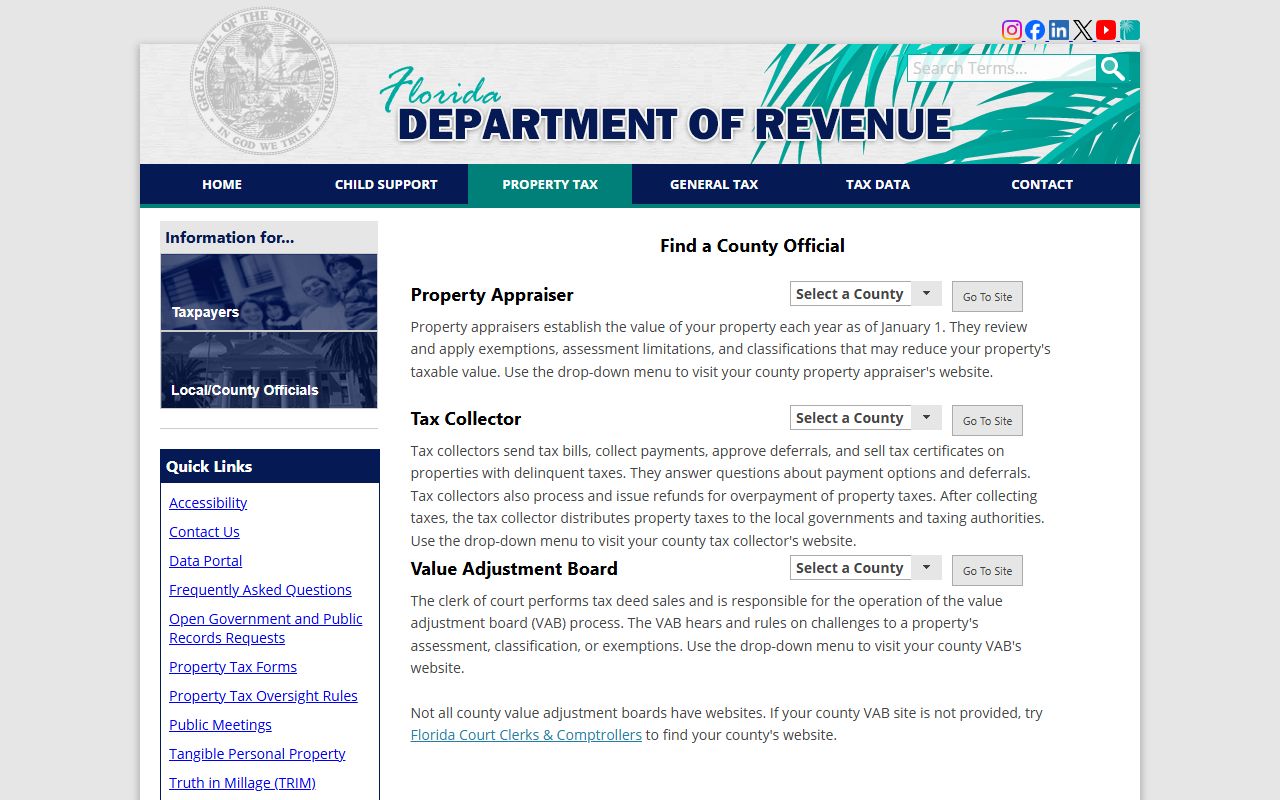
The state DOR directory is useful if you need to verify contact information for the Flagler County Property Appraiser or find contact details for other county offices. It lists current appraisers, tax collectors, and clerks for all 67 Florida counties.
Search results from the Flagler County parcel database show the current owner, mailing address, legal description, property classification, land area, building information, year built, just value, assessed value, taxable value, exemptions, and sales history. For Palm Coast canal-front properties, water frontage is often noted as well.
What Palm Coast Property Records Show
A standard Flagler County parcel record for a Palm Coast address contains these data fields:
- Owner of record - current legal owner and mailing address
- Parcel ID - Flagler County's unique identifier for the parcel
- Legal description - from the recorded deed
- Property use code - single family, condo, vacant, commercial, etc.
- Land area and building area
- Year built and construction class
- Just value - the annual market value estimate set by the Property Appraiser
- Assessed value - may be capped below just value for homesteaded properties
- Taxable value - after all exemptions are deducted
- Active exemptions - homestead, senior, disability, veteran
- Sales history - all recorded transfers with dates and prices
Palm Coast has seen strong growth in recent years. Home values have risen significantly. That means the gap between just value and assessed value has grown for long-term homesteaded owners, since the Save Our Homes cap has limited their assessed value increases while the market moved up quickly. Buyers purchasing in a rising market should understand that their assessed value in the first year after purchase will reset to just value, not the prior owner's lower assessed value.
Homestead Exemption for Palm Coast Homeowners
Florida homeowners who occupy their property as a primary residence can claim up to $50,000 in homestead exemption. The first $25,000 reduces taxable value for all taxing authorities. The second $25,000 applies to assessed value between $50,000 and $75,000 and is exempt from all levies except school taxes. In a growing market like Palm Coast, this exemption is worth applying for as soon as you qualify.
To qualify, you must own the property and use it as your permanent residence as of January 1 of the tax year. You must also be a Florida resident. The deadline is March 1 each year. Contact the Flagler County Property Appraiser at 386-313-4150 or visit the office at 1769 E Moody Boulevard, Building 2, Suite 102, Bunnell, FL 32110. The office website has application forms and may offer online filing options.
Once the exemption is in place, the Save Our Homes cap under Section 193.155 limits annual assessed value increases to 3% or the CPI rate, whichever is lower. If you sell your home and buy another one in Florida, you can transfer this accumulated benefit to the new property through portability. Portability must be applied for by the March 1 deadline in the year after your move. Other Flagler County exemptions include low-income senior, disability, widow or widower, and veterans exemptions. Call the Property Appraiser's office to ask about eligibility for any of these.
City of Palm Coast Government Resources
Palm Coast City Hall is at 160 Cypress Point Parkway, Palm Coast, FL 32164. The general city phone is 386-986-3700. The city website is palmcoast.gov. City departments handle permits, zoning, code enforcement, and utility services for properties within city limits.
The Building Department handles permits for all construction, renovation, and mechanical work. The phone is 386-986-3780 and the website is palmcoast.gov/building-department. Permit records show what work was done on a property, what inspections passed, and whether any open permits remain. Palm Coast's canal-front lots often have permits related to seawalls and docks in addition to standard building permits. Checking all of these before a purchase is a sound step.
The Florida Department of Revenue's public records guidance explains how to request property-related records from state and county offices across Florida.
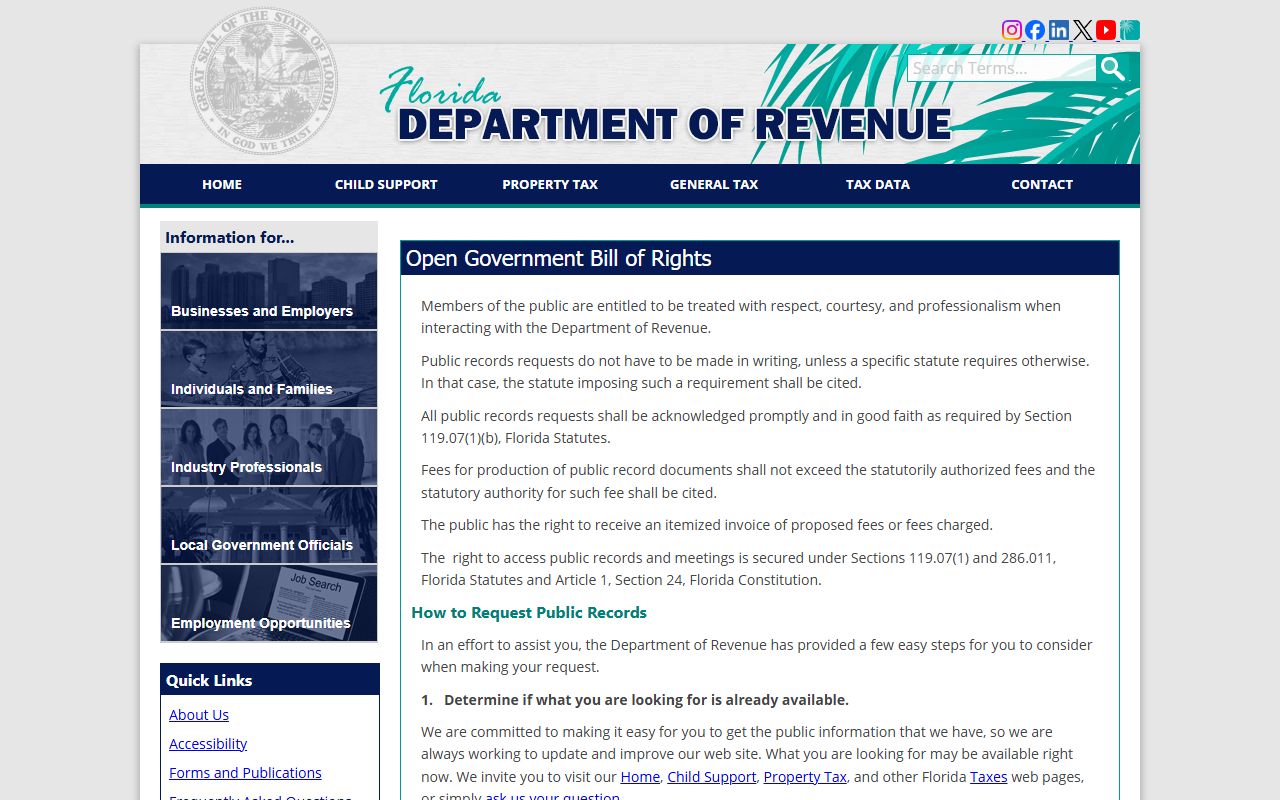
If you need records from the Florida Department of Revenue itself, such as state-level tax data or aggregate county assessment figures, this page explains the process for submitting a public records request. For parcel-specific records, you will still go to the Flagler County Property Appraiser or Clerk, but the state DOR is the right place for broader data needs.
Palm Coast's Planning Division handles zoning questions, comprehensive plan amendments, and development review. Given the city's planned-community layout, zoning designations are generally well-mapped. The city GIS system provides online access to parcel maps, zoning overlays, and flood zone data. Check palmcoast.gov for links to the GIS portal and zoning maps.
Official Records at the Flagler County Clerk
Recorded property instruments for Palm Coast parcels are held by the Flagler County Clerk of the Circuit Court. Under Chapter 28 of Florida Statutes, the Clerk maintains the Official Records index. For Palm Coast properties, this includes:
- Warranty deeds and quitclaim deeds
- Mortgages and mortgage satisfactions
- Mechanic's liens and releases
- Lis pendens filings
- Judgment liens
- Easements and plats
The Flagler County Clerk provides an online Official Records search. Many documents can be viewed and downloaded at no cost. Certified copies require a fee per page as set by Florida law under Chapter 119. The Clerk's office is in the Flagler County Courthouse in Bunnell. For Palm Coast residents, the drive to Bunnell is short, and many services are also available online without needing to go in person.
TRIM Notice and Tax Calendar
Each August, Flagler County sends a TRIM notice to every property owner in the county. TRIM means Truth in Millage. The notice is not a bill. It shows your proposed assessed value for the coming tax year, any exemptions the Property Appraiser has on file for your parcel, and proposed millage rates from each taxing authority that applies to your property.
If you think your assessed value is wrong, or an exemption is missing, you have approximately 25 days from the TRIM notice date to file a petition with the Flagler County Value Adjustment Board. The VAB holds hearings where you can present evidence for a lower value or a denied exemption. Many petitions are handled by the property owner directly, without an attorney. Filing fees are small.
After public budget hearings in September, final millage rates are set. Tax bills go out in November. Early payment discounts apply: 4% if paid in November, 3% in December, 2% in January, 1% in February. Taxes must be paid by March 31 to stay current. After April 1, unpaid taxes become delinquent and Flagler County begins tax certificate proceedings under Chapter 192 of Florida Statutes.
Nearby Cities
Palm Coast is in Flagler County on Florida's northeast coast. Qualifying cities in neighboring Volusia County are about 30 to 40 miles to the south.