
Plantation Property Records
Property records for Plantation, Florida are maintained by Broward County and cover every parcel inside city limits. This guide explains where to find ownership data, tax assessments, homestead exemptions, and deeds filed with the county clerk. Plantation sits in central Broward County and has a population of about 100,694. Most records are available online at no cost through the Broward County Property Appraiser and the Broward County Records Division. Whether you need a recent sale price, a deed copy, or want to file for a homestead exemption, the steps below will point you to the right office and the right portal.
Plantation Property Records Quick Facts
How Plantation Property Records Are Managed
All property records for Plantation fall under Broward County jurisdiction. The Broward County Property Appraiser (BCPA) is the office responsible for valuing every parcel and maintaining ownership data. The current appraiser is Marty Kiar. The BCPA office is located at 115 S Andrews Ave, Room 111, Fort Lauderdale, FL 33301. You can reach them by phone at (954) 357-6830 or by email at bcpamail@bcpa.net.
Florida law requires the property appraiser to assess all real property at just value each year, as set out under Chapter 193, Florida Statutes. The appraiser does not set tax rates. That is done by the county commission and other taxing bodies. The BCPA compiles the assessment rolls and sends them to the tax collector, who then mails tax bills each November.
Separate from the appraiser, the Broward County Records, Taxes and Treasury Division handles recorded documents such as deeds, mortgages, and liens. These are official public records under Chapter 28, Florida Statutes. Both offices serve all cities in Broward County, including Plantation.
The BCPA website is the first stop for most Plantation property searches. The site is free to use and open to anyone.
The Broward County Property Appraiser's homepage provides access to the online search portal, exemption applications, and additional property information tools.
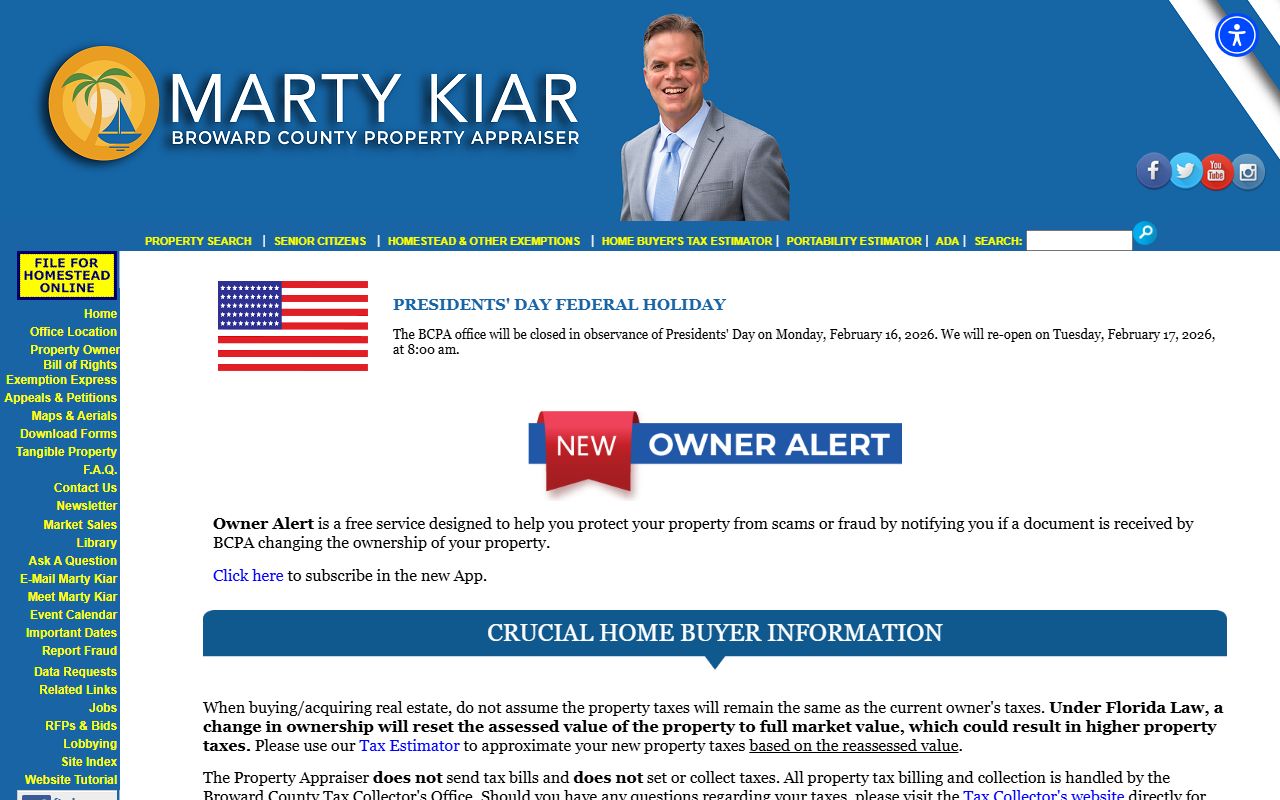
Visit bcpa.net to search Plantation parcel records by owner name, address, or parcel ID number.
Search Plantation Property Records Online
The BCPA provides a free parcel search at bcpa.net. You can look up any Plantation property by owner name, street address, or the 13-digit parcel ID. Results show the current owner, mailing address, legal description, lot size, building characteristics, and assessed value history going back several years.
Sales history is also available through the search portal. Each sale lists the date, price, deed type, and the names of the buyer and seller. This is useful if you want to track how a property's value has changed over time or compare sale prices in a neighborhood. Sales data is pulled from recorded deeds, so it reflects what is on file with the county clerk.
For document copies, the Broward County Records Division operates a separate online portal called Official Records Search. You can search that system at officialrecords.broward.org. Deeds, mortgages, satisfactions, and liens recorded since 1978 are available there. Certified copies can be ordered online for a fee. Uncertified copies are often free to view and print from the portal.
If you prefer to search in person, the BCPA office is open weekdays. The Records Division main office is also in Fort Lauderdale. Plantation residents can visit either location without an appointment for most requests.
What Plantation Property Records Show
A standard property record for a Plantation parcel contains several layers of information. At the top level you will find ownership details: the legal owner's name, the mailing address on file, and the date the current owner took title. Below that is the property description, which includes the subdivision name, block, lot, and legal description used in recorded deeds.
Assessment data shows the just value, assessed value, and taxable value for the current year and prior years. In Florida, the assessed value can be lower than the just value for homestead properties because of the Save Our Homes cap. That cap limits annual increases in assessed value to 3% or the rate of inflation, whichever is less. The difference between just value and assessed value is shown on the parcel record.
You can also see the exemptions applied to a parcel. Homestead, senior, disability, and veteran exemptions all appear on the record and reduce the taxable value. The record will show the dollar amount of each exemption and the year it was first granted.
Sales history, building characteristics (year built, square footage, number of bedrooms and bathrooms), and land use codes are also part of the record. For commercial parcels, income data may be included if the owner filed a return with the appraiser. All of this data is public under Chapter 119, Florida Statutes.
Homestead Exemption for Plantation Residents
Florida's homestead exemption is one of the biggest tax benefits available to Plantation property owners. If you own and live in your home as your primary residence, you can get up to $50,000 off your property's taxable value. The first $25,000 applies to all taxing authorities. The second $25,000 applies to all taxes except school taxes.
To qualify, you must have owned the property on January 1 of the tax year and used it as your permanent home on that date. You must also have a Florida driver's license or ID showing the Plantation address, and you must be a Florida resident. Non-citizens who hold a green card can still qualify in most cases.
The deadline to file is March 1 each year. Late applications are generally not accepted. You file with the Broward County Property Appraiser, not with the City of Plantation. The BCPA offers an online application at bcpa.net/homestead.asp as well as paper forms you can submit by mail or in person.
The BCPA homestead exemption page explains eligibility rules, required documents, and how to apply online for Plantation and all other Broward County cities.
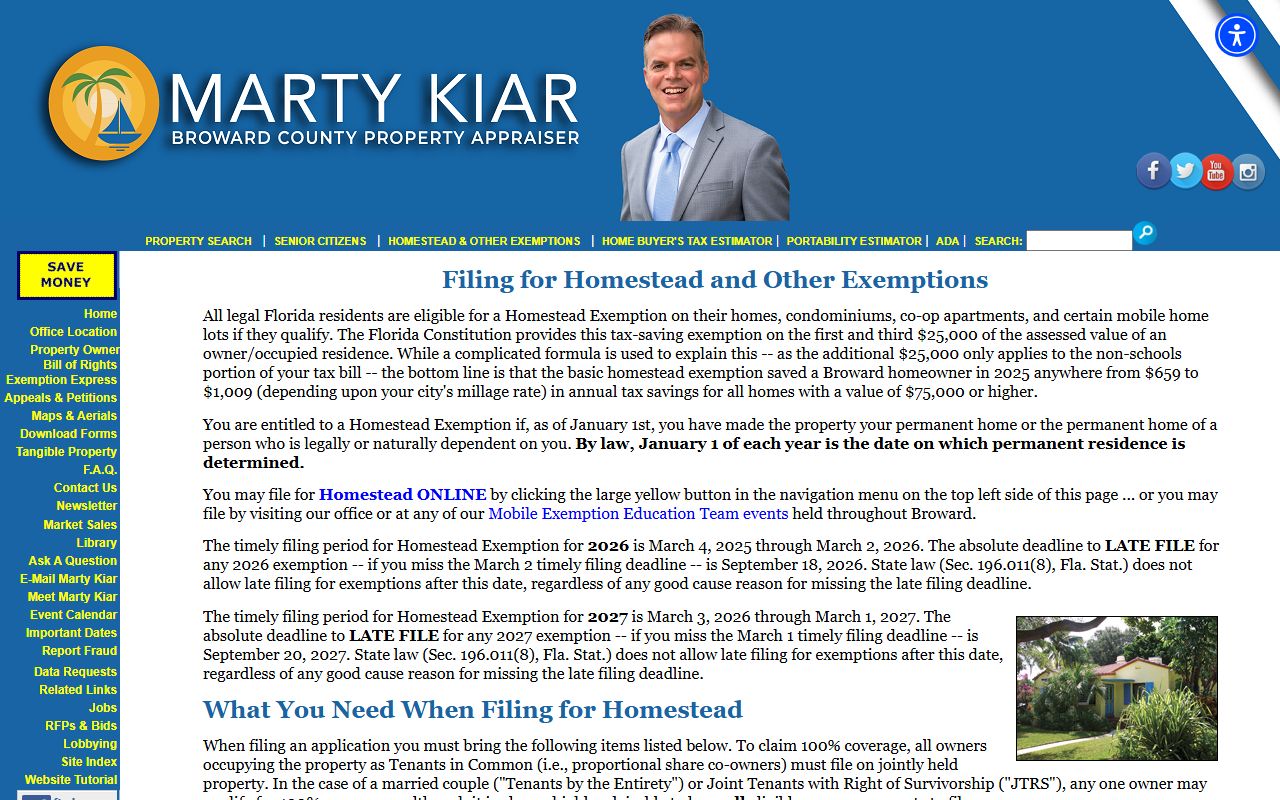
Go to bcpa.net/homestead.asp to start your homestead exemption application or check the status of an existing exemption.
Once granted, the Save Our Homes cap takes effect the following year. It limits assessed value increases to 3% or the CPI, whichever is lower. If you sell your home and buy another in Florida, you may be able to transfer some of the accumulated benefit through portability. The BCPA has a portability calculator on their site to help estimate the transfer amount.
Plantation City Government Resources
The City of Plantation handles local permitting, zoning, and code enforcement. City Hall is at 400 NW 73rd Avenue, Plantation, FL 33317. The main phone number is 954-797-2200. The city website is www.plantation.org. City records such as permits and business licenses are managed separately from county property records.
The Building Department handles permits for new construction, additions, and renovations. Their number is 954-797-2600. The department website at plantation.org/building-department has permit applications and inspection scheduling. Permit records are public and can affect property value and sale conditions, so it is worth checking them before buying.
Zoning records show what uses are allowed on a parcel. If you want to add a structure, change a use, or subdivide a lot, you will need to check zoning first. The Planning and Zoning Division at City Hall can answer those questions. Zoning maps are also available on the city's GIS portal.
Official Records at the Broward County Clerk
Deeds, mortgages, releases, and liens are recorded with the Broward County Clerk of Courts under Chapter 28, Florida Statutes. Recording a document creates a permanent public record and establishes the priority of competing claims. Every property transfer in Plantation goes through this process.
The Broward Official Records portal at officialrecords.broward.org lets you search recorded documents by name, document type, or date range. You can view images of most documents online. Certified copies cost a few dollars per page. The clerk's office also handles documentary stamp tax collection when a deed is recorded, which is paid at the time of filing.
Liens, including federal tax liens and contractor's liens, are also recorded here. If you are buying a Plantation property, a title search of the official records will turn up any open liens or encumbrances. You can do a basic name search yourself through the portal, though title companies provide more thorough searches as part of the closing process.
TRIM and the Property Tax Calendar
Each August, Broward County mails a TRIM (Truth in Millage) notice to every property owner. The TRIM notice shows the proposed assessed value, the exemptions on file, and the proposed tax rates from each taxing authority. It is not a bill. It is a notice of what your taxes will be if the proposed rates are adopted.
If you disagree with your assessed value, the TRIM notice contains instructions for filing a petition with the Value Adjustment Board (VAB). The deadline to file is 25 days after the mailing date of the TRIM notice. The VAB is an independent board that hears challenges to assessments and exemption denials.
Tax bills go out in early November. The full amount is due by March 31 of the following year, but Florida offers early-payment discounts. Pay in November and you get 4% off. December is 3%, January is 2%, and February is 1%. March is the last month with no discount. Properties with unpaid taxes after April 1 are subject to a tax certificate sale. Under Chapter 192, Florida Statutes, the state sets the framework for all property tax administration, including delinquency procedures.
Nearby Cities
Other Broward County cities with property record pages include the following.