
Broward County Property Records
Broward County property records serve nearly two million residents across 31 municipalities, from Fort Lauderdale and Hollywood to Coral Springs and Miramar. The Broward County Property Appraiser (BCPA) maintains the county's assessment database, and the Broward County Clerk handles all recorded instruments affecting title. Together these offices give property owners, buyers, researchers, and lenders a complete public record of ownership, value, and encumbrances for every parcel in the county.
Broward County Property Records Quick Facts
Broward County Property Appraiser
The Broward County Property Appraiser is Marty Kiar. The main office is at 115 S. Andrews Ave., Room 111, Fort Lauderdale, FL 33301. Office hours are Monday through Friday, 8:00 a.m. to 5:00 p.m., closed weekends and county holidays. The main phone number is (954) 357-6830. The fax number is (954) 357-6188. For general email correspondence, use bcpamail@bcpa.net. Exemption-specific inquiries can go to exemptions@bcpa.net.
The BCPA website at bcpa.net is a full-featured property records portal that handles millions of lookups each year. It provides parcel search, exemption information, forms, and an online FAQ system. The BCPA is responsible for assessing all real and tangible personal property in Broward County at just value each year, as required by Florida Statutes Chapter 193. For a county this large and densely developed, that means processing hundreds of thousands of parcel records and tracking market activity across a wide range of property types.
For visitors who want to avoid long waits at the main office, mornings between 8:00 a.m. and 10:00 a.m. tend to have shorter wait times. Avoiding lunch hours also helps. Many services can be handled online or by phone, which often saves a trip to the office entirely.
The BCPA homepage at bcpa.net provides access to the property search database, exemption resources, forms, and direct contact options for staff assistance.
How to Search Broward County Property Records
The BCPA website at bcpa.net is the primary place to search Broward County property records online. You can look up a parcel by owner name, property address, or folio number (the Broward County identifier for each parcel). Results show a full property record including ownership, assessed values, exemptions, sales history, and building data.
The BCPA also provides an interactive FAQ and online assistance tool. If you have questions about a specific record or need help interpreting what you find, the online Q&A system at web.bcpa.net can walk you through common questions about property assessments, exemptions, and appeals.
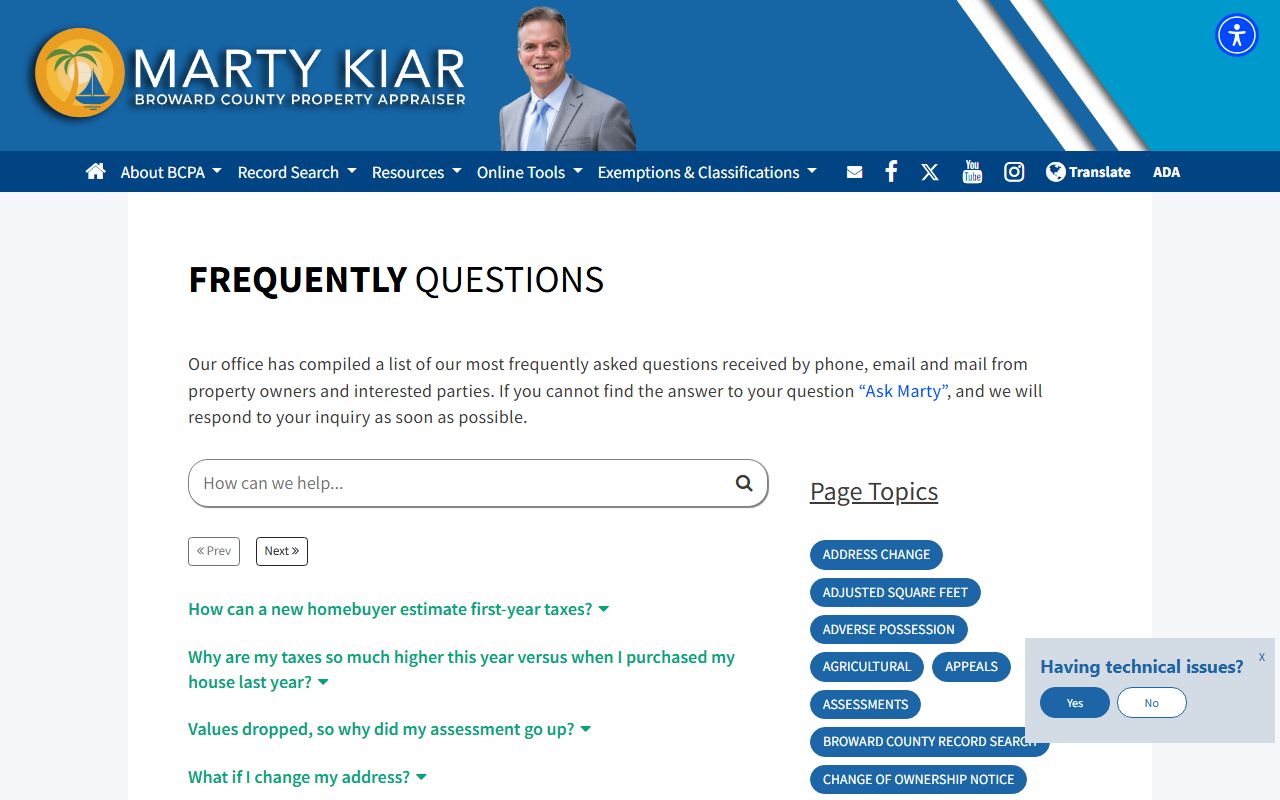
The BCPA's online Ask Questions tool provides answers to common questions about Broward County property records and exemption applications without requiring a call or office visit.
For form downloads, visit bcpa.net/forms.asp. Completed forms can be emailed to CSEmgmt@bcpa.net, faxed to (954) 357-6188, or mailed to the main office at 115 S. Andrews Ave., Room 111, Fort Lauderdale, FL 33301. For exemption-related help or to schedule a virtual meeting with BCPA staff, call (954) 357-5579.
If you need to update your mailing address on file with the BCPA, submit an address change request through the BCPA's online form or by mailing in a signed written statement. For security, address changes must be in writing and must include the folio number or other property identification details. Changes cannot be made verbally over the phone. This protects property owners from unauthorized address changes that could affect their receipt of tax notices and TRIM mailings.
Deed records and recorded instruments are at the Broward County Clerk of Courts, not the BCPA. Florida's Chapter 119 makes all such records public, and the clerk maintains them under Chapter 28 indexing standards.
What Broward County Property Records Show
A full BCPA property record contains several distinct data sets. The parcel summary shows the folio number, the property address, the owner's name, and the mailing address on file. The legal description is pulled from the recorded deed. The value section shows just value, assessed value after any cap, and taxable value after all exemptions. For a highly developed county like Broward with a large homestead population and significant Save Our Homes protection built up over many years, these three numbers often differ significantly for long-term owners.
Sales history tracks every recorded transfer of the property. For Broward properties that have traded hands multiple times, the sales history gives a clear picture of price appreciation, the types of deeds used, and whether the transaction was arm's-length or not. Non-arm's-length transactions (such as sales between family members, bank-owned sales, or sales at prices far below market) are flagged in the BCPA's system because they may not be reliable indicators of market value under Chapter 192.
Building data includes the year built, heated and total square footage, number of bedrooms and bathrooms, construction type, and condition grade. Extra features such as pools, covered patios, and docks are itemized separately. Land data shows the lot size, zoning designation, and land use code. All of this data feeds into the just value calculation and is updated as the BCPA processes new permits and inspections throughout the year.
Homestead Exemption in Broward County
Florida's homestead exemption cuts taxable value by up to $50,000 for owners who live in their Broward County property as their primary permanent home. The first $25,000 applies to all taxes. The second $25,000 covers values between $50,000 and $75,000 and applies only to non-school taxes. Both pieces of the exemption must be applied for together by March 1.
Detailed information on the homestead exemption and all other available exemptions is at bcpa.net/homestead.asp. Information about the Senior, Veteran, and all other exemptions can also be obtained on that page. The site explains eligibility requirements, lists the documents you need, and provides application instructions. For help with the process or to schedule a virtual meeting, call (954) 357-5579.
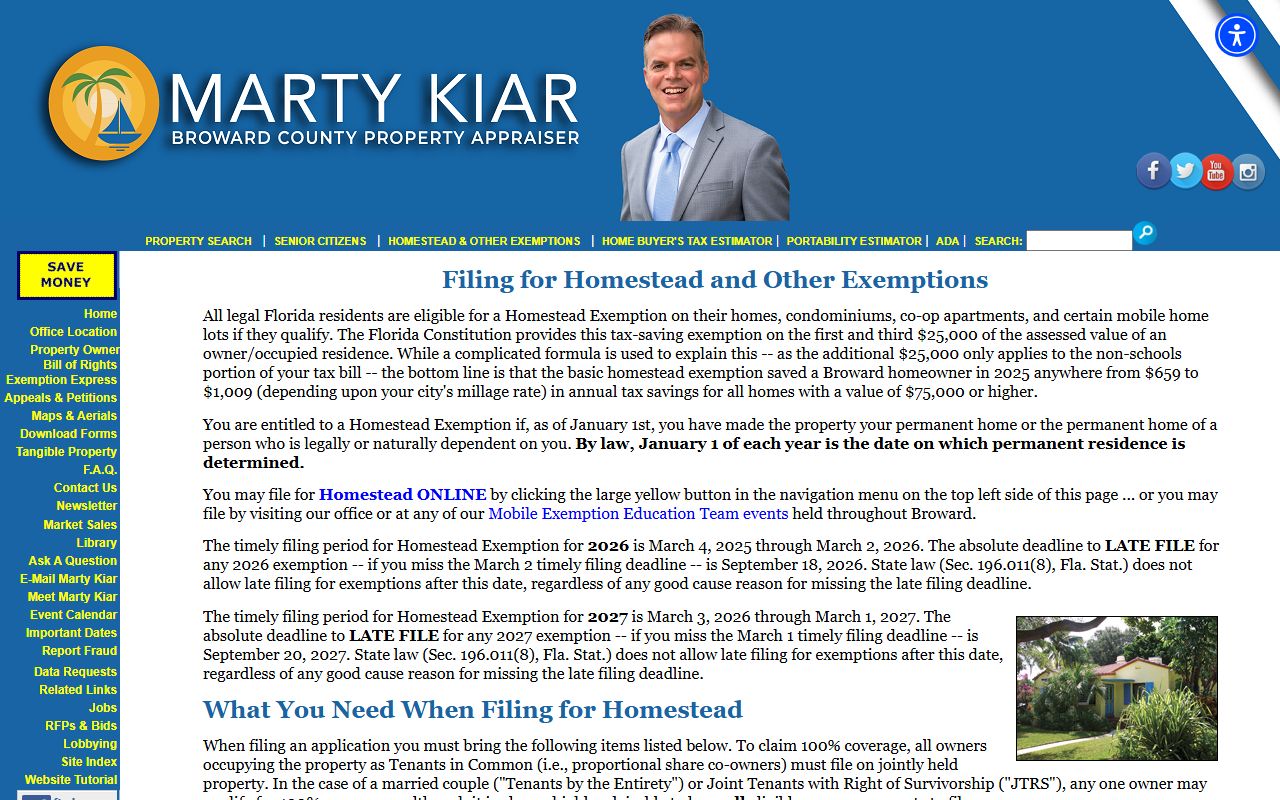
The BCPA homestead exemption page at bcpa.net/homestead.asp walks applicants through every step of the process and includes all supporting documentation requirements.
Once you receive the homestead exemption, the Save Our Homes cap under Florida Statutes Section 193.155 limits annual assessed value increases to 3% or the inflation rate, whichever is lower. In Broward County's active real estate market, long-term homeowners often have assessed values that are well below current market value as a result of this cap. When you sell, the cap resets on the new owner's first assessment. Portability lets you transfer up to $500,000 of accumulated benefit to a new Florida homestead. Apply for portability at the same time you file your new homestead exemption application.
Broward County's Owner Alert program is a free service that notifies property owners when a document that could change ownership is received by the BCPA. You sign up with your name, Property ID (folio number), and email address, and the BCPA sends you a fast alert if a deed or similar instrument affecting your property comes in. If you did not authorize it, you can act quickly. To sign up or ask questions about Owner Alert, email owneralert@bcpa.net or call 954-357-5579.
Broward County Property Tax Process
Florida's property tax process starts with the BCPA's annual assessment work. By August 1, the appraiser certifies the tax roll to the county. TRIM notices go out in August to all Broward County property owners. The notice shows the proposed assessed value, proposed millage rates from each taxing authority, and the scheduled public hearings. Review it carefully. It is your clearest window into how your tax bill is being calculated.
Broward County has a large number of overlapping taxing districts: the county, school board, each city government, hospital districts, and special districts all levy millage. Your TRIM notice lists each one. If you believe any aspect of the valuation is wrong, contact the BCPA promptly. Many informal adjustments are made before the roll is finalized if the owner presents solid evidence of error.
For a formal challenge, file a petition with the Broward County Value Adjustment Board. The deadline appears on your TRIM notice. VAB hearings are held before a special magistrate who reviews evidence from both sides and issues a written recommendation. The VAB then votes to approve, reject, or modify the recommendation. This is a fully independent process from the BCPA. Tax bills go out in November. Early payment discounts apply through February, and the full amount is due by March 31.
Note: The BCPA FAQ at floridarevenue.com and the BCPA's own online Q&A tool both cover common questions about Broward County property taxes, TRIM notices, and the appeals process in accessible language.
Official Records at the Broward County Clerk
The Broward County Clerk of Courts maintains all recorded documents that affect real property title in the county. Warranty deeds, quitclaim deeds, special warranty deeds, mortgages, satisfactions, assignments, mechanic's liens, judgment liens, and lis pendens filings are all part of the official records. Under Chapter 28, the clerk records these in sequence and indexes them by grantor and grantee so that anyone can trace the chain of title forward and backward.
Florida's Chapter 119 Public Records Law makes all of these documents open to the public. The Broward County Clerk's official records are accessible online through the clerk's website, where you can search by name, instrument type, or recording date. Certified copies carry the clerk's official seal and are needed for legal transactions. Uncertified copies work for research.
Broward County is one of Florida's largest and most active real estate markets. The volume of recorded instruments is high, and the range of property types includes single-family homes, condominiums, townhomes, commercial buildings, and vacant land. Before any purchase in Broward County, a full title search through the clerk's records is standard practice to identify any outstanding liens, judgments, or other encumbrances that a seller may not have disclosed.
Cities in Broward County
Broward County contains many cities that meet the population threshold for dedicated pages on this site. The county is highly urbanized with no unincorporated rural areas to speak of, and more than a dozen of its municipalities are large enough to qualify.
Nearby Counties
Broward County borders two other major South Florida counties. Both have robust property records systems and large populations of their own.