
Lauderhill Property Records
Property records for Lauderhill are held by the Broward County Property Appraiser and cover every parcel within the city, including ownership data, assessed and taxable values, legal descriptions, exemption status, building characteristics, and sales history. Lauderhill is a city in central Broward County, and its entire parcel database runs through the countywide Broward County PA system. This page covers how to search those records, what they include, how the homestead exemption works for Lauderhill residents, how to use the free Owner Alert fraud protection service, and where to find deeds and liens through the county clerk.
Lauderhill Property Records Quick Facts
How Lauderhill Property Records Are Managed
The Broward County Property Appraiser (BCPA), led by Marty Kiar, manages all property records for parcels in Lauderhill. The main office is at 115 S Andrews Ave, Room 111, Fort Lauderdale FL 33301. The phone is (954) 357-6830 and the general email is bcpamail@bcpa.net. The office website is at bcpa.net. Office hours are Monday through Friday, 8:00 a.m. to 5:00 p.m. If you plan to visit, mornings between 8:00 and 10:00 a.m. often have shorter wait times.
The BCPA handles property assessments and exemptions for all of Broward County, including Lauderhill. It does not set millage rates, does not issue tax bills, and does not collect taxes. Tax bills and payments go through the Broward County Tax Collector. If you have a question about paying your bill, contact the Tax Collector. For questions about your assessed value or exemption status, the BCPA is the right office.
The Property Appraiser assigns each Lauderhill parcel a Property ID number. This number is the unique identifier used in the BCPA's database and is referenced on tax bills, deeds, and title reports. Searching by Property ID is the fastest and most exact way to find a specific record.
The Broward County Property Appraiser's website lets you search all Lauderhill parcels for free by owner name, address, or Property ID number.
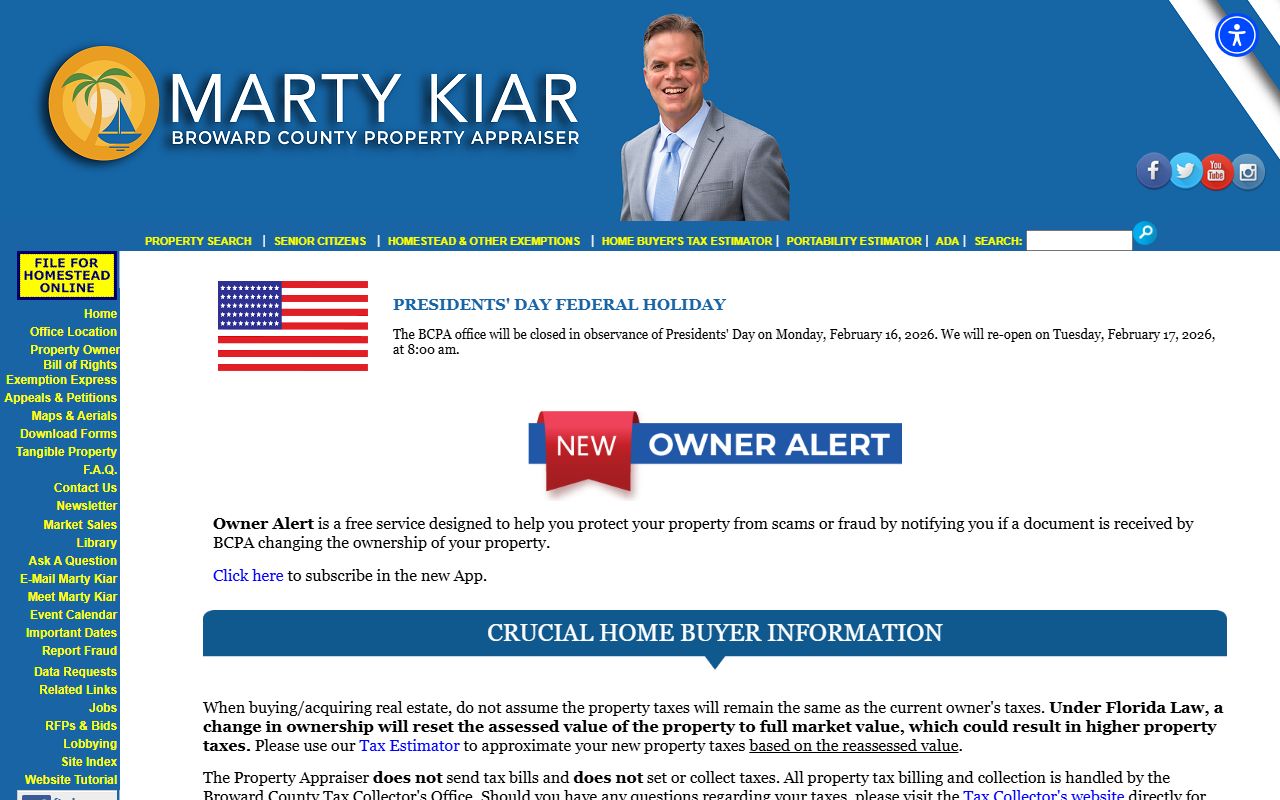
Find ownership data, values, and exemption details for any Lauderhill parcel at bcpa.net with no account or registration needed.
Search Lauderhill Property Records Online
The BCPA's online portal lets you search Lauderhill parcels by owner name, property address, or Property ID. Each result links to a full parcel detail page with all current data in a single view. The detail page shows the current owner and mailing address, the legal description, lot size, year built, building square footage, assessed value, taxable value, exemptions, and sales history.
Sales history shows all recorded transfers for the parcel, including the date, recorded price, and document type. Non-arms-length transactions (such as gifts, family deeds, or corporate transfers) often show a nominal price of $10 or $100. These do not reflect real market value. Look for transactions labeled as qualified sales when comparing to the market.
The portal also shows exemption details broken out by type. If a homestead exemption is active, you can see the full $50,000 or partial amount applied, plus any other exemptions that stack on top. This gives a clear picture of how much the taxable value is reduced from the assessed value.
All searches are free. No login is needed. The system is available at all hours. For questions about specific records, contact the BCPA at (954) 357-6830 or use the FAQ tool at web.bcpa.net/bcpaclient/#/Ask-Questions to find answers to common questions before calling.
What Lauderhill Property Records Include
Lauderhill parcel records held by the BCPA include ownership information, value data, building characteristics, land data, exemption details, and sales history. Ownership data shows the current titleholder and their mailing address. Ownership updates happen after a deed is recorded with the Broward County Clerk of Courts and processed by the BCPA.
Value data covers three key figures: the just value (market value), the assessed value (which may be lower for homestead properties), and the taxable value (after all exemptions are subtracted). The just value is the PA's estimate of what the property would sell for on the open market. The taxable value is what your tax bill is based on. If you have a homestead exemption and a Save Our Homes cap, your taxable value may be well below market.
Building characteristics include the property type, year built, total living area, construction type, and quality class assigned by the PA. Lauderhill has a mix of single-family homes, townhomes, and condominiums. For condos, each unit has its own parcel record separate from the building's common areas. The building characteristic data comes from field inspections, aerial updates, and permit records filed with local building departments.
Land data shows the lot dimensions, lot area, and zoning. Exemption data lists every active tax relief program tied to the parcel. The BCPA reviews exemptions each year and may remove those that no longer qualify, for example if an owner moves out and the property stops being a primary residence.
Homestead Exemption for Lauderhill Residents
Florida's homestead exemption is available to Lauderhill homeowners who use the property as their permanent primary residence. The exemption reduces the assessed value by up to $50,000: the first $25,000 applies to all taxing levies, and the second $25,000 applies to non-school levies only. This directly lowers the taxable value and reduces the total annual tax bill.
To qualify, you must own the property and occupy it as your primary Florida residence as of January 1 of the tax year. You need a Florida driver's license or ID with the Lauderhill address, or comparable documentation. You cannot claim homestead exemptions in Florida and another state at the same time.
Apply by March 1. Applications filed after March 1 do not take effect until the next year. Apply online through bcpa.net/homestead.asp, by mail, or in person at the BCPA office. For exemption questions, contact the BCPA at exemptions@bcpa.net or call (954) 357-5579.
Once your homestead is in place, the Save Our Homes cap limits the annual rise in your assessed value to 3% or the CPI, whichever is less. Lauderhill homeowners who have held their homestead for many years may have assessed values far below current market prices. When the property sells to a buyer who does not claim homestead, the assessed value resets to market value the following January 1.
Portability lets you transfer the Save Our Homes benefit to a new Florida homestead when you move. You have up to three years from abandoning the prior homestead to use portability. File the portability application at the same time as your new homestead application at the PA office for your new county.
Owner Alert: Free Deed Fraud Protection
The Broward County Property Appraiser offers a free service called Owner Alert. When you sign up, the BCPA sends you an email any time a document is received that could affect ownership of your Lauderhill property. This service is a fast way to catch deed fraud, unauthorized transfers, or other suspicious activity on your parcel.
To enroll, email owneralert@bcpa.net or call 954-357-5579. You will need to provide your name, Property ID number, and email address. There is no cost to sign up. Deed fraud is a known problem in South Florida, and this service puts an early warning system in place at no charge. It does not prevent fraud, but it gives you notice quickly enough to take action if something happens.
The BCPA's homestead exemption page covers eligibility rules, the March 1 deadline, and the online application for Lauderhill homeowners seeking to reduce their property tax bill.
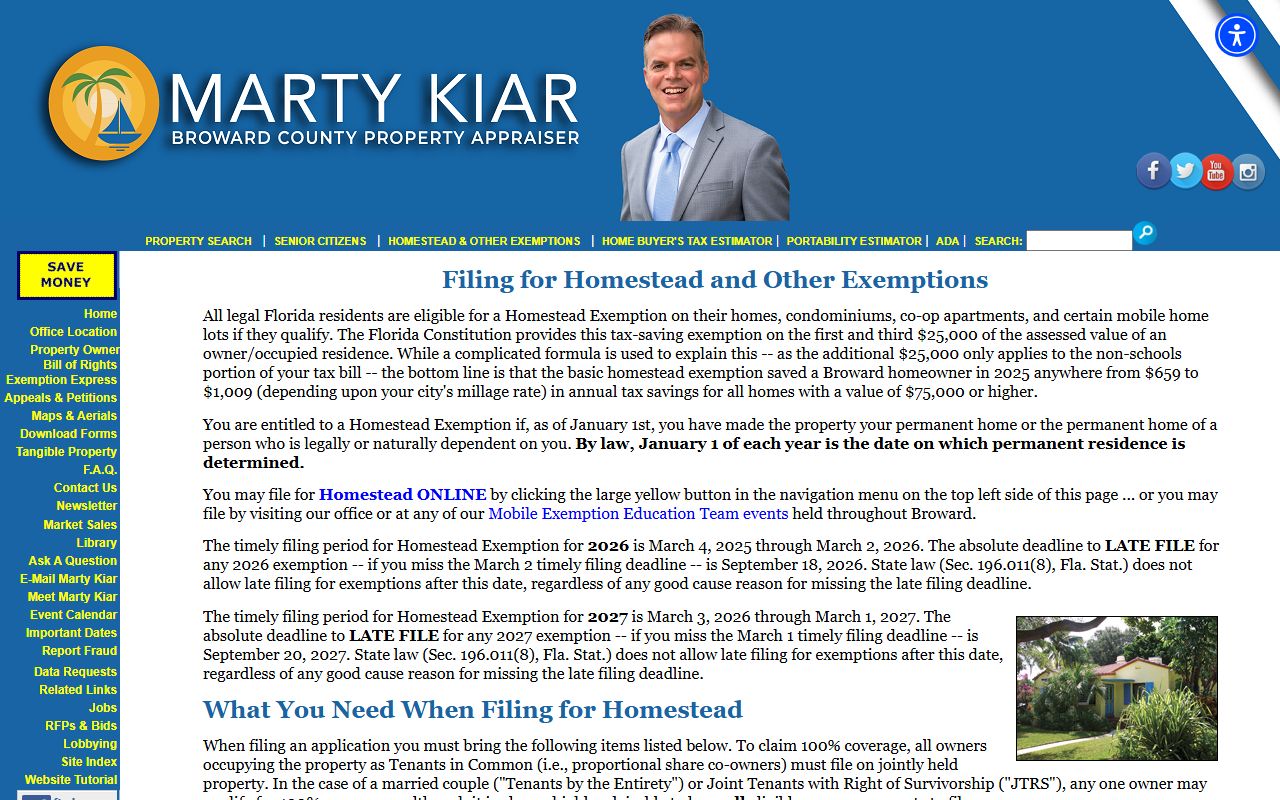
Apply for your homestead exemption or review eligibility at bcpa.net/homestead.asp before the March 1 deadline.
City of Lauderhill Government Resources
The City of Lauderhill's main office is at 5581 W Oakland Park Boulevard, Lauderhill FL 33313, phone 954-730-3000. The city website is at lauderhill-fl.gov. The city handles local zoning, code enforcement, and city-level public records. Zoning and land use records are available through the city's planning and zoning offices.
Building permits and inspections are handled by the City of Lauderhill Building Department, phone 954-730-3080, online at lauderhill-fl.gov/building-department. Building records are public. You can search permit history to find out about work done on a Lauderhill property, check whether permits were properly closed with inspections, or look up certificate of occupancy status. These records are separate from Property Appraiser data but are useful in combination with it.
Official Records at the Broward County Clerk
Deeds, mortgages, liens, and all other recorded instruments for Lauderhill properties are held by the Broward County Clerk of Courts. Under Chapter 28 of the Florida Statutes, the Clerk maintains the official records index for all recorded documents in the county. The PA parcel record shows the Book and Page reference for the most recent deed. Use that to find the document in the Clerk's index.
The Clerk's online system allows free searches by name or Book and Page number. Certified copies have a per-page fee. Common documents include warranty deeds, quitclaim deeds, mortgage satisfactions, judgment liens, and lis pendens filings. Together with the PA record, these give a full picture of the property's ownership and encumbrance history.
Public access to these records is guaranteed under Chapter 119, Florida's Public Records Law. No reason or special standing is needed to search property records. Most searches can be done online without visiting a government office.
TRIM Notice and Property Tax Calendar
The Broward County Property Appraiser sends TRIM notices to all Lauderhill property owners each August. The notice shows the proposed assessed and taxable values, the millage rates from each taxing authority (county, city, school board, and special districts), and the estimated tax bill. It is not a bill. You have 25 days from the mailing date to file a petition with the Value Adjustment Board if you disagree with the proposed value.
Petitioning the VAB is free. You can represent yourself or use a licensed tax agent or attorney. The VAB holds a hearing, reviews evidence, and issues a decision. If the ruling reduces your value, the November tax bill reflects the lower amount. Keep a copy of your TRIM notice. It is your key reference during the petition process.
Tax bills are mailed in November. Florida's early payment discount: 4% off in November, 3% in December, 2% in January, 1% in February. Full payment is due by March 31. After that date, taxes are delinquent and tax certificates are sold. Most Lauderhill homeowners pay in November to get the full 4% discount.
The property tax assessment cycle is set by Chapter 192 and Chapter 193 of the Florida Statutes. These laws cover how property is assessed, what exemptions are permitted, and the full timeline from the January 1 valuation date through the March 31 payment deadline.
Nearby Cities
Lauderhill is in central Broward County, close to several other large cities with property record pages.