
Marion County Property Records
Marion County property records are kept by the Marion County Property Appraiser, located in Ocala, and cover all parcels across this large north-central Florida county. You can search ownership data, assessed values, exemption status, and deed history online through the appraiser's public portal, or request records by phone or in person at the main office on SE 25th Avenue.
Marion County Property Records Quick Facts
Marion County Property Appraiser Office
The Marion County Property Appraiser is the primary office for all property record data in the county. The office sits at 503 SE 25th Avenue, Ocala, FL 34471, and can be reached by phone at 352-368-8300. Staff handle questions about parcel ownership, assessed values, exemptions, and tax roll data. The main website at marionappraiser.com gives you access to the online search tool at no cost.
Marion County covers a large area, with roughly 1,600 square miles of land. The appraiser's office manages a substantial number of parcels that span residential neighborhoods, farm tracts, timber land, and commercial sites. The county has grown steadily, which means the office processes a high volume of ownership changes, new construction filings, and exemption applications each year.
If you need to visit in person, the office is open on weekdays during normal business hours. Bring a parcel number or property address to make your search faster. Staff can pull up current and prior year records, print ownership history, and walk you through the exemption filing process if you qualify.
Note: The Property Appraiser does not set tax rates or collect taxes. Those functions belong to the Marion County Tax Collector.
How to Search Marion County Property Records Online
The Marion County Property Appraiser's website provides a free public search tool. You can look up any parcel by owner name, address, or parcel ID number. Results show the current owner, mailing address, legal description, land use code, and assessed value. Sales history is included, so you can see prior transfer dates and sale prices going back several years.
The Florida Department of Revenue also runs a statewide data portal that includes Marion County data. The page below shows the DOR's property tax data portal, which lets researchers and analysts pull county-level data sets.
The Florida Department of Revenue's Property Tax Data Portal provides statewide data including Marion County assessment and sales data for download.
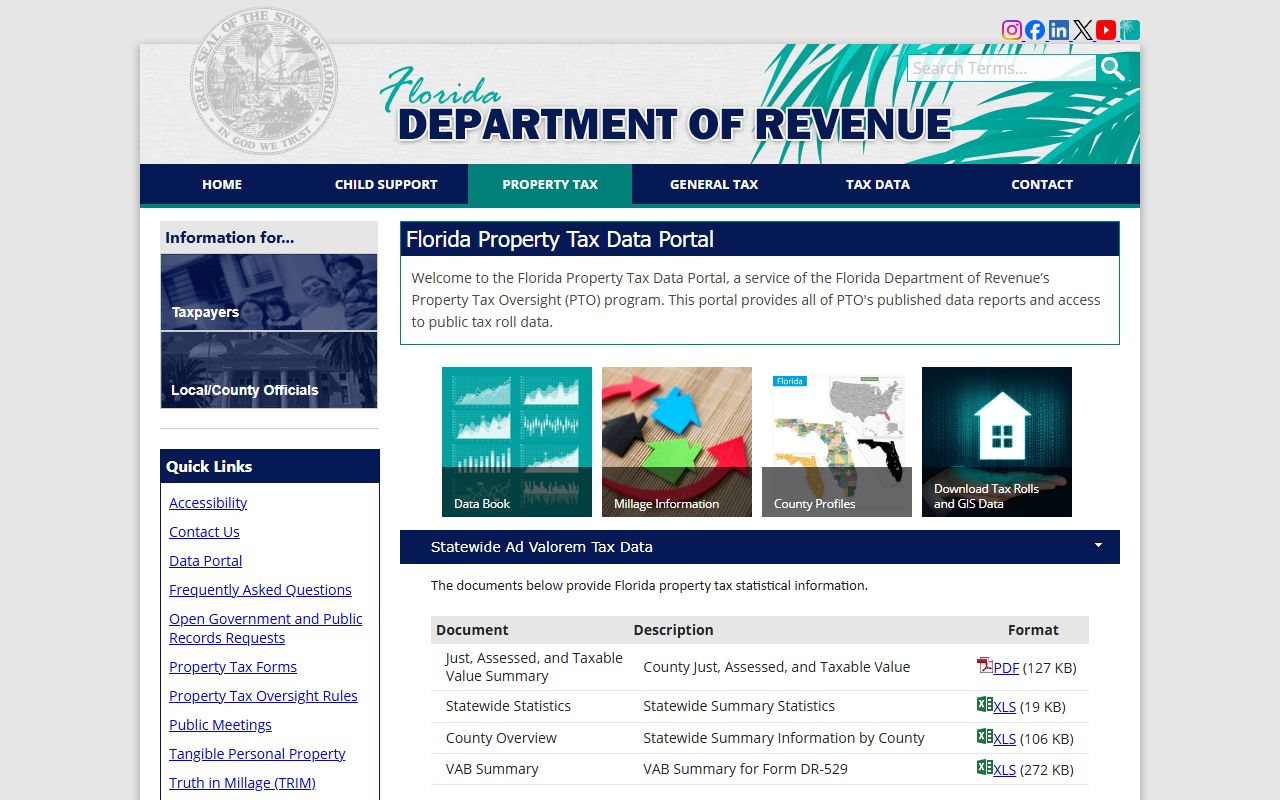
The portal is updated annually after each county certifies its tax roll, so the data reflects final assessed values and exemption totals for each year.
For deed and mortgage records, the Marion County Clerk of Circuit Court maintains official records that are separate from the appraiser's database. Those records include recorded deeds, liens, mortgages, and other instruments affecting title. The clerk's official records are governed by Chapter 28, Florida Statutes, which sets the framework for what clerks must record and how those records are made available.
What Marion County Property Records Contain
A standard Marion County property record includes the owner's name, the property's situs address, the legal description from the recorded plat or deed, the parcel identification number, and the land and improvement values. You will also see the just value (market value), assessed value, and any exemptions that reduce the taxable value.
Residential records show the year the structure was built, the square footage of living area, the number of bedrooms and bathrooms, and the construction type. Agricultural parcels show land use classifications, acreage, and any ag exemption that applies. Commercial records show building class, total area, and the most recent sale data.
Sales data is a key part of the record. Each transfer of ownership gets recorded with the sale date, sale price, deed type, and the official records book and page number where the deed was filed with the clerk. This lets you trace the ownership chain for any parcel over time. Marion County has a mix of horse farms, retirement communities, and growing suburban neighborhoods, so sales data reflects a wide range of property types and price points.
Homestead Exemption and Save Our Homes in Marion County
Florida law gives permanent residents a homestead exemption that can reduce a home's assessed value by up to $50,000. The first $25,000 applies to all property taxes, and a second $25,000 applies to non-school levies. To get the exemption, you must own and occupy the home as your primary residence on January 1 of the tax year, and you must file with the Marion County Property Appraiser by March 1.
Once you have the homestead exemption, the Save Our Homes cap limits how much the assessed value can rise each year. The cap holds annual increases to 3% or the rate of inflation, whichever is lower. This can create a significant gap between assessed value and market value over time, especially in areas where home prices have grown fast. Marion County has seen strong price appreciation, so the cap has provided real savings for long-term owners.
If you move to a new home in Florida, you may be able to transfer part of your Save Our Homes benefit to the new property. This process is called portability. You apply for portability at the same time you file for homestead on the new property. The appraiser's office can explain how the calculation works and how much benefit you can bring with you.
Additional exemptions are available for widows and widowers, persons with disabilities, veterans with service-connected disabilities, and senior citizens with limited income. Each has its own eligibility rules and filing requirements. The Marion County Property Appraiser's website lists current exemption types and the forms needed to apply.
Note: All exemption applications are due by March 1. Late filings are generally not accepted except in cases of extenuating circumstances.
TRIM Notices and Marion County Tax Process
Each August, Marion County property owners receive a Truth in Millage (TRIM) notice. This document shows the proposed assessed value for the year, any exemptions on the parcel, and the proposed tax rates from each taxing authority that covers the property. It is not a tax bill, but it shows what your bill will look like if the proposed rates are adopted.
The TRIM notice is the point in the year when you should check your assessed value carefully. If you think the value is wrong, you have a right to challenge it. The first step is an informal conference with the appraiser's staff. If that does not resolve the issue, you can file a formal petition with the Marion County Value Adjustment Board. The petition deadline is typically 25 days after the TRIM notice is mailed.
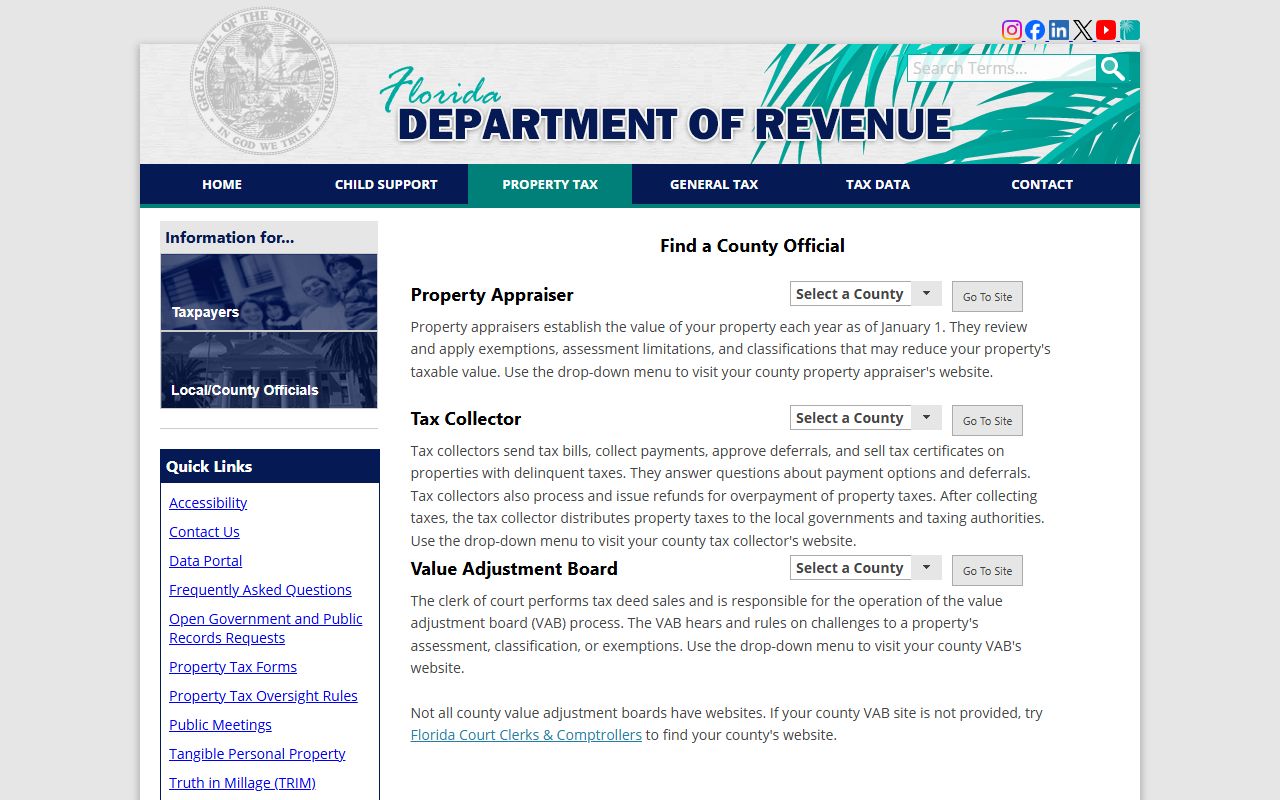
The Florida Department of Revenue provides a page listing county officials and their contact details, which can help property owners confirm the right office to contact for a given issue.
The DOR's Find County Officials page lists the property appraiser, tax collector, and VAB contact information for every Florida county, including Marion.
After the taxing authorities adopt final millage rates, the Tax Collector mails the actual tax bills in November. Payment is due by March 31 of the following year. Early payment earns a discount of up to 4%.
Official Records at the Marion County Clerk
The Marion County Clerk of Circuit Court records and maintains all official instruments that affect real property in the county. These include warranty deeds, quit-claim deeds, mortgage documents, satisfactions of mortgage, liens, and lis pendens notices. The clerk's office is located at the Marion County Courthouse in Ocala.
Florida law requires that deeds and other instruments be recorded in the county where the property sits. Under Chapter 28, Florida Statutes, the clerk charges a recording fee based on the number of pages and must index each document for public access. Most Marion County deed records are available online through the clerk's website, searchable by grantor or grantee name, document type, or recording date.
When you buy or sell a property, the deed gets recorded with the clerk, who assigns it a book and page number or instrument number. That reference ties back to the property appraiser's database, which is how the appraiser updates ownership information after a sale. The two offices work together to keep public records accurate, but each maintains its own independent database with different fields and functions.
Florida DOR Oversight and Property Tax Law
The Florida Department of Revenue supervises property assessment statewide under Chapter 192, Florida Statutes. This chapter defines key terms like just value, assessed value, and taxable value, and it sets rules that every county property appraiser must follow. The DOR conducts annual compliance reviews and can require counties to adjust their rolls if assessments are out of line with market data.
Assessment procedures are further governed by Chapter 193, Florida Statutes, which covers how appraisers must value different types of property, including homestead, agricultural, and tangible personal property. Public access to government records, including property records, is governed by Chapter 119, Florida Statutes, also known as the Public Records Law. That law gives any person the right to inspect or copy public records, with limited exceptions.
Marion County's property appraiser must certify the county's tax roll to the DOR each year, confirming that all assessments meet state requirements. This certification is a key checkpoint in the property tax calendar and takes place after the Value Adjustment Board process wraps up in the fall.
Cities in Marion County
Ocala is the county seat and the largest city in Marion County, but its population falls below the 100,000 threshold for a dedicated city page on this site. Other communities in the county, including Belleview, Dunnellon, and Silver Springs Shores, are also below that level. If you are looking for records tied to a specific address in Marion County, the county property appraiser's database covers all incorporated and unincorporated areas.
Nearby Counties
Marion County borders eight other Florida counties. Each has its own property appraiser and public records system.