
Find Property Records in Franklin County
Franklin County property records are held by the county's Property Appraiser office in Apalachicola, a small coastal seat on Florida's Forgotten Coast. This panhandle county covers roughly 12,000 residents spread across barrier islands, marshland, and fishing communities. Records include ownership data, parcel assessments, deed filings, and exemption status. This page explains where to find those records, how state law governs access, and what each office can provide.
Franklin County Property Records Quick Facts
Franklin County Property Appraiser
The Franklin County Property Appraiser operates from 33 Market Street, Suite 101, Apalachicola, FL 32320. The main phone number is 850-653-9233. The office website is at franklincountyflorida.com/property-appraiser. There you can search parcel records by owner name, address, or parcel ID. The site also has exemption forms and contact details for staff.
The screenshot below shows the Franklin County Property Appraiser's website, which provides online access to local parcel data and exemption information.
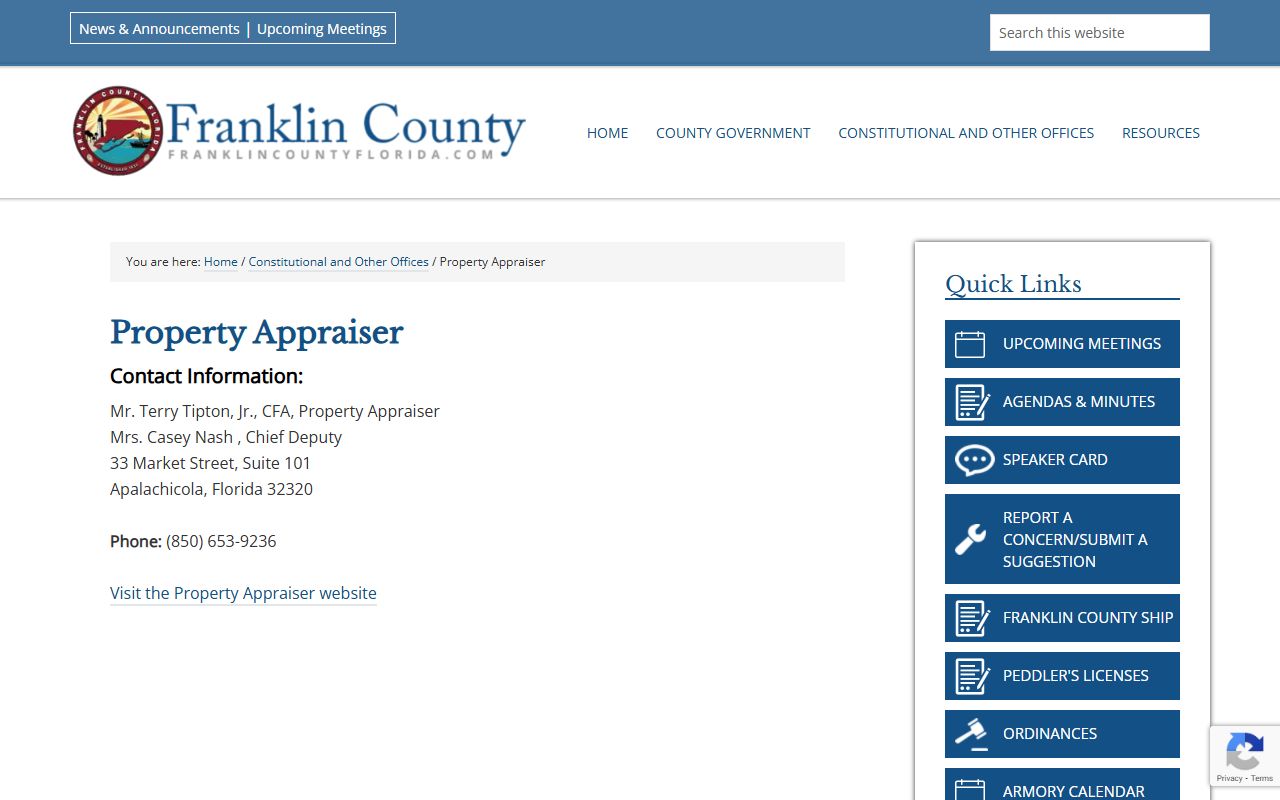
The appraiser's site is the primary starting point for any property research in Franklin County, whether you're checking ownership, reviewing assessed values, or verifying exemption status before a purchase.
Florida's Chapter 193 statutes require the appraiser to set a just value for all real property in the county as of January 1 each year. In Franklin County, that valuation work covers a mix of property types: waterfront residential lots, commercial fishing operations, coastal commercial parcels, and timberland in the interior. The appraiser uses sales data and comparable market information to arrive at each parcel's just value.
Parcel Data and Online Search
The online parcel search shows a range of data for each Franklin County property. You can see the current owner of record, mailing address, legal description, land size, building details, and both the just value and assessed value. The difference between those two numbers often reflects the Save Our Homes cap, which limits how fast assessed values can rise for homesteaded properties.
Search results also show the tax year history for each parcel, so you can track how values have changed over time. This is useful when you're doing due diligence on a potential purchase or checking that your own assessment lines up with local market conditions.
Because Franklin County is a small county, the volume of transactions is lower than urban Florida counties. That can make it harder to find comparable sales. The appraiser's office staff are generally accessible and can answer specific questions about how your parcel was valued.
Note: Waterfront and island properties in Franklin County often have complex parcel boundaries tied to mean high water lines, which can differ from simple survey plats.
Deeds and Recorded Land Documents
Deeds, mortgages, and recorded instruments for Franklin County property are filed with the Franklin County Clerk of Courts. Under Chapter 28, the clerk maintains all recorded land documents and is responsible for keeping those records available to the public. You can search the Clerk's records by grantor and grantee name or by document type.
Recorded deeds in Franklin County carry a documentary stamp tax based on the sale price. This makes them a useful tool for checking what a property sold for even before the appraiser's roll is updated. Lis pendens filings, judgment liens, and easement agreements are also kept in the official records and can affect a parcel's title status.
Franklin County's Clerk of Courts is located in Apalachicola and can provide copies of recorded documents in person or, in many cases, through their online portal. Recording fees apply when submitting new documents.
Homestead Exemptions in Franklin County
Florida homeowners who use their Franklin County property as a primary residence can apply for homestead exemption. The exemption reduces the assessed value by up to $50,000. The first $25,000 applies to all tax levies, including school taxes. The second $25,000 applies only to non-school levies. Applications must be submitted by March 1 of the tax year in which you want the benefit.
Additional exemptions may be available for seniors, disabled veterans, and widowers. The Franklin County Property Appraiser's office can walk you through the options during a visit or phone call. Each exemption has its own documentation requirements, so it helps to call ahead and ask what to bring.
The Save Our Homes benefit kicks in after your first year of homestead and caps annual assessment increases at 3% or the CPI rate, whichever is lower. For long-time Franklin County residents, this cap can mean a significant gap between market value and assessed value, which lowers the tax bill compared to a new purchase at the same price.
Property Taxes and the Tax Collector
After the Property Appraiser sets values, the Franklin County Tax Collector issues the annual tax bills. Bills come out each November. Florida law allows early payment discounts under Chapter 192: 4% off in November, 3% in December, 2% in January, and 1% in February. Full payment is due by March 31.
If taxes go unpaid, the county can sell tax certificates to investors, and eventually hold a tax deed sale. Franklin County publishes notice of tax deed sales through the Clerk's office. Buyers at these sales should research any other liens or encumbrances that survive the sale process. The Tax Collector's office can answer questions about payment options, delinquent accounts, and installment plans.
Public Records Rights in Franklin County
Florida's public records law at Chapter 119 makes most property records open to anyone who asks. You don't have to explain why you want to see them. Ownership data, assessed values, recorded deeds, tax payment history, and exemption status are all public. Franklin County offices are required to respond to records requests in a reasonable time and at a reasonable cost.
Some narrow categories of information are protected, such as the home addresses of certain law enforcement or protected persons. But the bulk of what you'd need to research a Franklin County property is available without restriction. You can request records in person, by mail, or by email depending on which office holds them.
The Florida Department of Revenue also provides statewide resources. Their local officials page lists all county appraisers and tax collectors, and their taxpayer information section covers appeals, exemptions, and owner rights in plain language.
Challenging Your Assessment
If you disagree with the Franklin County Property Appraiser's valuation of your property, you can request an informal review. Bring evidence of lower comparable sales or a recent independent appraisal. Many owners get corrections at this stage.
If the informal review doesn't resolve it, you can file a petition with the Franklin County Value Adjustment Board before the deadline shown on your TRIM notice in August. The VAB holds hearings and can lower the appraiser's value if the evidence supports it. After the VAB, you can still take the case to circuit court if needed.
Cities in Franklin County
Franklin County has no cities that meet the population threshold for a dedicated city page on this site. Apalachicola is the county seat and largest community. Other areas include Carrabelle and Eastpoint, which are smaller unincorporated communities along the coast.
Nearby Counties
Franklin County sits on the Gulf Coast panhandle, bordered by Gulf County to the west, Liberty County to the north, Jefferson County to the east, and Wakulla County to the northeast. Each of those counties has its own property appraiser and recorded documents office.