
Find Hillsborough County Property Records
Hillsborough County property records are managed by the county property appraiser and the clerk of court, giving residents, buyers, investors, and researchers a direct way to find ownership data, assessed values, exemption status, and deed history for parcels throughout one of Florida's most populous counties. Whether you are searching for a Tampa home, reviewing a commercial property in Brandon, checking a lot in Plant City, or tracing the title history of any parcel in the county, these records are public under Florida law and available to anyone who asks.
Hillsborough County Property Records Quick Facts
Hillsborough County Property Appraiser
The Hillsborough County Property Appraiser is Bob Henriquez, and the office is located at 601 E Kennedy Boulevard, Tampa, FL 33602. You can reach the office at (813) 272-6100 or by email at custserv@hcpafl.org. Office hours are Monday through Friday, 8 a.m. to 5 p.m., excluding holidays. The main website is hcpafl.org, which gives you access to the property search portal, exemption applications, contact options, and news from the office.
Property Appraiser Bob Henriquez has focused on modernizing the office. He has cut the office budget for two consecutive years, directing savings back to taxpayers while improving services. The office launched the first-ever mobile version of the HCPA website, making it easier to search property records on a phone or tablet. The office has also received an international award for its cutting-edge desktop appraisal system, which helps staff work more efficiently across the county's large and diverse property base.
The office operates under Florida Statutes Chapter 193, which governs property assessment across all 67 Florida counties. With nearly 1.5 million residents, Hillsborough County processes one of the largest volumes of property transactions, exemption filings, and assessment reviews in the state.
The HCPA website is the main online access point for property records in Hillsborough County.
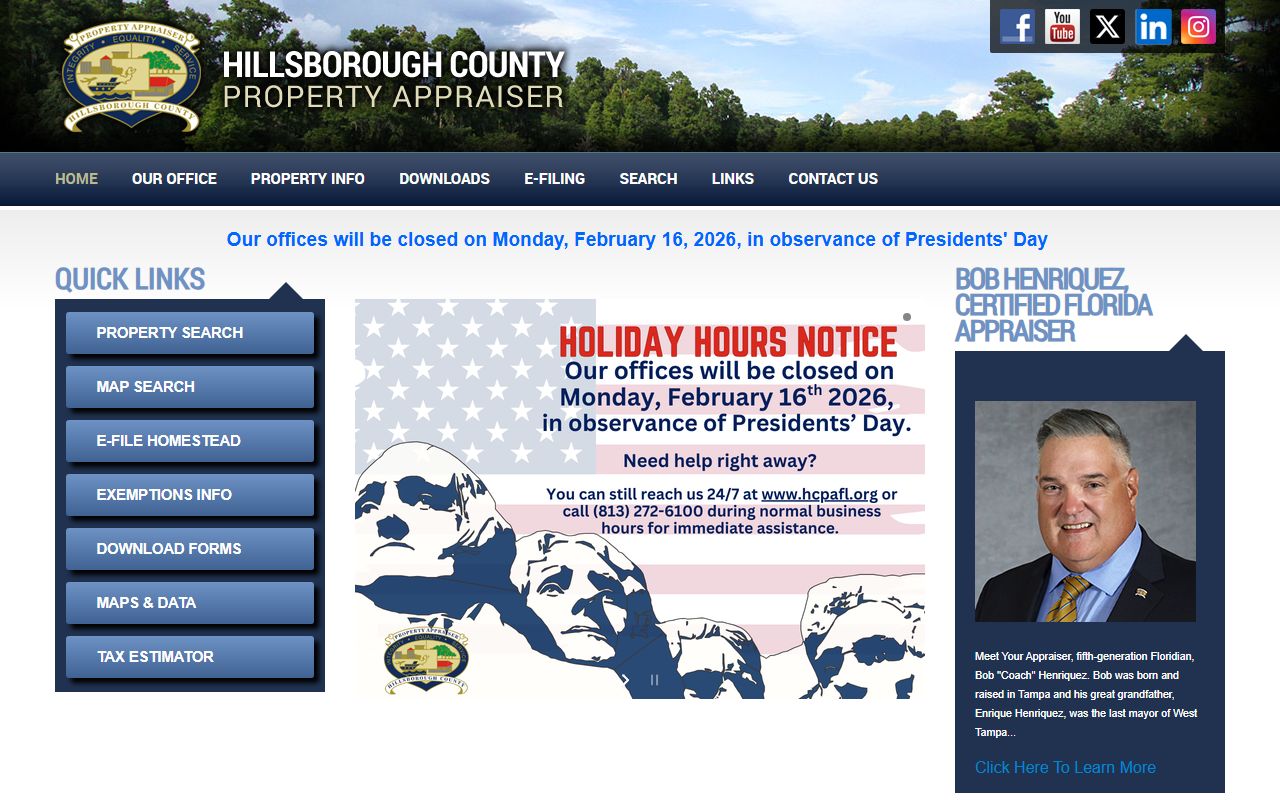
The homepage links to the search portal, exemption tools, and news updates from the property appraiser's office.
How to Search Hillsborough County Property Records
The online search portal at hcpafl.org is the quickest way to find a property record in Hillsborough County. You can search by owner name, property address, or parcel identification number. The system returns a full record showing the legal description, current ownership, just and assessed values, exemption status, prior sales data, and building characteristics. The database is updated regularly as new transactions, assessments, and changes are processed by the appraiser's office.
For questions, contact, or feedback, the office provides an online form at hcpafl.org/Contact-Us/Email-Us-Feedback. Staff can help with complex lookups, ownership history questions, and exemption inquiries. In-person service is available at the Kennedy Boulevard office in Tampa during regular business hours.
For recorded instruments such as deeds, mortgages, liens, and releases, you need the Hillsborough County Clerk of the Circuit Court, not the property appraiser. The clerk maintains those official records under Florida Statutes Chapter 28. The clerk's records and the appraiser's data cross-reference through parcel numbers and legal descriptions. Note: Hillsborough County also offers a Property Fraud Alert service through the clerk's office, a free tool that monitors official records for documents recorded against your property and alerts you by email, which can help you catch fraud early.
Property Fraud Alert in Hillsborough County
Hillsborough County Property Appraiser Bob Henriquez has publicized the Property Fraud Alert service as a tool for protecting real estate from deed fraud. This is a free service that monitors official records filed with the Clerk of the Circuit Court. When a new document is recorded using your name or property, you receive an alert so you can check whether it was authorized. Property fraud, including fraudulent deed transfers, is a concern in high-value real estate markets like Tampa, and early detection makes it far easier to address.
To sign up, you contact the Hillsborough County Clerk of the Circuit Court directly. The service does not cost anything, and you do not need to own multiple properties to use it. Any property owner can enroll. If you get an alert about a document you did not authorize, contact the clerk and a licensed attorney promptly. Catching a fraudulent filing early reduces the legal work needed to correct the title.
This type of program is especially useful for owners who do not live on their property full-time or who own vacant land that they check infrequently. The longer fraudulent documents go unnoticed, the more complicated the resolution can become.
What Hillsborough County Property Records Show
A standard property record from the Hillsborough County Property Appraiser includes the current owner's name and mailing address, the physical property address, the parcel identification number, and the legal description from the recorded deed. The valuation section shows the just value (market value), the assessed value after applicable caps, and the taxable value after all exemptions are subtracted. These three numbers serve different purposes, and understanding the difference helps you read a property tax bill accurately.
Sales history in the record lists prior transactions with dates, sale prices, and deed instrument references. This lets you trace how a property has changed hands and how its value has moved over time. Florida Statutes Chapter 192 requires all property to be placed on the tax roll, so every parcel in Hillsborough County has a full record in the appraiser's database regardless of whether it has recently sold. Building data shows square footage, year built, construction type, roof type, and condition. Extra features such as pools, detached garages, and outbuildings are listed separately with individual value calculations.
Homestead Exemption in Hillsborough County
Florida's homestead exemption cuts up to $50,000 from the taxable value of a primary residence. The first $25,000 applies against all taxing authorities. The second $25,000 applies only to non-school millage on assessed values between $50,000 and $75,000. To get the exemption, you must own the property, live there as your primary Florida residence, and file with the Hillsborough County Property Appraiser by March 1 of the first year you want coverage.
Once homestead status is in place, Florida Statutes Section 193.155 activates the Save Our Homes cap, which limits assessed value increases to 3% or the rate of inflation, whichever is lower. Tampa area home prices have climbed sharply in recent years, so the Save Our Homes cap has been particularly valuable for long-term homeowners. When you sell and buy a new Florida home, you may be able to transfer part of the accumulated assessment savings through portability. The appraiser's office can walk you through the portability application process.
Other exemptions are available for veterans with service-connected disabilities, surviving spouses of veterans and first responders, seniors with low household income, widows and widowers, and people with total and permanent disabilities. Each requires its own application and supporting documents filed by the March 1 deadline. Note: Contact the office at custserv@hcpafl.org if you have questions about eligibility before submitting an application.
The contact page provides email, phone, and in-person options for reaching the Hillsborough County Property Appraiser office with exemption or record questions.
Property Tax Process in Hillsborough County
The tax cycle begins each August when the Hillsborough County Property Appraiser mails a Truth in Millage (TRIM) notice to every property owner. The TRIM notice is not a bill. It shows your proposed assessed value, the exemptions currently on file, and the proposed millage rates from all taxing authorities that apply to your parcel. It also includes dates for public budget hearings where you can comment on proposed rate increases.
If you believe your assessed value is too high, start by calling or visiting the HCPA office. Many disputes are resolved informally at that stage. If you cannot reach an agreement, you can file a petition with the Value Adjustment Board by the deadline printed on your TRIM notice, which is usually in mid-September. The VAB is independent of the property appraiser and can order a value reduction if the evidence supports it.
Tax bills are mailed in November. Discounts apply: 4% in November, 3% in December, 2% in January, 1% in February. The full amount is due March 31. Hillsborough County has a high volume of property tax transactions given the county's size, so the tax collector's office processes payments through multiple channels including online, by mail, and in person. The Florida Department of Revenue maintains taxpayer resources at floridarevenue.com/property/Pages/Taxpayers.aspx that apply statewide, including Hillsborough County.
Official Records at the Hillsborough County Clerk
Deeds, mortgages, liens, lis pendens notices, and other instruments affecting real property in Hillsborough County are recorded and maintained by the Clerk of the Circuit Court. Recording a deed creates a public record and establishes the legal chain of title. Florida's public records law, Chapter 119, makes these documents available to any member of the public, and you can search them in person or online through the clerk's official records portal.
Hillsborough County has one of the highest volumes of recorded instruments in the state, given the size of the real estate market in Tampa and surrounding areas. The clerk's records index allows searches by grantor, grantee, parcel number, or document type. Certified copies carry a per-page fee set by statute. Before buying any property in Hillsborough County, a thorough review of both the appraiser's records and the clerk's official records is standard practice to ensure you understand what is recorded against the title.
Cities in Hillsborough County
Tampa is the county seat and the largest city in Hillsborough County, and it has a dedicated page on this site. Other cities in the county include Temple Terrace, Plant City, and numerous unincorporated communities, but those do not have separate city pages here.
Nearby Counties
Hillsborough County borders several counties in the Tampa Bay region. Each has its own property appraiser and official records system.