
Manatee County Property Records Search
Manatee County property records are maintained by the Property Appraiser's office in Bradenton and cover all real estate and tangible personal property in this Southwest Florida county. You can search ownership data, assessed values, exemption status, and sales history online at manateepao.gov, or visit the office in person at 915 4th Avenue W, Bradenton, FL 34205 during business hours, Monday through Friday from 8:30 AM to 5:00 PM.
Manatee County Property Records Quick Facts
Manatee County Property Appraiser
The Manatee County Property Appraiser's office is at 915 4th Avenue W, Bradenton, FL 34205. Phone: 941-748-8208. Fax: 941-741-4789. Email: info@manateepao.gov. Office hours are Monday through Friday, 8:30 AM to 5:00 PM. The official website is at manateepao.gov.
The Manatee County Property Appraiser is responsible for identifying, locating, and fairly valuing all property within Manatee County, Florida, for tax purposes. This includes real estate, tangible personal property, and certain exemptions that may reduce a property owner's taxable value. The office employs appraisers, data entry staff, GIS specialists, and customer service personnel to maintain accurate records for every parcel in the county.
Manatee County is one of Florida's faster-growing counties. Strong real estate demand along the Gulf Coast has pushed property values higher in recent years, making the appraiser's task of keeping assessed values current an ongoing challenge. The office follows the rules set by Chapter 192 of Florida law, which applies to all county property appraisers in the state.
How to Search Manatee County Property Records Online
The Manatee County Property Appraiser runs an online search portal at manateepao.gov. You can search by owner name, property address, or parcel identification number. Results show the current owner of record, the assessed value, taxable value, exemptions, property description, and sales history. The site also includes a GIS map viewer that lets you see the parcel on an aerial photo and review boundary lines.
The official Manatee County Property Appraiser website, shown below, is the starting point for all online property record searches in Bradenton and the surrounding county.
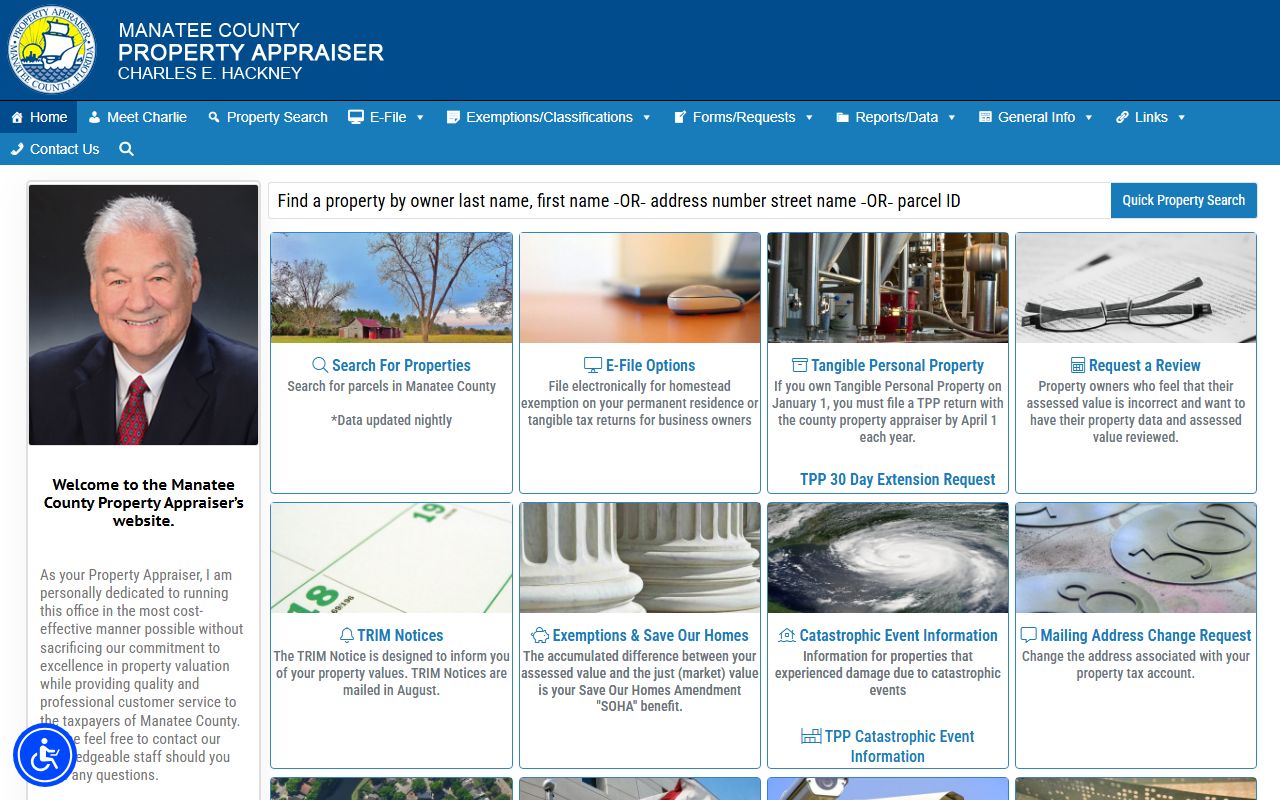
From the homepage you can access the property search tool, exemption applications, GIS maps, tax estimator, and links to the Manatee County Tax Collector. The site is free to use and available at all hours.
For in-person help, visit 915 4th Avenue W in Bradenton during business hours. Staff can assist with property searches, explain your assessment, and help you apply for exemptions. You can also email info@manateepao.gov with questions. If you need recorded deeds or mortgages, those are at the Manatee County Clerk of Court, also in Bradenton.
What Manatee County Property Records Show
A Manatee County property record is a public document that shows a complete summary of a parcel's key data. You will see the parcel ID, the legal description, the current owner's name and mailing address, and the date the owner acquired the property. The record breaks out just value, assessed value, and taxable value separately, so you can see exactly how exemptions affect what you owe in taxes.
For residential properties, the record includes the year built, the number of bedrooms and bathrooms, the square footage of living area, the construction type, and the roof type. Improvement value and land value are shown separately. For commercial or investment properties, the record may include building class, number of units, and other relevant data. Agricultural parcels show any special land classification and the assessed value that results from that classification.
Sales history for every parcel is part of the public record under Chapter 119. You can see the full transfer history with dates, prices, and the type of deed used in each transaction. The assessment methodology the appraiser uses to set values from market data is governed by Chapter 193.
Homestead Exemption in Manatee County
Florida homeowners can significantly reduce their property tax bill through the Homestead Exemption. Here is what the exemption provides in Manatee County. A reduction of up to $50,000 in taxable value for eligible homeowners. Additional savings for seniors, disabled persons, and veterans through specialized exemptions. Portability of tax benefits when moving to a new home in Florida, under the Save Our Homes provision established in Section 193.155 of Florida law.
To qualify for the standard Homestead Exemption, you must own the property and use it as your primary Florida residence on January 1. File your application with the Manatee County Property Appraiser by March 1. Bring your Florida driver's license or ID with the property address, a recorded deed, and your Social Security number. The office will review your application and notify you of the outcome.
The Save Our Homes cap limits annual assessed value increases for homestead properties to 3% or the Consumer Price Index, whichever is lower. In a county like Manatee where property values have risen sharply, this cap can produce large savings over time. Long-term homeowners may find that their assessed value is substantially lower than the current market value of the home.
Portability lets you take that accumulated benefit with you when you move to another Florida home. Apply for portability at the same time you apply for the Homestead Exemption at your new property. The Manatee County Property Appraiser's office can calculate your estimated portability amount before you close on a new home.
Important Property Tax Dates in Manatee County
Knowing the key dates in the Manatee County property tax calendar helps you stay on top of your obligations and take advantage of available savings.
- January 1: Property value snapshot date. The appraiser assesses all Manatee County property as of this date each year.
- March 1: Homestead Exemption application deadline. Miss this date and you will wait another full year.
- April 1: Tangible Personal Property filing deadline for businesses. Late returns result in monthly penalties.
- August 1: TRIM Notices mailed to all Manatee County property owners.
- November: Tax bills mailed by the Manatee County Tax Collector. November payment earns a 4% discount.
- April 1: Taxes become delinquent. County can begin tax certificate sale process on unpaid balances.
Note: Exact mailing dates can shift by a few days from year to year. Always check your TRIM Notice and tax bill for the specific deadlines that apply to your parcel.
TRIM Notices and the Property Tax Process
Every August, Manatee County property owners receive a TRIM Notice. TRIM stands for Truth in Millage. This is not a bill, but an informational statement showing how proposed millage rates will affect your property taxes. The notice shows your assessed value, any exemptions, your taxable value, and the proposed tax from each taxing authority. Review it as soon as it arrives.
If your assessed value is higher than it should be, you have two options. First, call or visit the Property Appraiser's office for an informal review. This is the fastest route and often resolves the issue. Second, if the informal review does not help, file a petition with the Manatee County Value Adjustment Board before the deadline on your TRIM Notice. The VAB schedules a formal hearing where you present evidence supporting a lower value. An independent hearing officer reviews both sides and issues a recommendation.
Once the tax roll is certified, the Manatee County Tax Collector sends out actual tax bills around November 1. Pay in November for a 4% discount. December is 3%, January is 2%, and February is 1%. Taxes become delinquent on April 1. If left unpaid, the county sells tax certificates on the delinquent amounts, beginning a process that can ultimately lead to loss of the property.
Frequently Asked Questions About Manatee County Property Records
Many residents have the same questions when they start looking into Manatee County property records. Here are answers to a few of the most common ones.
How do I look up property tax records in Manatee County? Go to manateepao.gov and use the property search tool. You can search by owner name, address, or parcel ID. The results show assessed value, taxable value, exemptions, and sales history for any parcel in the county.
Where do I pay my Manatee County property taxes? Taxes are paid to the Manatee County Tax Collector, not the Property Appraiser. The Tax Collector has offices in Bradenton and may accept online payments as well. The Property Appraiser's website has a link to the Tax Collector's payment portal.
How do I apply for a homestead exemption? Visit or contact the Manatee County Property Appraiser's office at 915 4th Avenue W, Bradenton, FL 34205. The deadline is March 1. Bring your Florida ID, deed, and Social Security number. Online filing may also be available through the Property Appraiser's website.
How can I check who owns a property in Manatee County? Search by address at manateepao.gov. The property record shows the current owner of record and their mailing address. For historical ownership, you can also search the Manatee County Clerk of Court's recorded documents database.
The Property Appraiser's FAQ page provides additional answers to common questions about Manatee County property taxes and assessments.
The FAQ page covers common questions about how to search records, how exemptions work, how to appeal an assessment, and what the TRIM notice means for Manatee County property owners.
Official Records at the Manatee County Clerk
The Manatee County Clerk of Court records all official instruments affecting real property. Deeds, mortgages, liens, lis pendens, and other documents are indexed and kept as permanent public records. When a property sells in Manatee County, the deed is recorded here and that recording gives public notice of the ownership change. You can search these records to verify title, check for liens, or trace the ownership history of any parcel.
Chapter 28 of Florida law covers the Clerk's recording duties and the fees that apply. The Clerk's office has locations in Bradenton. Many recorded documents can be searched online through the Clerk's official records portal. Searching Clerk records for deeds and mortgages is separate from the Property Appraiser's assessment database, so you may need to use both sources to get a complete picture of a property.
Florida Department of Revenue Oversight
The Florida Department of Revenue monitors the Manatee County Property Appraiser and all other Florida county appraisers through its Property Tax Oversight program. The DOR reviews assessment practices each year and checks that values are within acceptable ranges of market levels. With Manatee County's real estate market seeing strong activity, the DOR review process helps ensure that assessments keep pace with market changes while still protecting homestead property owners through the Save Our Homes cap.
The DOR publishes a range of public resources including the statewide data portal, taxpayer guides, and the local officials directory. These tools are free at floridarevenue.com/property. The data portal includes county-level summaries for Manatee County that show total assessed value, exemption totals, and year-over-year changes in the tax roll.
Cities in Manatee County
Bradenton is the county seat and the largest city in Manatee County, with a population of roughly 60,000. Bradenton and other Manatee County communities do not currently meet the population threshold for a dedicated city property records page on this site. Property records for all Manatee County communities are available through the county-level Property Appraiser and Clerk offices in Bradenton.
Nearby Counties
Manatee County borders these Southwest Florida counties, each with their own property records offices.