
Tampa Property Records Lookup
Tampa property records are kept by the Hillsborough County Property Appraiser and the Hillsborough County Clerk of Court. If you need to search ownership, sales history, assessed values, or exemption status for any parcel inside Tampa city limits, this guide walks you through each official source and what you can access for free online.
Tampa Property Records Quick Facts
How Tampa Property Records Are Maintained
Tampa sits within Hillsborough County, and all property appraisal functions for parcels inside the city are handled at the county level. The Hillsborough County Property Appraiser (HCPA) maintains the parcel database, sets assessed values, and processes all exemption applications for Tampa properties.
The Property Appraiser is Bob Henriquez. The main office is at 601 E Kennedy Boulevard, Tampa, FL 33602. Phone is (813) 272-6100 and email is custserv@hcpafl.org. Office hours are Monday through Friday, 8 a.m. to 5 p.m., excluding holidays. The main website is hcpafl.org.
Under Chapter 193 of Florida Statutes, the Property Appraiser must assess all property at just value annually. For homesteaded properties, the Save Our Homes cap limits how much the assessed value can increase each year. The HCPA also conducts field inspections to keep property characteristics current in the database.
Recorded instruments like deeds and mortgages are the responsibility of the Hillsborough County Clerk of Court. The Clerk maintains the Official Records under Chapter 28 of Florida Statutes. You will need to use both the Property Appraiser and the Clerk to get a complete picture of any parcel's status.
How to Search Tampa Property Records
The Hillsborough County Property Appraiser's search tool at hcpafl.org is the main free resource. You can search by owner name, property address, or parcel ID number. The HCPA also launched a mobile-friendly version of its website so you can look up records on your phone without a separate app.
The screenshot below shows the HCPA homepage, which is where you start all property searches for Tampa parcels.
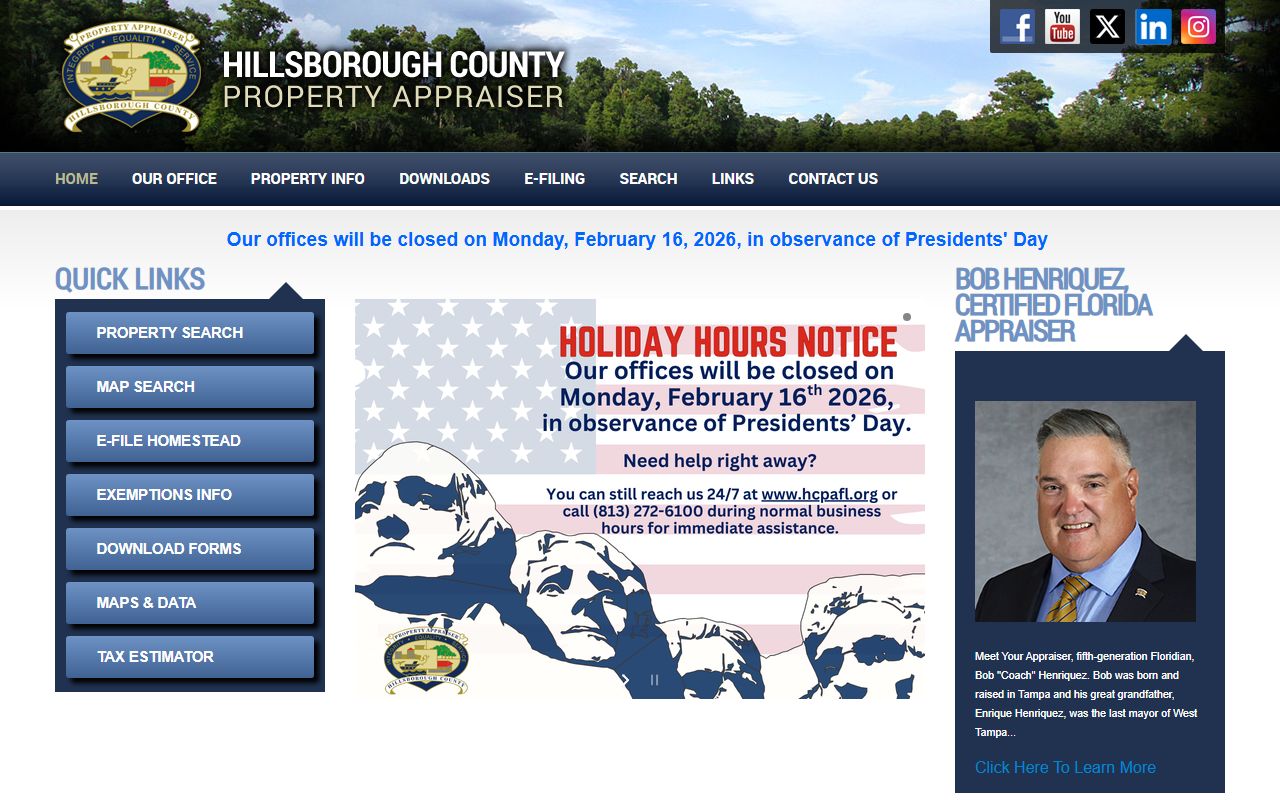
The search interface lets you enter a partial address, last name only, or full parcel ID. Results load quickly and each result links directly to the full parcel detail page.
When you open a parcel record on the HCPA site, you will see the owner's name and mailing address, a parcel map, land and building data, all assessed values for the current year, and the complete sales history. Sales history shows the date of each transfer, the sale price, and the instrument type (warranty deed, quitclaim deed, etc.).
For recorded documents, search the Hillsborough County Clerk's Official Records system at hillsclerk.com. You can search by grantor or grantee name, book and page, or document type. Many documents are available as free PDFs. Certified copies require a fee per page under Chapter 119.
Property tax payment status is available through the Hillsborough County Tax Collector at hctc.net. You can verify whether taxes are current, view payment history, and find the amount owed for any parcel by using the parcel ID number from the HCPA search results.
What Tampa Property Records Show
A parcel record from the Hillsborough County Property Appraiser includes all the core data you need for due diligence on a Tampa property. Here is what the record typically contains:
- Owner of record and mailing address
- Parcel ID number (unique to each property)
- Legal description as recorded in the deed
- Land use classification
- Lot size in square feet
- Building square footage, year built, and construction type
- Just (market) value as of January 1
- Assessed value (may be lower than just value due to Save Our Homes cap)
- Taxable value after exemptions
- Exemptions on file (homestead, senior, veteran, disability)
- Full sales history with dates, prices, and deed types
The gap between just value and assessed value can be large for long-time Tampa homeowners. This matters to buyers because when a property transfers, the Save Our Homes cap resets. The new owner's assessed value will jump to just value in the first year, which means a higher tax bill than what the previous owner paid.
Homestead Exemption for Tampa Residents
Tampa homeowners who occupy their property as a primary residence on January 1 of the tax year can apply for the homestead exemption. The exemption reduces taxable value by up to $50,000. The deadline to apply is March 1 each year.
Applications are filed with the Hillsborough County Property Appraiser. You can apply online at hcpafl.org or visit the office at 601 E Kennedy Boulevard. You will need proof of Florida residency such as a Florida driver's license or voter registration, plus proof of ownership. First-time filers need to bring documentation. Renewals are automatic as long as you still qualify.
The Save Our Homes cap comes into effect after your first year of homestead. It limits assessed value increases to 3% or the rate of change in the Consumer Price Index, whichever is less. For long-term Tampa residents, this benefit can mean the assessed value is tens of thousands of dollars below market value.
Portability lets you transfer your accumulated Save Our Homes savings to a new homestead in Florida. You must apply for portability at the same time you apply for a new homestead, by the March 1 deadline. The HCPA staff can answer questions about portability calculations at (813) 272-6100 or custserv@hcpafl.org. Other exemptions offered in Hillsborough County include additional homestead for low-income seniors, a $500 widow/widower exemption, veteran exemptions, and exemptions for totally and permanently disabled persons.
City of Tampa Resources
The City of Tampa's Planning and Development Department handles zoning, land use, and permitting. The screenshot below shows the planning portal where you can research land use regulations for Tampa parcels.

Zoning determines what uses are allowed on a parcel and what can be built. If you are researching a property for redevelopment or want to know what your neighbors can do with their lot, the Planning Department is the right place to ask.
Tampa City Hall is at 306 E Jackson Street, Tampa, FL 33602. The general city number is 813-274-8211. The city website is tampa.gov.
The Construction Services Department handles building permits and inspections. The office is at 1400 N Boulevard, Tampa, FL 33607, phone 813-274-3100. Permits can be searched online at tampa.gov/departments/construction-services. Permit records are public and show what work was done, when permits were pulled, and whether final inspections were passed. This is useful research before buying or renovating a property in Tampa.
Official Records at the Hillsborough County Clerk
The Hillsborough County Clerk of Court maintains the Official Records for all documents recorded in the county. Under Chapter 28 of Florida Statutes, the Clerk records and indexes deeds, mortgages, liens, plats, and other property instruments. These records establish the chain of title and identify any encumbrances on a property.
Common document types in the Hillsborough Official Records:
- Warranty deeds and special warranty deeds
- Quitclaim deeds
- Mortgages and satisfactions of mortgage
- Mechanic's liens and releases
- Judgment liens
- Lis pendens
- Plats and subdivision maps
The HCPA also notes that a Property Fraud Alert service is available in Hillsborough County. This free service lets you register names and receive alerts whenever a document is recorded in the Official Records under those names. It is a useful way to catch any unauthorized deed transfer or fraudulent lien on your property before it causes serious problems.
TRIM Notice and Property Tax Timeline
Hillsborough County sends TRIM notices to all property owners each August. The Truth in Millage notice shows your proposed assessed value, exemptions on file, and the proposed tax rates from each taxing authority that levies on your parcel. The notice is not a bill. It is a preview of what your November tax bill will likely look like.
If your assessed value seems too high, you have 25 days from the TRIM notice date to file a petition with the Hillsborough County Value Adjustment Board. The VAB hears evidence from property owners and makes independent decisions on value and exemption disputes. You do not need an attorney to file, though licensed tax agents can represent you.
After September hearings, final millage rates are set and tax bills go out in November. The discount schedule is: 4% for November payment, 3% for December, 2% for January, 1% for February. Taxes not paid by March 31 become delinquent. Under Chapter 192, the county then holds a tax certificate sale in May to collect unpaid taxes.
Nearby Cities
Tampa is the largest city in the Tampa Bay area. Several other qualifying cities are nearby in Pinellas and Hillsborough Counties.