
Orange County Property Records Search
Orange County property records are managed by the Orange County Property Appraiser, Amy Mercado, at 200 S. Orange Avenue in Orlando. The office covers all parcels in one of Florida's most populous counties, and you can search ownership data, assessed values, exemptions, and sales history at no cost through the public portal at ocpaweb.ocpafl.org. The main office phone is 407-836-5044.
Orange County Property Records Quick Facts
Orange County Property Appraiser Office and Contacts
The Orange County Property Appraiser's office is at 200 S. Orange Avenue, Suite 1700, Orlando, FL 32801. Property Appraiser Amy Mercado leads the office and its staff, who handle assessment, exemptions, tangible personal property, mapping, and GIS functions for the entire county. The main number is 407-836-5044. Specialized divisions have direct lines: Residential Assessment at 407-836-5205, Commercial Assessment at 407-836-5404, Tangible Personal Property at 407-836-5049, Mapping at 407-836-5411, IT and GIS at 407-836-5037, and Constituent Services and Exemptions at 407-836-5044. The office fax is 407-836-5029. Technical and website questions can be sent to helpdesk@ocpafl.org.
Orange County is one of the largest property tax rolls in Florida. The county encompasses Orlando and many surrounding communities, ranging from established neighborhoods near downtown to new master-planned communities and resort-area developments near Walt Disney World and the International Drive corridor. Managing assessment across this varied landscape requires a large and specialized staff, which is why the appraiser's office maintains separate divisions for residential, commercial, agricultural, and tangible personal property assessments.
The appraiser's main website at ocpaweb.ocpafl.org provides the full public record search, and a dedicated exemptions portal is at exemption.ocpafl.org for homestead and other exemption applications. Both are free to use and do not require an account or registration.
The Orange County Property Appraiser website is the primary public portal for searching Orange County property records, viewing assessment data, and accessing exemption information.
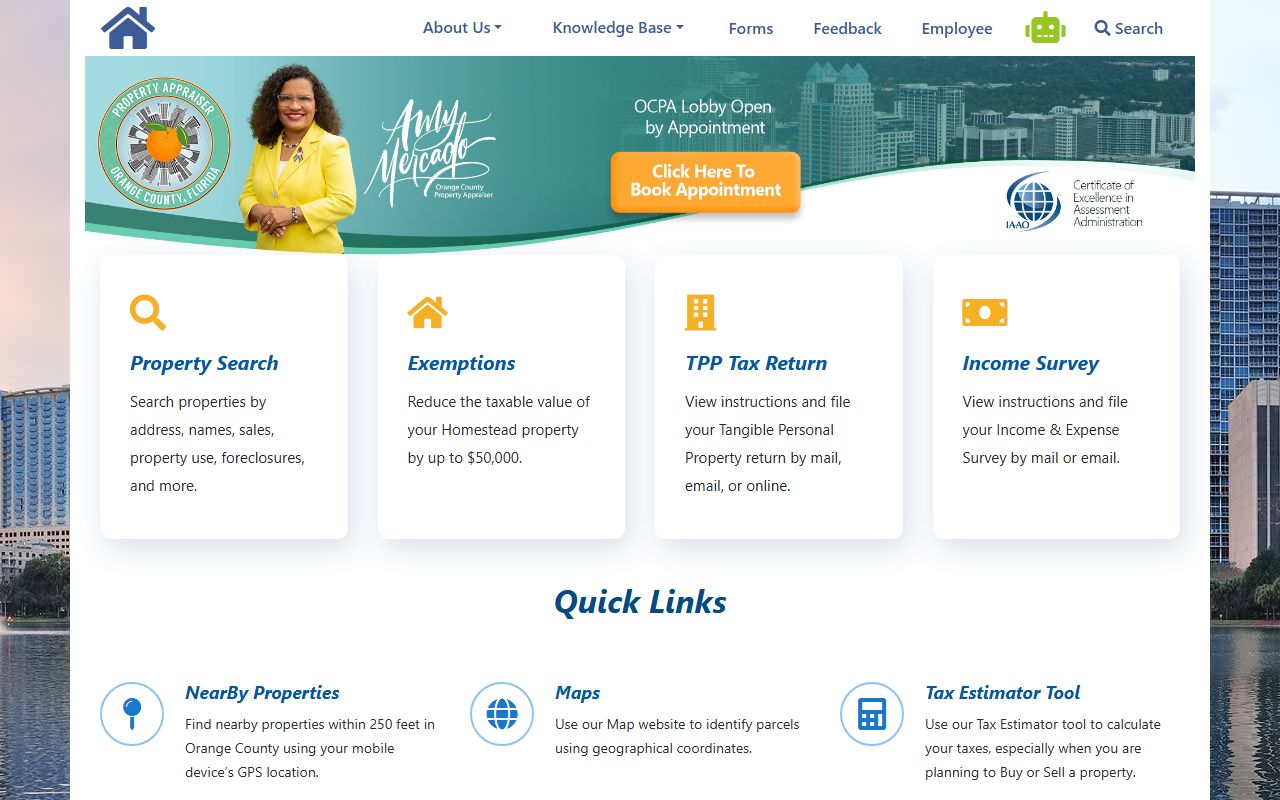
The portal allows parcel searches by owner name, parcel ID, or address, and returns detailed records including ownership, valuation, exemptions, and sales history for every parcel in the county.
Note: The Property Appraiser does not send tax bills or collect taxes. Contact the Orange County Tax Collector for billing and payment questions.
How to Search Orange County Property Records Online
The Orange County Property Appraiser's public search tool at ocpaweb.ocpafl.org is the fastest way to find any parcel record in the county. You can search by owner name, parcel identification number, or street address. Results show the current owner, mailing address, legal description, land use code, just value, assessed value, taxable value, and all exemptions. The sales history section of each record shows prior transfers with dates, prices, deed types, and official records references.
Orange County also offers a GIS map interface that lets you search visually by clicking on a map location. This is useful when you know roughly where a property is but do not have a specific address or parcel number. The mapping tool is connected to the same parcel database, so clicking a parcel on the map pulls up the full record.
For homestead exemption applications and renewals, use the dedicated portal at exemption.ocpafl.org. This site guides you through the application process and lets you check the status of a filed application. Filing online is generally faster than mailing a paper form.
The Orange County Homestead Exemption portal lets property owners apply for homestead and other exemptions online, check application status, and view which exemptions are currently active on their parcel.
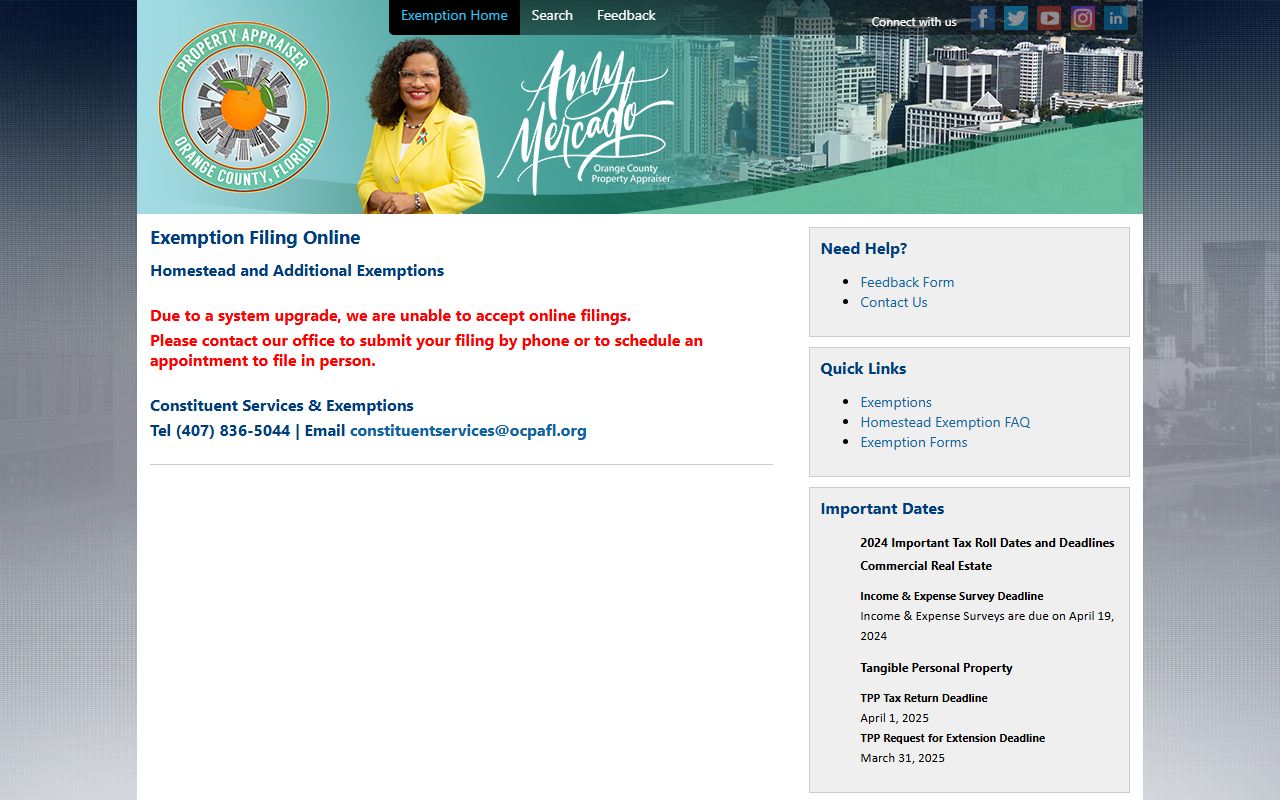
The online exemption portal simplifies filing and helps applicants confirm their exemption is on file well before the March 1 deadline.
What Orange County Property Records Contain
An Orange County parcel record includes the owner name, mailing address, property situs address, legal description, parcel ID, and land use classification. Valuation fields show just value (market value), assessed value with any Save Our Homes cap applied, and taxable value after all exemptions. Any active exemptions, such as homestead, agricultural classification, senior citizen, veteran, or disability exemptions, appear on the record.
Residential records show detailed building characteristics: year built, heated area in square feet, number of bedrooms and baths, garage and pool status, construction type, roof material, and heating and cooling systems. These details come from permit data and periodic field inspections. Orange County's rapid growth means a large number of parcels have recent construction dates, and the appraiser's records reflect additions, renovations, and new builds as they are completed and permitted.
Commercial records in Orange County cover a wide range of property types. Hotels and resorts near the theme park corridor, office buildings downtown, retail centers throughout the suburbs, and industrial facilities near the airport all have detailed records showing building class, gross area, occupancy, and income data where applicable. Commercial assessment in Orange County uses income-based approaches for income-producing properties in addition to the cost and sales comparison methods used for other property types.
Condominium records show the unit number, the complex name, the building the unit is in, and the percentage interest the unit holds in the common elements. Orange County has a large condominium inventory that includes everything from resort timeshare units to urban high-rises and suburban condo communities. Each unit is assessed individually based on its size, floor level, and comparable sales within the project.
Sales history data shows every recorded transfer for each parcel, linked to the official records instrument filed with the Orange County Clerk. The history is useful for understanding how a property's value has changed over time and for comparing recent sale prices to current assessed values.
Homestead Exemption and Save Our Homes in Orange County
Orange County property owners who own and occupy their home as a primary residence on January 1 of the tax year can apply for the homestead exemption. The exemption reduces assessed value by up to $50,000. The first $25,000 applies to all tax levies. The second $25,000 applies to all levies except school taxes. Applications must be filed with the Orange County Property Appraiser by March 1. You can apply online at exemption.ocpafl.org or in person at the main office on S. Orange Avenue.
Once you have the homestead exemption, the Save Our Homes cap limits your assessed value from rising more than 3% per year (or the inflation rate, whichever is lower). Orange County has seen strong home price appreciation in recent years, particularly in areas like Winter Park, Dr. Phillips, and the communities near the major employment centers. Long-term homeowners with the cap in place have seen substantial gaps open between their assessed value and the current market value of their home, resulting in lower tax bills than new buyers in the same neighborhood.
Portability lets you carry your accumulated Save Our Homes benefit to a new Florida home when you move. You apply for portability at the same time you file for homestead on the new property. The Orange County Property Appraiser's Constituent Services and Exemptions division can help you calculate your portability benefit and complete the required forms. The phone number for that division is 407-836-5044, which is the same as the main office line.
Other exemptions available in Orange County include the senior citizen low-income exemption (additional $25,000 off taxable value for qualifying seniors), the veteran's exemption for service-connected disabilities, the first responder total and permanent disability exemption, the widow and widower exemption, and exemptions for other disabilities. Each has specific requirements. The exemption portal at exemption.ocpafl.org lists all available programs and the documentation needed.
Note: Exemption applications for the current tax year must be received by March 1. Late applications are generally not accepted except in cases of extenuating circumstances approved by the Value Adjustment Board.
TRIM Notices and Property Tax Process in Orange County
Each August, Orange County property owners receive a Truth in Millage (TRIM) notice. This notice is not a tax bill; it shows the proposed assessed value for the parcel, all active exemptions, and the proposed tax rates from every taxing authority that covers the property. Orange County has multiple taxing bodies: the county commission, Orange County Public Schools, various municipal governments (Orlando, Apopka, Maitland, Ocoee, Winter Garden, Winter Park, and others), and multiple special districts including the South Florida Water Management District and various fire and lighting districts.
Read your TRIM notice carefully when it arrives. Compare the proposed assessed value to what you think the property would sell for in the current market. If it seems too high, call the appraiser's office to discuss it. An informal conference with staff can often resolve simple errors quickly. If the informal review does not satisfy you, file a formal petition with the Orange County Value Adjustment Board within 25 days of the TRIM mailing date. The VAB process gives you the right to present evidence at a hearing before a special magistrate.
After all taxing authorities adopt final millage rates, the Orange County Tax Collector mails actual tax bills in November. Early payment earns a discount: 4% in November, 3% in December, 2% in January, and 1% in February. The full amount is due by March 31. Properties with unpaid balances after that date become delinquent and may eventually be subject to a tax certificate sale.
Official Records at the Orange County Clerk and State Law
The Orange County Clerk of Courts records all legal instruments that affect real property in the county, including deeds, mortgages, satisfactions, easements, and liens. These official records are maintained under Chapter 28, Florida Statutes. All recorded documents are public records and most are searchable online through the Orange County Comptroller's official records system. You can search by name, document type, or recording date.
Property assessment follows Chapter 192 and Chapter 193, Florida Statutes. These chapters define just value, set assessment methodology rules for different property classes, and establish the process for annual tax roll certification. The Florida Department of Revenue reviews Orange County's tax roll each year and provides oversight to ensure all assessments meet state standards.
Public access to Orange County property records is guaranteed by Chapter 119, Florida Statutes, Florida's Public Records Law. Any person can request inspection or copies of records held by the appraiser or clerk. The law requires a prompt response and limits fees to the actual cost of duplication. Most records are available online at no cost.
Cities in Orange County
Orange County includes multiple cities and municipalities. Orlando is the county seat and the largest city, with a population well above the 100,000 threshold for a dedicated page on this site.
Other communities in Orange County, including Apopka, Winter Garden, Ocoee, Winter Park, Maitland, and Edgewood, fall below the 100,000 threshold and do not have dedicated city pages on this site. Property records for all Orange County communities are available through the countywide search at ocpaweb.ocpafl.org.
Nearby Counties
Orange County sits in central Florida and borders five counties. Each has its own property appraiser and public records system.