
Search Sarasota County Property Records
Sarasota County property records are managed by the Property Appraiser's office and are available online through the official search portal. Whether you need ownership history, current assessed value, exemption status, or sales data, this guide covers the tools, offices, and laws that govern public property records in Sarasota County, Florida.
Sarasota County Property Records Quick Facts
Sarasota County Property Appraiser
Bill Furst is the elected Property Appraiser for Sarasota County. The office operates under a legal charge from the Florida Constitution to establish the fair, legal, and just value of real property in the county. The Sarasota County Property Appraiser is an independent, constitutional officer. That means the office does not report to the County Commission and does not set tax rates.
The main office is in downtown Sarasota. A South County office in Venice serves residents in the southern part of the county. The official website is sc-pa.com, where you can access the full property database, file for exemptions, and review appraisal information. Both offices accept walk-in visits and phone calls during regular business hours.
The Clerk of the Circuit Court handles recorded documents such as deeds, mortgages, and liens. Those records are separate from the appraiser's database but are equally public. If you need the full chain of title for a parcel, you will use both offices.
How to Search Property Records Online
The Sarasota County Property Appraiser's official website provides multiple ways to search property records. Each method caters to different needs depending on the information you already have.
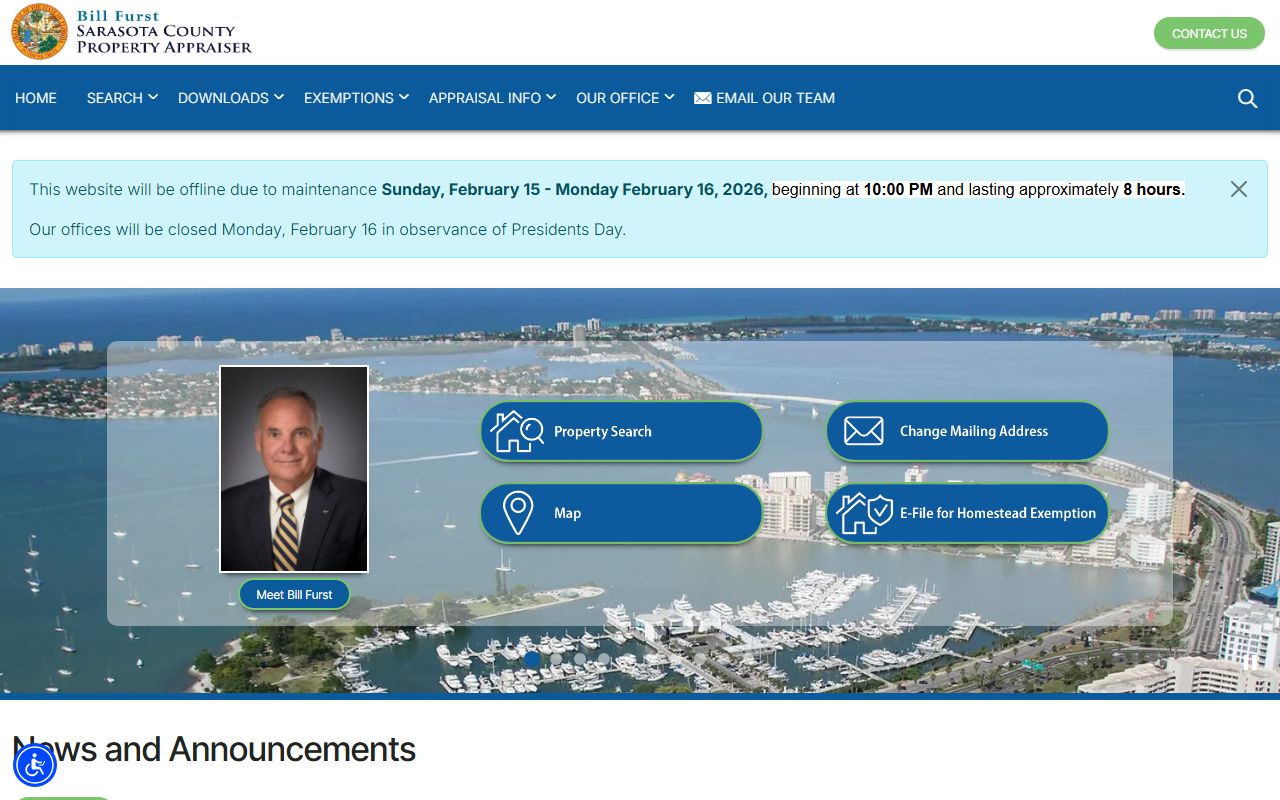
You can search by owner name, by parcel number, or by property address. The name search works well if you know who owns a property but not the address. The parcel number search is the most direct route if you have the ID from a tax notice or deed. Address search is good for quick lookups on a specific street.
Search results display the parcel's ownership history, legal description, lot size, building square footage, year built, and a full breakdown of assessed and taxable values going back several years. Exemptions on file for the property are also listed. This single search page gives you most of what you need without making a formal records request.
Parcel Viewer and GIS Maps
The Geographic Information System (GIS) maps allow users to view properties visually on an interactive map. You can click on any parcel in Sarasota County to pull up its basic record, see the parcel boundaries, and view aerial imagery. The map layers include flood zones, zoning overlays, and other planning data that affect property use and value.
GIS tools are especially helpful when you are comparing neighboring properties, checking lot boundaries, or trying to understand how a parcel relates to surrounding land use. The map viewer is free and does not require an account. You can zoom down to street level and switch between satellite and base map views.
Land use information is also included in the property appraiser's database. The records contain land use and zoning details that show how a parcel is classified, whether it is residential, commercial, agricultural, or another category. These classifications affect both the appraisal method and any exemptions that may apply.
Sales History and Market Value
Users can review a property's sales history, including dates of past transactions, selling prices, and ownership changes. This data helps you understand what a property has sold for over time and gives context to the current assessed value. The office uses recent arm's-length sales to calibrate market values across neighborhoods.
State law dictates that property is assessed in its condition on January 1. There is no allowance for the office to prorate for events that take place during the year. If a house burns down on February 1, the assessment for that year is still based on the January 1 condition. Likewise, if you complete an addition in October, it does not appear in the roll until the following year.
Property values are reassessed annually based on the market value as of January 1. Changes can occur due to fluctuations in the real estate market, property improvements such as new construction, remodeling, or additions, or changes in exemptions and land use classifications. A big jump in your assessed value from one year to the next usually reflects one of these factors.
Appraisal Process
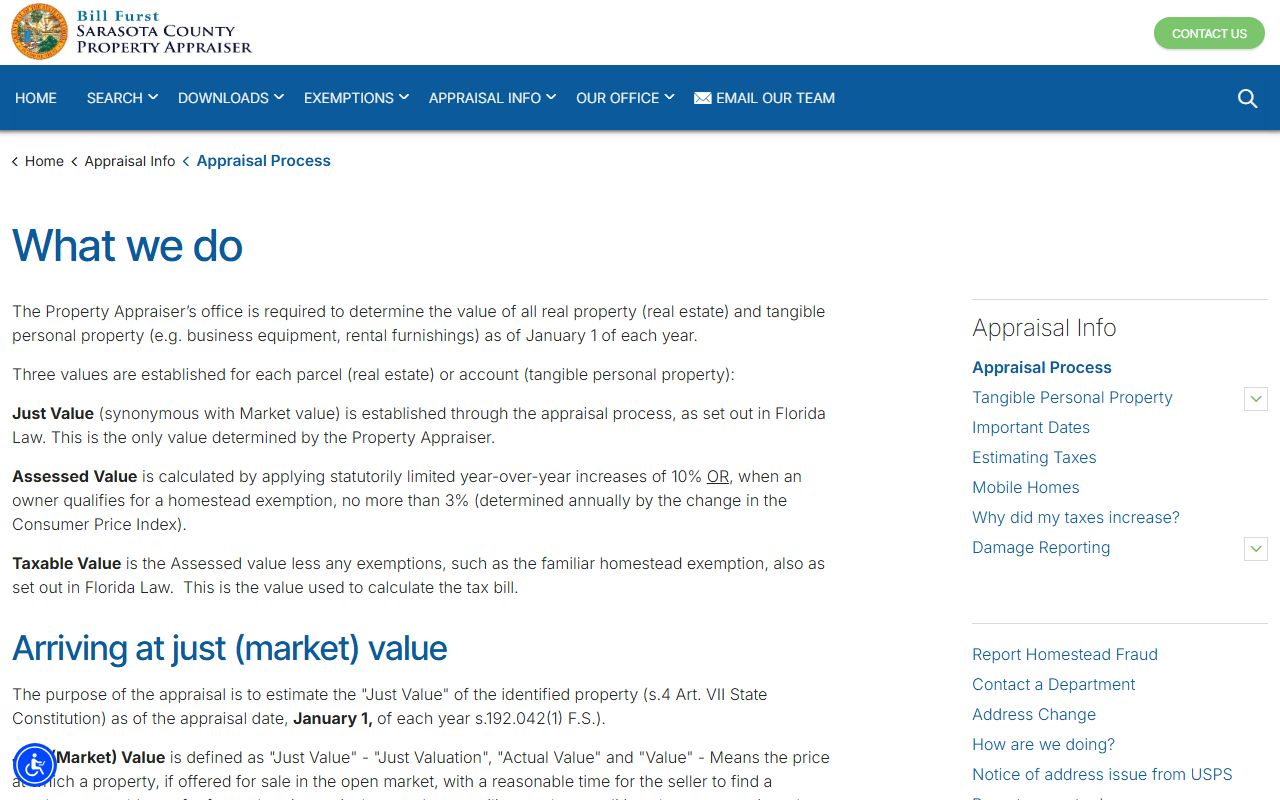
The appraisal process in Sarasota County follows state law and standard appraisal methodology. The office uses three approaches to value: the sales comparison approach, the income approach, and the cost approach. Residential properties are typically valued using sales comparison, while income-producing properties rely more on the income approach.
The office inspects properties on a rotating basis and also reviews permits pulled for improvements. A new permit for a room addition or pool, for example, will trigger a review of that parcel. The appraiser's field staff visits the property, measures the improvement, and updates the database. These updates affect assessed value starting the following January 1.
Full appraisal information, including details about how values are set and what data goes into the process, is available at sc-pa.com/appraisal-info. The page explains the legal standards the office must meet and how it handles different property types across the county.
Homestead Exemption and Other Exemptions
Florida homeowners who make their Sarasota County property their permanent residence may qualify for a Homestead Exemption. To apply, you must submit an application to the Property Appraiser's Office, either online through the official website or in person at one of the offices. Required documents typically include proof of residency, such as a Florida driver's license, voter registration, or utility bills. The filing deadline is March 1st each year.
The Homestead Exemption reduces assessed value by up to $50,000. The first $25,000 applies to all tax levies. The second $25,000 applies to assessed value between $50,000 and $75,000 and does not apply to school taxes. On a $200,000 home, this saves a meaningful amount each year depending on local millage rates.
Other exemptions in Sarasota County include senior low-income exemptions, veterans' exemptions, widow and widower exemptions, disability exemptions, and the agricultural classification for qualifying farmland. Each has its own set of income thresholds, documentation needs, and renewal requirements. The office can walk you through which programs fit your situation.
Save Our Homes and Portability
Florida's Save Our Homes amendment caps the annual increase in assessed value for homesteaded properties at 3% or the rate of inflation, whichever is lower. Over time, this creates a gap between market value and taxable value. In a rising market like Sarasota has seen in recent years, the SOH cap can mean big savings for long-time owners.
When you move, you can take that SOH benefit with you through portability. The accumulated difference between market value and assessed value transfers to your new Florida primary residence, up to $500,000. You apply for portability at the same time you apply for Homestead Exemption on the new property. The deadline is March 1.
If you disagree with the Property Appraiser's opinion of your property's value, you have the right to appeal. However, please call the office first. A quick review of the records, or a physical inspection, will often clear up any misunderstanding. Many issues are resolved without a formal hearing.
Legal Framework
Sarasota County property records and assessments are governed by several Florida statutes. Chapter 192 establishes the general framework for property taxation statewide. Chapter 193 sets out the assessment procedures and classification rules the Property Appraiser follows. Chapter 119, the Public Records Law, makes most of these records available to any member of the public on request.
The Clerk of the Circuit Court records deeds, mortgages, and liens under Chapter 28. These recorded instruments are public and are searchable through the Clerk's online database. Together with the Property Appraiser's records, they form a complete picture of any parcel's legal and valuation history.
Cities in Sarasota County
North Port is the largest city in Sarasota County and has a dedicated property records page. Other cities in the county include the city of Sarasota, Venice, and several smaller communities.
Nearby Counties
Sarasota County borders Charlotte to the south, DeSoto to the east, and Manatee to the north.