
Access Charlotte County Property Records
Charlotte County property records give buyers, sellers, researchers, and property owners access to ownership history, assessed values, exemption status, and deed filings for all real estate in this Southwest Florida county. The Charlotte County Property Appraiser maintains the assessment database from its main office in Port Charlotte, and the clerk of court holds all recorded instruments affecting title. Searching these records is an important step before any real estate decision in Charlotte County.
Charlotte County Property Records Quick Facts
Charlotte County Property Appraiser
The Charlotte County Property Appraiser's office is at 18500 Murdock Circle, Suite 200, Port Charlotte, FL 33948. The main phone number is 941-743-1392. The office website is at charlottecountyfl.gov, where you can find online search tools, exemption information, contact details, and downloadable forms.
Charlotte County sits on Florida's Gulf Coast south of Sarasota and north of Lee County. The county encompasses Port Charlotte, Punta Gorda, and a large area of residential developments, waterways, and rural land. Many of the county's residential parcels are in the Port Charlotte and Deep Creek areas, where planned community development in past decades created thousands of platted lots, many of which remain vacant. The property appraiser tracks all of these parcels, improved and unimproved alike, under the requirements of Florida Statutes Chapter 193.
Charlotte County has a significant retiree population and a large number of seasonal and part-time residents. This affects both the homestead exemption caseload and the mix of ownership types the appraiser's office processes each year. Many properties in the county are held by out-of-state owners or trusts, which means the mailing addresses on file often differ from the property addresses.
The Florida Department of Revenue maintains a statewide taxpayer resource at floridarevenue.com that covers the basics of Florida property tax and is useful context for Charlotte County owners navigating the system for the first time.
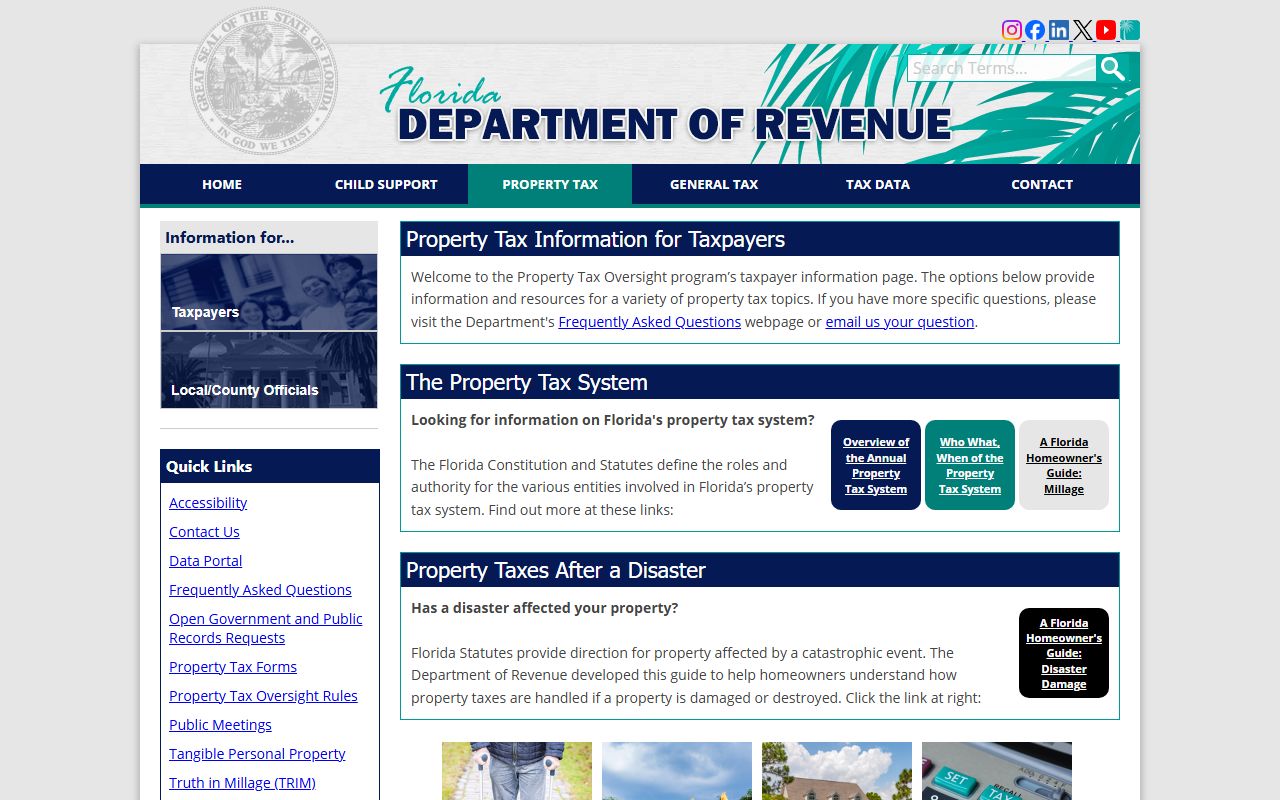
The Florida DOR taxpayer page covers assessment, exemptions, TRIM notices, and appeals in terms that apply to Charlotte County property owners and all others across the state.
How to Search Charlotte County Property Records
The Charlotte County Property Appraiser website at charlottecountyfl.gov provides online access to parcel records. You can search by owner name, property address, or parcel identification number. Results show current ownership, assessed value, tax data, exemptions, and sales history. The online tool works well for current-year lookups and most routine research needs.
For in-person searches, the main office at 18500 Murdock Circle in Port Charlotte is the place to go. Call 941-743-1392 before visiting to confirm hours and to find out if the records you need are available online or require staff assistance. For older records and complex parcel histories, in-person searches with staff assistance are often faster than trying to reconstruct a record from the online system alone.
Deed records, mortgages, and all other instruments affecting title to Charlotte County property are maintained at the Charlotte County Clerk of Circuit Court. These records are public under Florida's Chapter 119 Public Records Law, and the clerk's recording and indexing duties are established by Chapter 28. The clerk's office is in Punta Gorda, the county seat.
Charlotte County has a large volume of vacant lots that were sold as part of earlier planned community developments, and some of those lots have complex title histories involving multiple deed types, easements, and platted restrictions. Searching both the appraiser's database and the clerk's recorded instruments is advisable before purchasing any of these parcels.
Note: The Florida Department of Revenue's local officials directory at floridarevenue.com lists contact information for the Charlotte County property appraiser and other local officials in case you need to verify current contact details.
What Charlotte County Property Records Show
A Charlotte County property record from the appraiser's database covers the standard Florida property data set. The parcel summary shows the owner's name and mailing address, the property address, the parcel number, and the legal description. For platted lots in Charlotte County's many subdivisions, the legal description references the plat book and page where the subdivision was recorded.
The value summary shows three key numbers: just value (market value), assessed value (after any applicable cap or classification), and taxable value (after exemptions). For homestead properties that have been owned for many years, assessed value may be well below market value because the Save Our Homes cap has prevented full increases from flowing through to the tax roll. For recently purchased properties, assessed and market values are usually close to each other in the first year after sale.
Charlotte County has a significant number of canal-front and waterway-adjacent properties, and the records for these parcels often include water frontage dimensions and dock or seawall features as extra feature entries. Unimproved lots show land area, zoning, and use classification without building or extra feature data. All parcel types appear on the tax roll under Chapter 192 requirements, whether improved or not.
Homestead Exemption in Charlotte County
Florida's homestead exemption is available to Charlotte County owners who live in their property as their permanent primary residence. The exemption reduces taxable value by up to $50,000: the first $25,000 applies against all taxes, and the second $25,000 (for values between $50,000 and $75,000) applies only to non-school taxes.
To apply, visit the property appraiser's office at 18500 Murdock Circle in Port Charlotte or check the county website for any online filing option. The deadline is March 1 each year. You need a Florida driver's license or ID showing the property address, proof of ownership, and your Social Security number. New homeowners who close near or after the March 1 deadline should still apply, as the exemption can sometimes be retroactively approved in qualifying circumstances.
The Save Our Homes cap under Florida Statutes Section 193.155 limits annual assessed value increases for homestead properties to 3% or the prior year's rate of inflation change, whichever is lower. For Charlotte County's retiree and snowbird communities, this cap can make a significant difference in annual tax liability for those who have owned their homes for a decade or more. Remember that the cap resets on sale, so new buyers take on the full market-based assessment starting with their first tax year of ownership.
Other exemptions available in Charlotte County include the additional senior exemption for residents aged 65 and older with limited income, the veteran's exemption, the surviving spouse exemption, the disability exemption, and the first responder exemption. Each has specific eligibility and documentation requirements. The appraiser's office at 941-743-1392 can tell you which ones may apply to your situation.
Charlotte County Property Tax Process
Charlotte County follows Florida's standard property tax calendar. By August 1, the property appraiser certifies the tax roll. TRIM notices go out in August showing proposed values and proposed millage rates from the county, school board, and all other taxing authorities that cover your parcel. Read your TRIM notice closely. It shows not just what you will likely pay but also when public hearings are scheduled where you can comment on the proposed rates.
If the proposed assessed value is higher than you believe is correct, you can contact the property appraiser's office first to discuss it. Informal corrections are made regularly when owners bring in solid evidence of error. If that doesn't resolve it, file a petition with the Charlotte County Value Adjustment Board. The VAB holds hearings before independent special magistrates who weigh the evidence from both sides. Petition deadlines are shown on the TRIM notice.
Tax bills come from the Charlotte County Tax Collector in November. Early payment saves money: 4% discount in November, 3% in December, 2% in January, 1% in February. Full payment without discount is due by March 31. Taxes not paid after that date become delinquent in April. The county sells tax certificates in June, and properties with unpaid certificates for two or more years can eventually be subject to a tax deed sale. The Florida DOR property tax FAQ explains each stage of this process in plain language.
Official Records at the Charlotte County Clerk
The Charlotte County Clerk of Circuit Court records, indexes, and maintains all instruments affecting real property in the county. Warranty deeds, quitclaim deeds, special warranty deeds, mortgages, satisfactions, assignments, mechanic's liens, judgment liens, and lis pendens filings all pass through the clerk's recording office. Each document is given a recording number and becomes part of the public record on the day it is recorded.
The recording and indexing process follows Chapter 28 requirements, and the resulting grantor-grantee index forms the basis for all title research in the county. Florida's Chapter 119 Public Records Law ensures these records are open to the public. The clerk's office is in the Punta Gorda courthouse. Copies can be obtained in person, by mail, or in some cases through the clerk's online system.
Charlotte County's property market has a large inventory of older deeds from decades of planned community development. Researching a parcel from the Port Charlotte area may involve tracing deeds through multiple corporate developers as well as individual owners. A title company or real estate attorney familiar with Charlotte County records can make this process faster and more reliable, especially for vacant lots where the chain of title may be less straightforward than for improved properties with recent sales.
Cities in Charlotte County
Charlotte County includes Punta Gorda as its only incorporated city. Punta Gorda is the county seat. Port Charlotte, the county's most populous community, is an unincorporated area. Neither Punta Gorda nor Port Charlotte meets the population threshold for a dedicated city page on this site.
Nearby Counties
Charlotte County borders several other Southwest Florida counties. Each has its own property records system maintained by an independently elected property appraiser and clerk of court.