
Suwannee County Property Records
Suwannee County property records are maintained by the Property Appraiser's office in Live Oak and are open to the public through the official website and in-person visits. Use this guide to find ownership data, assessed values, exemption status, and sales history for any parcel in this north-central Florida county.
Suwannee County Property Records Quick Facts
Suwannee County Property Appraiser
The Suwannee County Property Appraiser's office is at 215 Houston Avenue SW, Live Oak, FL 32064. The main phone number is 386-362-1385. The official website is suwanneepa.com, where you can search parcel records, view maps, and find information about exemptions and the assessment process. The Property Appraiser is an elected constitutional officer who operates independently from the Board of County Commissioners.
The office values all real and tangible personal property in Suwannee County as of January 1 each year. That value becomes the basis for property tax bills. The office does not set millage rates or collect taxes. The County Commission and school board set rates. The Tax Collector handles collection. The Property Appraiser's role is strictly valuation and exemption administration.
Suwannee County is a rural north Florida county with a mix of agricultural land, timberland, and residential properties. The real estate market here is less active than in major metro areas, but the Property Appraiser still reviews sales data, permits, and classifications regularly to keep assessments accurate under state law.
Searching Property Records Online
The Suwannee County Property Appraiser's website provides a parcel search tool. You can search by owner name, parcel ID, or property address. Results include ownership information, the property's legal description, land and building details, assessed values by year, and any exemptions on file. The system is free to use and requires no account or login.

GIS mapping tools are also available through the website. The interactive map lets you click on any parcel in the county to pull up its record. You can view parcel boundaries, switch between base map and aerial views, and use the map to find properties when you know a general location but not the exact address or parcel number.
Sales history appears in the parcel record for most transactions. You can see when the property last sold and for how much, going back several years. This gives useful context when reviewing the current assessed value or comparing a parcel to similar sales in the area.
For older records, recorded deeds, mortgages, and other instruments affecting title, you will need the Suwannee County Clerk of the Circuit Court. The Clerk's recording division maintains those documents as public records. The Clerk's office is also in Live Oak. Many older records have been digitized, but some historical documents may require an in-person visit.
Homestead Exemption and Save Our Homes
Florida's Homestead Exemption reduces the assessed value of a primary residence by up to $50,000. To qualify in Suwannee County, you must own the property and use it as your permanent home as of January 1. You also need a Florida driver's license or ID, Florida vehicle registration, and Florida voter registration listing the property address. Apply through the Property Appraiser's office by March 1 each year.
The first $25,000 of the Homestead Exemption reduces the assessed value for all tax levies. The second $25,000 applies to assessed value between $50,000 and $75,000 and does not reduce school taxes. The combined effect can be significant, especially at the millage rates in effect in Suwannee County.
Once Homestead Exemption is in place, the Save Our Homes cap limits how much your assessed value can rise each year. The cap is the lower of 3% or the Consumer Price Index inflation rate. This protection accumulates over time and can result in a taxable value well below the current market value if you have owned the home for many years. If you sell and buy another Florida home, you can transfer this benefit through portability, up to $500,000.
Agricultural Classification in Suwannee County
Agricultural classification, sometimes called the Greenbelt Law, is especially relevant in rural Suwannee County. Under this classification, qualifying farmland, ranchland, and timberland is assessed at its agricultural use value rather than market value. This can produce a very large reduction in taxable value for working agricultural properties.
To qualify, the land must be used for a bona fide agricultural purpose. This includes cattle grazing, crop production, timber operations, aquaculture, apiculture, and similar activities. The Property Appraiser reviews each application and may inspect the property. Simply leaving land idle does not qualify. You must demonstrate active agricultural use.
Applications for agricultural classification are due March 1. If you own rural land in Suwannee County and use it for farming or timber, contact the Property Appraiser's office at 386-362-1385 to ask about the application process and required documentation. Getting the classification right can significantly reduce your annual tax bill.
Other Exemptions Available
Beyond the standard Homestead Exemption, Suwannee County property owners may qualify for:
- Senior low-income exemption for qualifying residents age 65 and older
- Veterans' exemption for honorably discharged veterans with a service-connected disability
- Total and permanent disability exemption
- First Responder disability exemption
- Widow and widower exemption
- Tangible personal property exemption for qualifying businesses
Each exemption has its own qualification rules and documentation requirements. Some have income limits. The Property Appraiser's staff can help you determine which programs apply to your situation. Call 386-362-1385 or visit the office in Live Oak to learn more.
Contact the Florida Department of Revenue
The Florida Department of Revenue oversees property tax administration statewide and provides guidance and oversight for county Property Appraisers. If you have a complaint about how the Property Appraiser's office handled your case, or need state-level information, the DOR Property Tax Oversight program is the place to start.
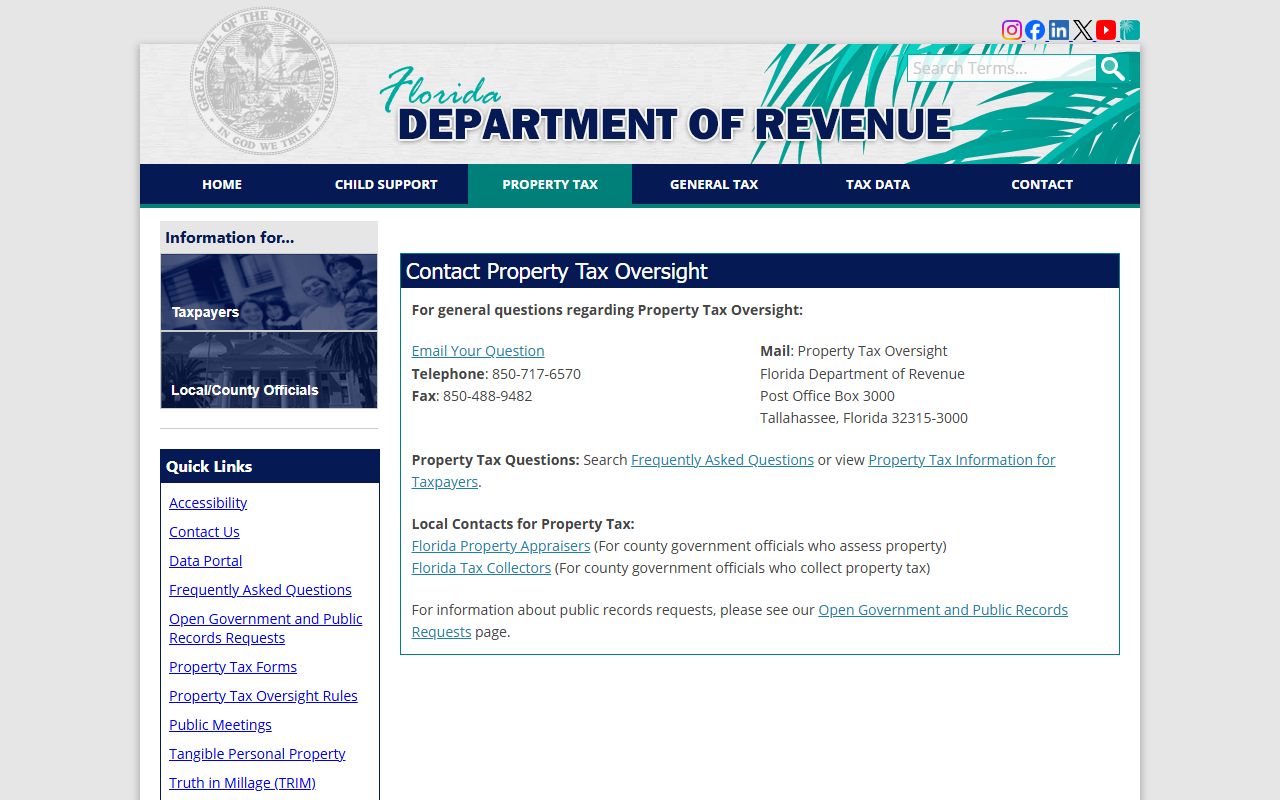
The DOR Property Tax Oversight division sets rules that all county Property Appraisers must follow. It reviews assessment rolls, handles certain appeals, and provides training and standards for county offices. Their contact page lists phone numbers, addresses, and email contacts for the state property tax team. This is also where you can reach the state if you believe a county office is not following proper procedures.
Appealing Your Assessment
If you believe the Suwannee County Property Appraiser has overvalued your property, start by calling the office at 386-362-1385 to request an informal review. An appraiser will look at your parcel and discuss the valuation with you. Bring any supporting evidence you have, such as recent comparable sales, an independent appraisal, or documentation of property defects. Many disputes end here.
If the informal review does not fix the problem, file a petition with the Suwannee County Value Adjustment Board. The deadline is on your TRIM notice, sent in August. The filing fee is $15. A special magistrate reviews the evidence and makes a recommendation. The board issues a final order after the hearing.
Circuit court is the final appeal option. This is a bigger commitment of time and money, and most cases are resolved before reaching that stage. But it is an available option for property owners who have a strong case and are willing to pursue it.
Legal Framework for Property Records
Suwannee County property records are governed by Florida Statutes. Chapter 192 sets out the general framework for property taxation. Chapter 193 covers assessment procedures and property classification rules. Chapter 119, the Public Records Law, ensures that most records held by the Property Appraiser and other government offices are open to any member of the public. Chapter 28 governs the Clerk of the Circuit Court's recording functions for deeds, mortgages, and other instruments.
Cities in Suwannee County
Suwannee County includes Live Oak, Branford, Wellborn, and several unincorporated communities. None of these communities currently meet the population threshold for a dedicated city records page. For property records in any Suwannee County city or rural area, use the county Property Appraiser's resources above.
Nearby Counties
Suwannee County borders Columbia to the east, Dixie to the south, Hamilton to the north, Lafayette to the west, Madison to the northwest, and Taylor to the southwest.