
Taylor County Property Records
Taylor County property records are managed by the Property Appraiser's office in Perry and are available to the public at no cost through the official website and in-person requests. This guide covers how to search ownership data, assessed values, exemptions, and sales history for any parcel in this north Florida Gulf Coast county.
Taylor County Property Records Quick Facts
Taylor County Property Appraiser
The Taylor County Property Appraiser's office is located at 108 N Jefferson Street, Perry, FL 32347. The main phone number is 850-838-3515. The official website is taylorpa.com, where you can search property records, view maps, and find information about exemptions and the assessment process. The Property Appraiser is a constitutional officer elected by county voters and operates independently from the county government.
The office determines the fair market value of all real and tangible personal property in Taylor County as of January 1 each year. That value is used to calculate property tax bills, which are sent by the Tax Collector. The Property Appraiser does not set tax rates and does not collect taxes. Those functions belong to the County Commission, school board, and other taxing authorities.
Taylor County is a rural Big Bend county bordering the Gulf of Mexico. Much of the land is timberland, farmland, or coastal wetland. The mix of rural parcels, coastal lots, and small-town residential properties creates a varied workload for the Property Appraiser's office. Agricultural classification and waterfront valuation are common issues for property owners in this county.
Searching Property Records Online
The Taylor County Property Appraiser's website allows you to search parcels by owner name, parcel identification number, or property address. Search results show current ownership information, the legal description, land and building details, assessed values going back several years, and any exemptions on file.
The office also maintains a GIS map viewer that lets you browse the county parcel by parcel on an interactive map. This is useful when you are researching a property by location rather than by owner name or parcel number. You can click on any parcel to see basic record information and parcel boundaries.
Sales history is part of the parcel record for most properties. You can view past transactions, including dates and sale prices, for arm's-length sales. This data helps explain the current assessed value and lets you compare a property against similar recent sales in the area.
For recorded instruments such as deeds, mortgages, liens, and easements, you will need the Taylor County Clerk of the Circuit Court. The Clerk's recording division handles these documents and makes them available as public records. Older records may require an in-person visit to the Clerk's office in Perry.
Florida Statutes and Property Law
Taylor County property records and assessments are governed by the Florida Statutes. The Legislature's official website provides access to the full text of all current statutes, including those that cover property assessment, exemptions, and public records.
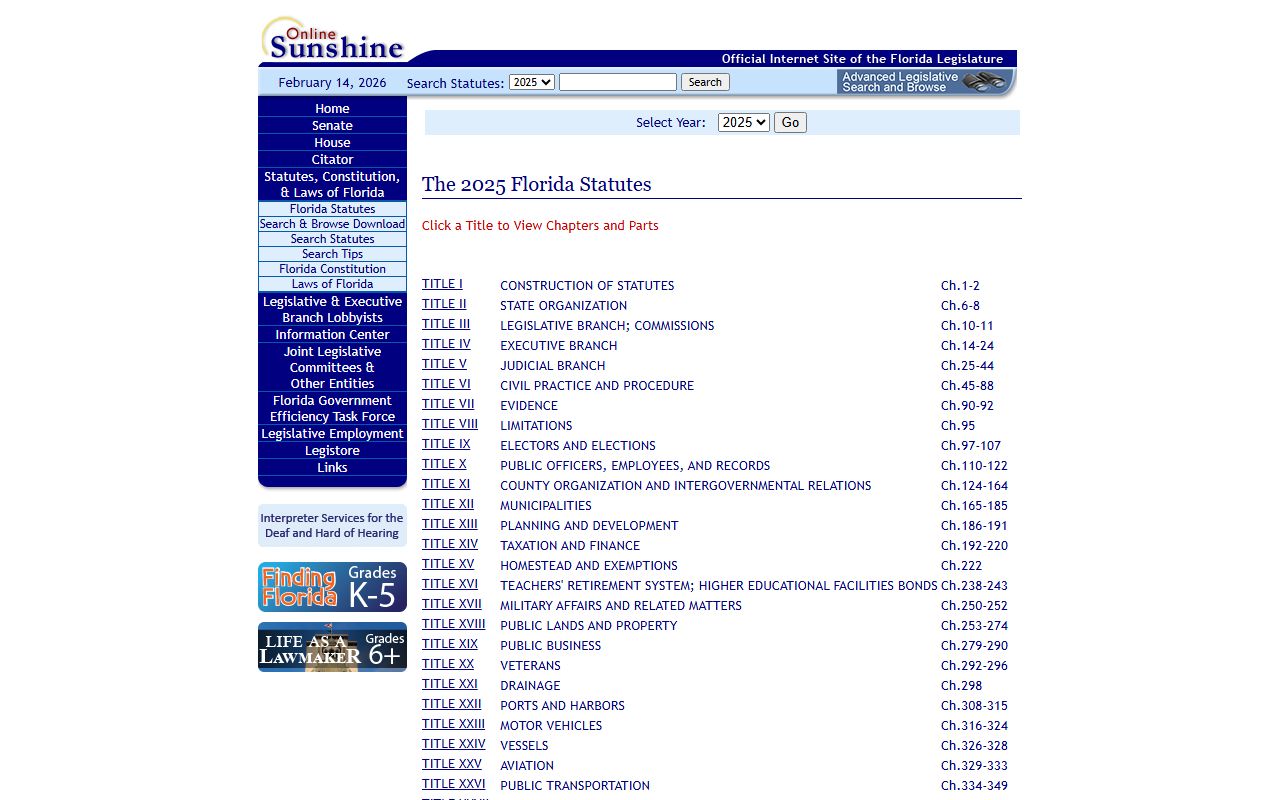
Chapter 192 sets out the general framework for property taxation in Florida. Chapter 193 covers assessment procedures in detail, including how property is classified and valued. Chapter 119 is Florida's Public Records Law, which makes most government records available to any member of the public. Chapter 28 covers the recording functions of the Clerk of the Circuit Court. These four chapters cover most of what you need to know about how property records are created, maintained, and accessed in Taylor County.
Homestead Exemption
Florida's Homestead Exemption reduces the assessed value of a primary residence by up to $50,000. Taylor County property owners who use their home as their permanent residence as of January 1 can apply at the Property Appraiser's office. The deadline is March 1 each year. You will need a Florida driver's license or ID, Florida vehicle registration, and Florida voter registration, all showing the property address.
The first $25,000 of the exemption reduces assessed value for all tax levies. The second $25,000 applies only to value between $50,000 and $75,000, and it does not reduce school taxes. The combined effect lowers your taxable value and reduces the tax bill from all applicable taxing authorities.
The Homestead Exemption also activates Florida's Save Our Homes cap. After the exemption is in place, your assessed value cannot rise more than 3% per year or the inflation rate, whichever is lower. Over time, this creates a gap between market value and taxable value that protects long-time homeowners from large tax increases in rising markets. If you move to a new Florida home, portability lets you transfer this benefit to the new property, up to $500,000.
Agricultural Classification
Agricultural classification is widely used in Taylor County given the large amount of working farmland and timberland. Under Florida's Greenbelt Law, qualifying agricultural land is assessed at its use value rather than market value. The difference can be enormous for large rural tracts where market value far exceeds agricultural productivity value.
To get the classification, the land must be used for a bona fide agricultural purpose. This includes cattle operations, timber production, row crop farming, aquaculture, and similar activities. The Property Appraiser reviews applications and may inspect the property. Idle land does not qualify. You need evidence of active agricultural use.
Apply for agricultural classification by March 1. Bring documentation of your agricultural activity, such as contracts, sales receipts, timber management plans, or lease agreements with agricultural operators. If you already have the classification, you do not need to reapply each year unless your use changes. But if you make a change that affects agricultural use, notify the Property Appraiser's office promptly.
Other Exemptions
Taylor County property owners may qualify for several additional exemptions:
- Senior low-income exemption for residents age 65 and older who meet income limits
- Veterans' exemption for honorably discharged veterans with a service-connected disability
- Total and permanent disability exemption
- First Responder disability exemption
- Widow and widower exemption
- Tangible personal property exemption for qualifying businesses
Each exemption has different requirements. Some have annual income limits. Contact the Property Appraiser's office at 850-838-3515 to find out which programs you may qualify for and what paperwork you will need to submit.
Florida Department of State and Official Records
The Florida Department of State provides a range of services that touch on property and public records in Taylor County and across the state. The DOS oversees business entity filings, notary public commissions, and other official state functions that may connect to property research.

For property research, the DOS is relevant when you need to verify entity ownership. If a property is owned by a corporation, LLC, or other business entity, the DOS business entity database lets you look up the registered agent, owners, and filing history for that entity. This can help you find contact information for property owners who hold title through a business rather than as individuals.
Appealing Your Assessment
If you believe your Taylor County property has been overvalued, call the Property Appraiser's office at 850-838-3515 to request an informal review. Bring recent comparable sales data, an independent appraisal, or other evidence showing the value is too high. Staff will review your parcel and discuss the valuation with you. A lot of disputes are resolved at this stage.
If the informal review does not resolve your concern, file a petition with the Taylor County Value Adjustment Board. The filing deadline is shown on your TRIM notice, mailed in August. The fee is $15. A special magistrate hears the case and makes a recommendation. The board issues a final order. Taxpayers who still disagree can appeal to circuit court, though most cases stop at the VAB level.
Cities in Taylor County
Taylor County includes Perry and several small unincorporated communities. Perry is the county seat but does not meet the population threshold for a dedicated city records page. For property records in any Taylor County location, use the county Property Appraiser's resources above.
Nearby Counties
Taylor County borders Dixie to the south, Jefferson to the west, Lafayette to the east, Leon to the northwest, Madison to the north, and Suwannee to the northeast.