
Clearwater Property Records Lookup
Clearwater property records are maintained by the Pinellas County Property Appraiser and the Pinellas County Clerk of the Circuit Court and Comptroller. This guide explains how to search ownership data, assessed values, sales history, homestead exemptions, and recorded documents for any parcel in Clearwater, the county seat of Pinellas County.
Clearwater Property Records Quick Facts
How Clearwater Property Records Are Managed
Clearwater is the county seat of Pinellas County, and all property assessment records for the city are managed by the Pinellas County Property Appraiser. The Property Appraiser is Mike Twitty. The main office is at 315 Court Street, 2nd Floor, Clearwater, FL 33756. That puts the appraiser's office inside the city itself, which is convenient for Clearwater residents who need in-person assistance.
The office phone is (727) 464-3207. You can also reach the exemptions team by email at hx@pcpao.gov. The main website is pcpao.gov. The office is open during standard business hours and also offers virtual appointment scheduling for property owners who prefer to meet remotely. Contact the office through the website to set up a virtual session.
Pinellas County is a peninsula county with no land borders to the east or west, only Tampa Bay and the Gulf. This makes it one of Florida's most densely developed counties. The property mix in Clearwater includes single-family homes, condominiums, commercial properties, and significant waterfront parcels along Clearwater Harbor and the Gulf.
Florida law under Chapter 193 requires the Property Appraiser to assess all real property at just value each year. The Pinellas office completes this annually and maintains the parcel database for every property in the county, including all of Clearwater. Recorded instruments are filed separately with the Pinellas County Clerk under Chapter 28.
How to Search Clearwater Property Records
The Pinellas County Property Appraiser's online search at pcpao.gov is free and available to the public at any time. To find a Clearwater parcel, you can search by:
- Owner name
- Property address
- Parcel ID number
- Subdivision name
- Condo building name and unit
The search returns the owner of record, mailing address, legal description, property use classification, land area, building details, year built, just value, assessed value, taxable value, active exemptions, and the full sales history for the parcel. For waterfront properties in Clearwater, the record often includes additional data on water frontage and dock information if applicable.
The Pinellas County Property Appraiser's homepage, shown below, is where all Clearwater parcel searches begin.
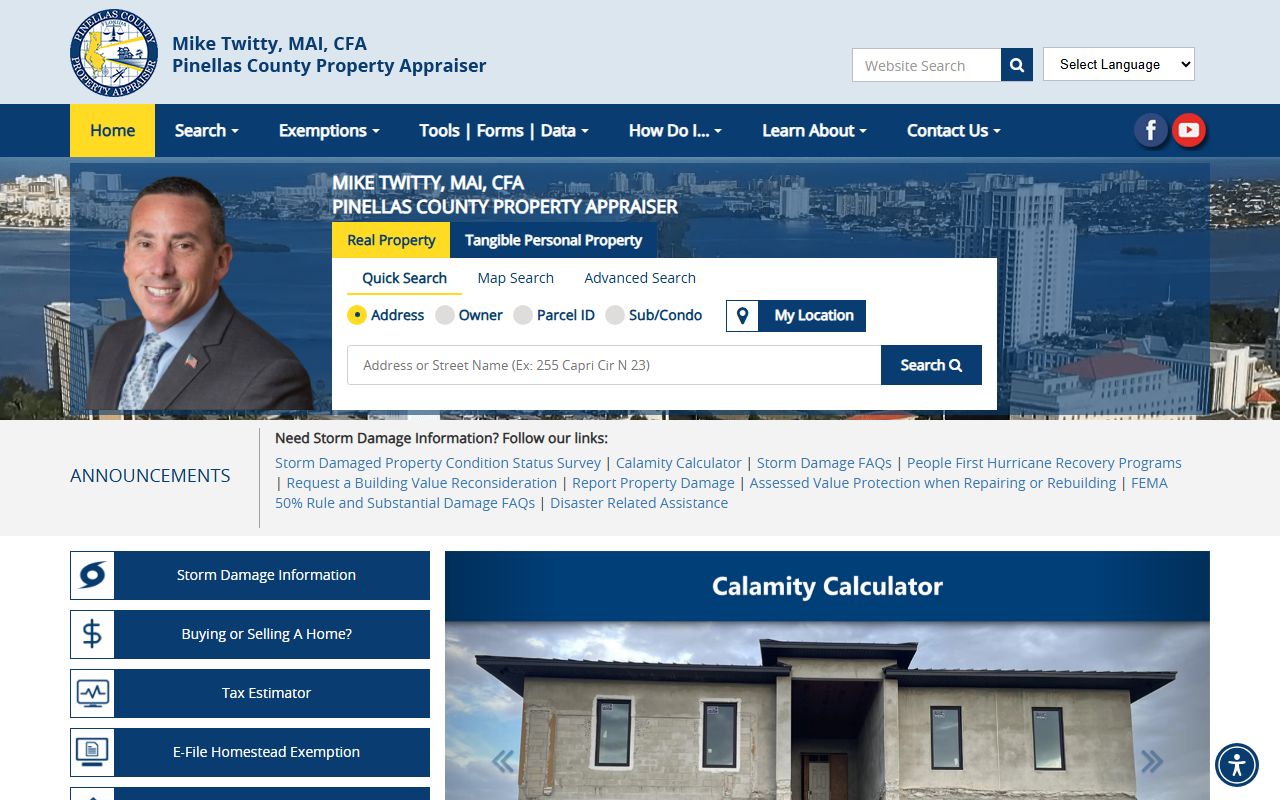
The site gives you access to the full parcel search, exemption filing, appeal information, and the office's contact page. The search tool works well for both residential and commercial properties and covers all jurisdictions within Pinellas County.
For recorded documents in Pinellas County, the Clerk of the Circuit Court and Comptroller provides an online portal for searching the Official Records index. Searches are free. Many documents can be viewed at no cost. Certified copies carry fees set by Florida law.
What Clearwater Property Records Show
A parcel record for a Clearwater property typically contains the following data fields from the Pinellas County Property Appraiser:
- Owner of record - current legal owner and mailing address
- Parcel ID - Pinellas County's unique parcel identifier
- Legal description - from the recorded deed
- Property use code - single family, condo, commercial, vacant land, etc.
- Land area and building square footage
- Year built and construction class
- Just value - market value estimate set each January 1
- Assessed value - may be capped below just value for homesteaded properties
- Taxable value - just value minus all exemptions
- Active exemptions - homestead, senior, disability, veteran
- Sales history - past transfers with dates, prices, and deed types
Clearwater has a large condo market, particularly along the beachfront and the Intracoastal. Condo records in Pinellas County give unit-level data. Each unit has its own parcel ID and its own assessed and taxable value. If you are researching a condo, use both the building name and the unit number in your search to pull the right record.
Homestead Exemption for Clearwater Homeowners
Florida's homestead exemption can reduce your taxable value by up to $50,000. The first $25,000 applies to all taxing authorities that levy on your property. The second $25,000 applies to assessed value between $50,000 and $75,000 and is exempt from all taxes except the school board millage. For Clearwater homeowners, this exemption is worth filing for every year you qualify.
To qualify, you must own the property and make it your permanent primary residence as of January 1 of the tax year. You must be a legal Florida resident. The deadline is March 1. The Pinellas County Property Appraiser's exemptions team can be reached at hx@pcpao.gov. The office also offers virtual appointments if you cannot come in person to 315 Court Street in Clearwater. Application forms and online filing options are available at pcpao.gov.
The Pinellas County Property Appraiser's contact page, shown below, lists all ways to reach the office including the virtual appointment option and the exemptions email address.
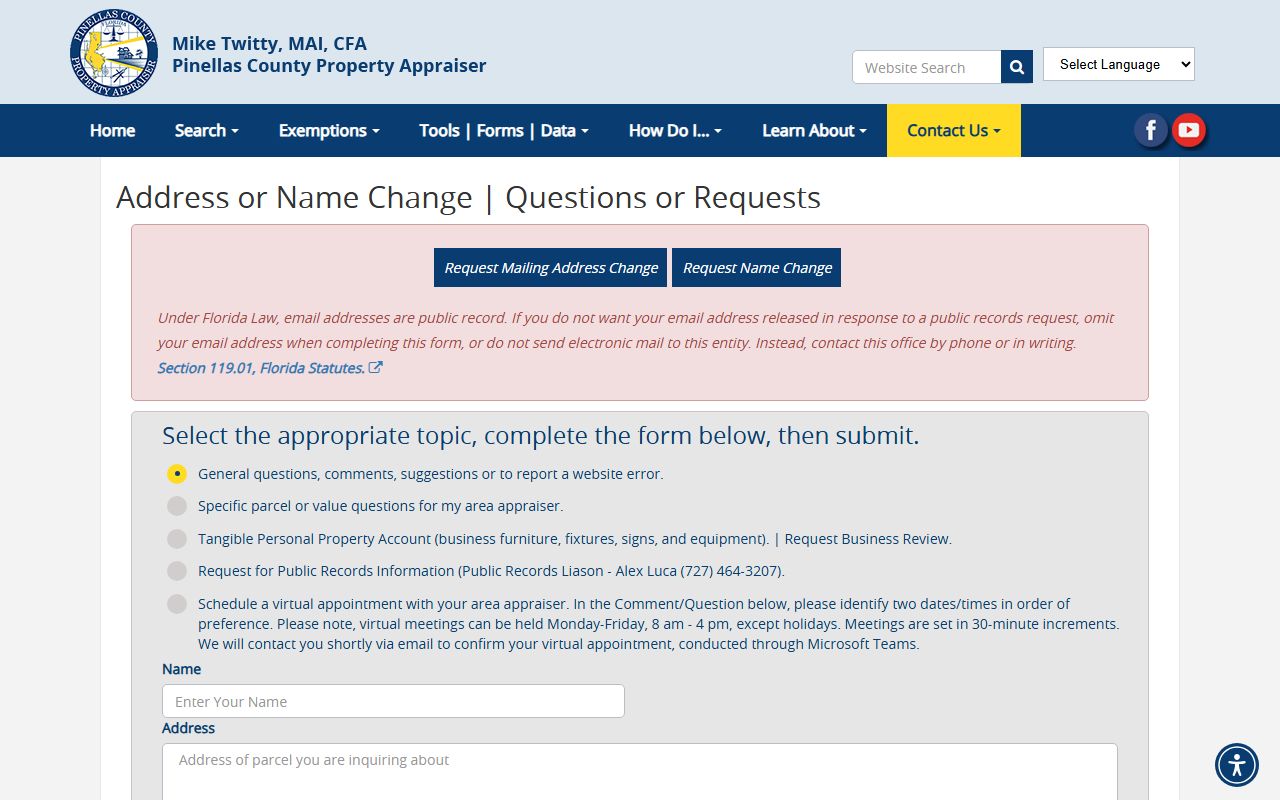
If you have questions about whether a specific exemption applies to your property, or you need to update an existing exemption after a change in circumstances, contacting the office through one of the methods listed here is the fastest way to get answers.
The Save Our Homes cap under Section 193.155 limits the annual increase in a homesteaded property's assessed value to 3% or the rate of inflation, whichever is lower. This benefit builds over time. When you sell and move to a new Florida home, you can transfer the accumulated cap difference through portability. Both the homestead exemption and portability applications must be filed by March 1. Other available exemptions include low-income senior, disability, widow or widower, and veterans. Call (727) 464-3207 for specifics.
City of Clearwater Government Resources
Clearwater City Hall is at 112 S Osceola Avenue, Clearwater, FL 33756. The general city phone is 727-562-4040. The city website is myclearwater.com. City offices handle zoning, code enforcement, utility services, and other municipal functions that affect property owners.
The Building Department is at 100 S Myrtle Avenue, Clearwater, FL 33756, phone 727-562-4567. Their site is myclearwater.com/building-department. If you need to check permit history on a property, the Building Department can provide that information. Looking up permits before you buy is smart. Open permits or failed inspections can affect a property's value and may need to be resolved before a sale can close.
The city's Planning and Development department handles zoning questions, variance applications, and land use changes. If you want to know what a parcel is zoned for or whether a specific use is allowed, contact Planning and Development through the city website. Clearwater's zoning code is available online through the city's municipal code portal.
Official Records at the Pinellas County Clerk
Deeds, mortgages, liens, and other recorded property instruments for Clearwater parcels are maintained by the Pinellas County Clerk of the Circuit Court and Comptroller. Under Chapter 28 of Florida Statutes, the Clerk maintains the Official Records index. For Clearwater properties, the following types of documents are on file:
- Warranty deeds and quitclaim deeds
- Mortgages and satisfaction of mortgage documents
- Mechanic's liens and lien releases
- Lis pendens filings
- Judgment liens
- Easements and subdivision plats
The Clerk's online Official Records search allows you to search by grantor and grantee name, document type, and recording date range. Many documents can be viewed online without charge. Certified copies of recorded instruments carry a fee set by Florida law under Chapter 119. The Clerk's main courthouse is in Clearwater, making it one of the more accessible county clerks in the state for city residents.
TRIM Notice and Tax Calendar
Every August, Pinellas County sends a TRIM notice to every property owner of record. TRIM stands for Truth in Millage. The notice is not a tax bill. It tells you your proposed assessed value for the next tax year, what exemptions the Property Appraiser shows for your parcel, and the proposed millage rates from each taxing authority that covers your property. For Clearwater owners, this typically includes the county, the city, the school board, and several other special districts.
If your assessed value seems too high, or an exemption you applied for is not reflected, the TRIM notice is your cue to act. You have about 25 days from the date on the notice to file a petition with the Pinellas County Value Adjustment Board. The VAB process is independent of the Property Appraiser and provides a formal hearing before a special magistrate. Filing fees are small and the process is accessible to individual property owners.
Final millage rates are adopted at public budget hearings in September. Tax bills go out in November. Early payment discounts are 4% in November, 3% in December, 2% in January, and 1% in February. The last day to pay without penalty is March 31. After April 1, taxes become delinquent and Pinellas County begins tax certificate proceedings under Chapter 192 of Florida Statutes.
Nearby Cities
Clearwater is in central Pinellas County. Other qualifying cities in the Tampa Bay area are close by.