
St. Petersburg Property Records Search
St. Petersburg property records are maintained by the Pinellas County Property Appraiser and the Pinellas County Clerk of Circuit Court and Comptroller. If you need to find ownership data, assessed values, sales history, deed documents, or homestead exemption status for any parcel in St. Petersburg, Florida, both offices offer free online access to their databases.
St. Petersburg Property Records Quick Facts
How St. Petersburg Property Records Are Maintained
St. Petersburg is the largest city in Pinellas County. All property appraisal functions for parcels inside city limits are handled at the county level by the Pinellas County Property Appraiser's office. The city does not maintain a separate property assessment database.
The Pinellas County Property Appraiser is Mike Twitty, MAI, CFA. The main office is at 315 Court Street, 2nd Floor, Clearwater, FL 33756. Note that the Property Appraiser's office is in Clearwater, the county seat, not in St. Petersburg. The phone number is (727) 464-3207 and email is hx@pcpao.gov. The main website is pcpao.gov.
Under Chapter 193 of Florida Statutes, the Property Appraiser must assess all real property in the county at just value annually. For homesteaded properties, the Save Our Homes cap limits how much the assessed value can increase year over year. Property inspections are conducted on a regular cycle to keep building and land data current.
Recorded documents including deeds, mortgages, and liens are handled by the Pinellas County Clerk of Circuit Court and Comptroller. The Clerk's Official Records are governed by Chapter 28 of Florida Statutes and provide the legal record of property transfers and encumbrances in the county.
How to Search St. Petersburg Property Records
The Pinellas County Property Appraiser's online search at pcpao.gov is the main free tool for St. Pete property lookups. You can search by owner name, property address, or parcel ID number. The system returns a list of matching records and clicking any result takes you to a full parcel detail page.
The Pinellas County Property Appraiser's homepage is shown below. All St. Petersburg property searches run through this county-level portal.
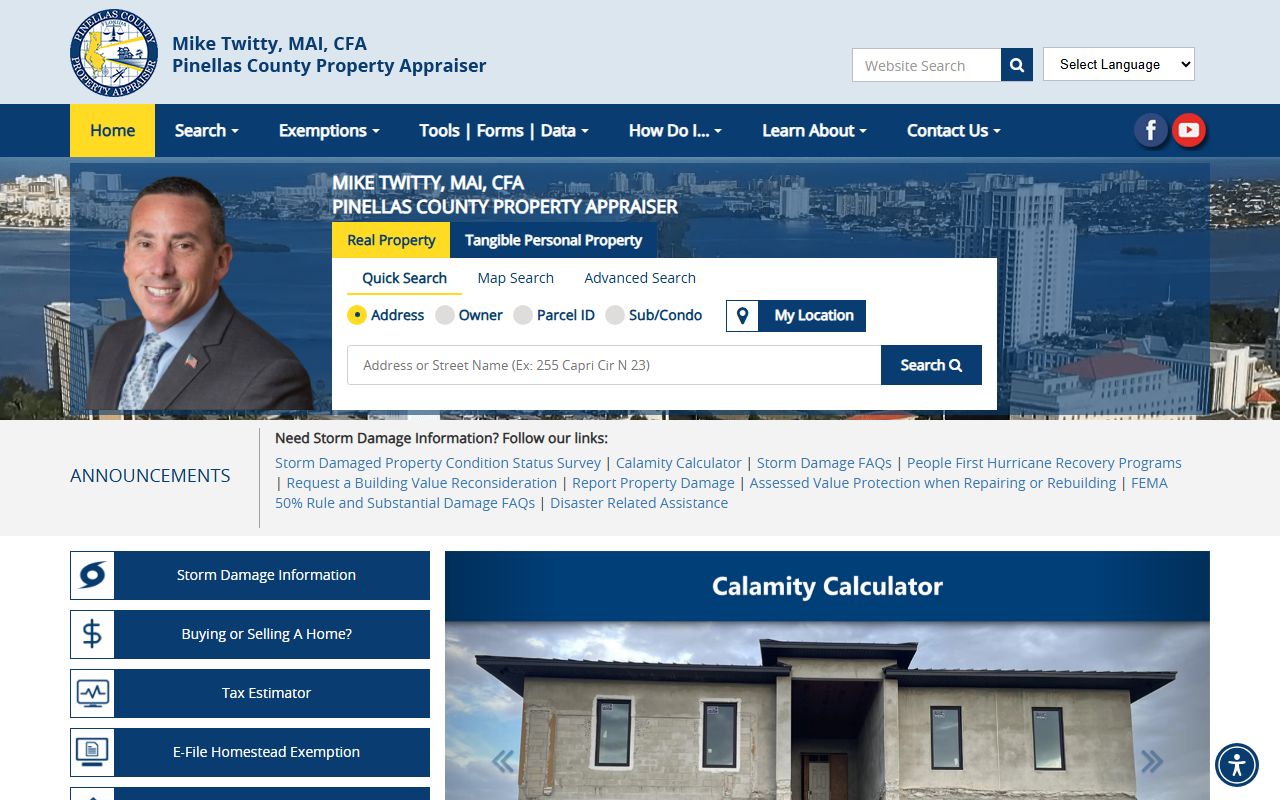
The PCPAO website provides parcel maps, building data, assessed values, exemptions, and sales history for all properties in Pinellas County, including those inside St. Petersburg city limits.
Parcel detail pages from the PCPAO show current ownership, legal description, land and building data, all assessed and taxable values for the current year, exemptions on file, and the complete sales history. Each sale entry shows the date, price, deed type, and the OR Book and Page reference for the recorded instrument.
For homestead exemption status, the PCPAO also offers a dedicated lookup tool shown below. You can check whether a homestead is active on any parcel without going through the main search.
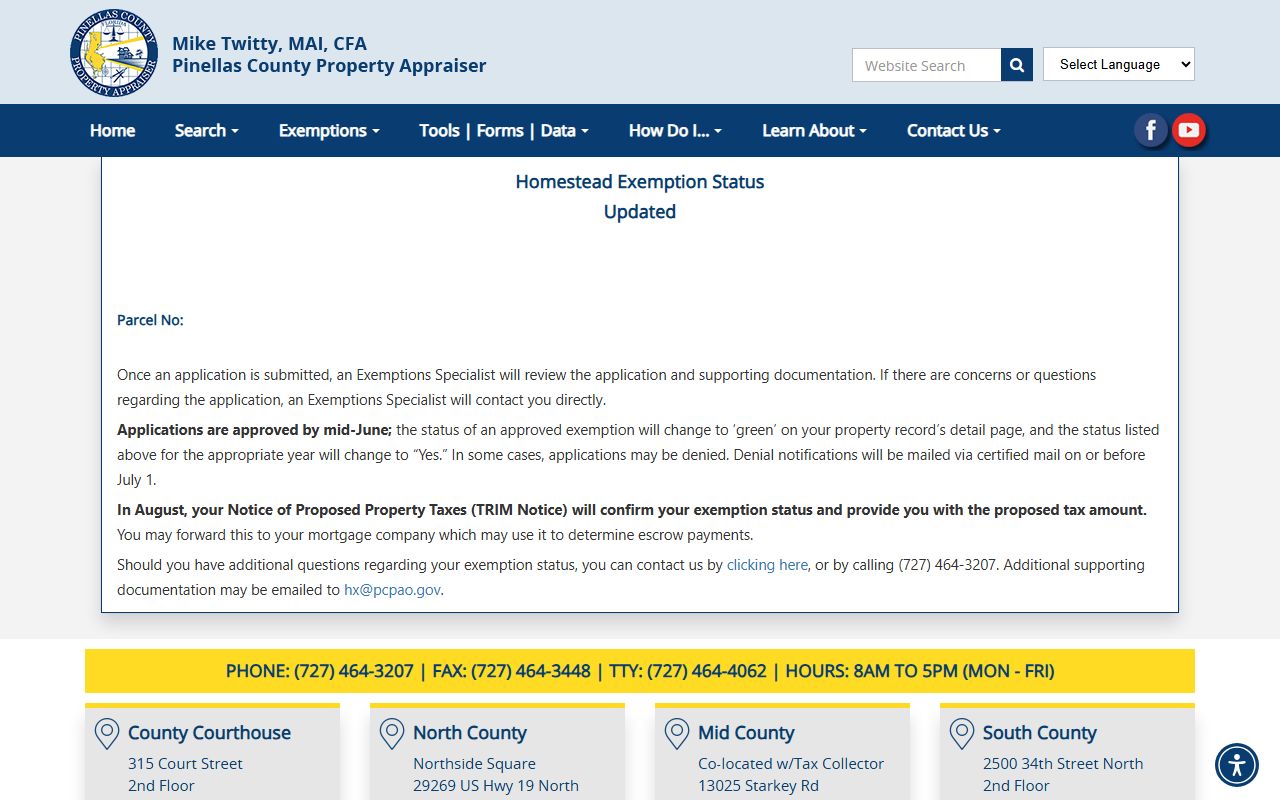
This tool is useful if you want to quickly verify exemption status before making an offer on a property or want to confirm your own exemption is properly on file.
For recorded documents, the Pinellas County Clerk's Official Records search is at mypinellasclerk.gov. You can search by name, document type, or recording date. Many documents are available as free PDFs online. Certified copies carry a per-page fee under Chapter 119.
What St. Petersburg Property Records Show
A full PCPAO parcel record for a St. Petersburg property typically includes the following data:
- Owner of record and mailing address
- Parcel ID number
- Legal description
- Land use classification
- Lot size
- Building data: year built, living area, construction type, condition, number of stories
- Just (market) value
- Assessed value (may be capped)
- Taxable value after exemptions
- Active exemptions
- Sales history with dates, amounts, and recorded instrument references
St. Petersburg has a dense housing stock with many older neighborhoods, condominiums near the waterfront, and a growing downtown core. For condominiums, each unit gets its own parcel ID. For neighborhoods with older homes, the year built in the Property Appraiser's record reflects the original construction year, not the date of any additions or major renovations. Permit records from the city can fill in that gap.
Homestead Exemption for St. Petersburg Residents
Florida's homestead exemption reduces the taxable value of a primary residence by up to $50,000. To qualify, you must own and occupy the property as your permanent Florida residence as of January 1. The application deadline is March 1 each year. Applications filed after March 1 will not apply until the following tax year.
Applications are submitted to the Pinellas County Property Appraiser. You can apply online at pcpao.gov, in person at 315 Court Street in Clearwater, or at one of the satellite offices the PCPAO maintains in the county. Documents you will need include a Florida driver's license or ID showing the property address, voter registration, and proof of ownership.
Once the homestead is in place, the Save Our Homes cap begins in the second year. It limits annual assessed value increases to 3% or the CPI change, whichever is lower. For a long-term St. Pete resident in a neighborhood where values have risen significantly, the assessed value on their property may be far below what a new buyer would pay in taxes. That gap closes when the property transfers to a new owner.
Portability lets St. Petersburg homeowners transfer the accumulated Save Our Homes benefit to a new homestead in Florida. You apply for portability at the same time as the new homestead, by the March 1 deadline. The PCPAO can estimate your portability amount before you apply. Other available exemptions include senior low-income homestead, disability, veteran exemptions, and surviving spouse exemptions.
City of St. Petersburg Resources
The City of St. Petersburg maintains its own departments for permits, planning, and development that are separate from county-level property appraisal. City Hall is at 175 5th Street N, St. Petersburg, FL 33701. The main city number is 727-893-7171 and the city website is stpete.org.
Development Services handles building permits and inspections for construction inside St. Pete city limits. The office number is 727-893-7231. You can access permit records and submit applications at stpete.org/development_services. Permit history shows what work has been done on a property, whether permits were pulled for that work, and whether final inspections were completed. This is useful information when researching a property before purchase or renovation.
The city's planning division handles zoning, land use amendments, and variances. If you need to know what can be built on a parcel or want to verify the current zoning, the city's planning resources are the right place to look. Zoning inside the city limits is governed by St. Petersburg's land development regulations, not by the county's zoning code.
Official Records at the Pinellas County Clerk
The Pinellas County Clerk of Circuit Court and Comptroller maintains the Official Records for all documents recorded in Pinellas County. Under Chapter 28 of Florida Statutes, the Clerk records and indexes all property-related instruments. These records are the authoritative source for chain of title and encumbrance research on St. Petersburg properties.
Types of documents in the Pinellas Official Records include:
- Warranty deeds
- Quitclaim deeds
- Mortgages and mortgage satisfactions
- Mechanic's liens and releases
- Judgment liens
- Lis pendens
- Plats and subdivision maps
- Declaration of Condominium documents
You can search the Pinellas Official Records online at mypinellasclerk.gov. Most documents are available as free PDFs. Certified copies cost a per-page fee. If you need to trace title or check for liens on a St. Pete property, the Clerk's system lets you search by any party name that appears as grantor or grantee on a recorded instrument.
TRIM Notice and Property Tax Timeline
Every August, the Pinellas County Property Appraiser sends TRIM notices to all property owners. The Truth in Millage notice shows the proposed assessed value for your parcel, any exemptions on file, and the proposed tax rates from each taxing authority. For a St. Petersburg property, those taxing bodies typically include Pinellas County, the City of St. Petersburg, the school board, water management districts, and possibly other special districts.
The TRIM notice is not a bill. It is a preview of what your November tax bill will look like if the proposed rates are adopted. If you disagree with the assessed value or believe an exemption was denied incorrectly, you have 25 days from the TRIM notice date to file a petition with the Pinellas County Value Adjustment Board. The VAB process is open to all property owners and is independent of the Property Appraiser.
Final millage rates are set in September after public hearings. Tax bills are sent in November. You get a 4% discount for paying in November, 3% in December, 2% in January, and 1% in February. Pay in full by March 31 to stay current. After April 1, taxes are delinquent and the county begins tax certificate proceedings under Chapter 192.
Nearby Cities
St. Petersburg is located on the Pinellas Peninsula. Other qualifying cities in the area are in Pinellas County and across Tampa Bay in Hillsborough County.