
Hialeah Property Records
Hialeah property records are held by the Miami-Dade County Property Appraiser and the Miami-Dade Clerk of Courts. If you need to search ownership history, assessed values, sales data, deed documents, or homestead exemption status for any parcel in Hialeah, Florida, this guide explains which office has what you need and how to access it for free online.
Hialeah Property Records Quick Facts
How Hialeah Property Records Are Maintained
Hialeah is a city within Miami-Dade County. The city does not maintain its own property appraisal database. All parcel records for properties inside Hialeah city limits are held and updated by the Miami-Dade County Property Appraiser. This includes ownership data, assessed values, exemptions, and parcel characteristics.
The Miami-Dade County Property Appraiser is Tomás Regalado. The office is at 111 NW 1st Street, Suite 710, Miami, FL 33128. Phone is 305-375-4712 and email is PAWebmail@MiamiDadePA.gov. The website is miamidadepa.gov.
Florida law under Chapter 193 requires the Property Appraiser to assess all real property at just value annually. Miami-Dade is the most populous county in Florida, and its Property Appraiser office handles hundreds of thousands of parcels including every property in Hialeah. The just value is determined as of January 1 each year.
Recorded documents for Hialeah properties, such as deeds and mortgages, are kept by the Miami-Dade Clerk of Courts. The Clerk's Official Records are the legal repository for all recorded instruments under Chapter 28 of Florida Statutes.
How to Search Hialeah Property Records
The Miami-Dade County Property Appraiser's online search tool is the primary free resource for Hialeah property lookups. The search portal is at miamidadepa.gov. You can search by owner name, property address, or folio number. Miami-Dade uses the term "folio" for its parcel identifier, a 13-digit number unique to each property.
The Miami-Dade Property Appraiser's homepage is the starting point for all Hialeah property searches. The screenshot below shows the main interface.
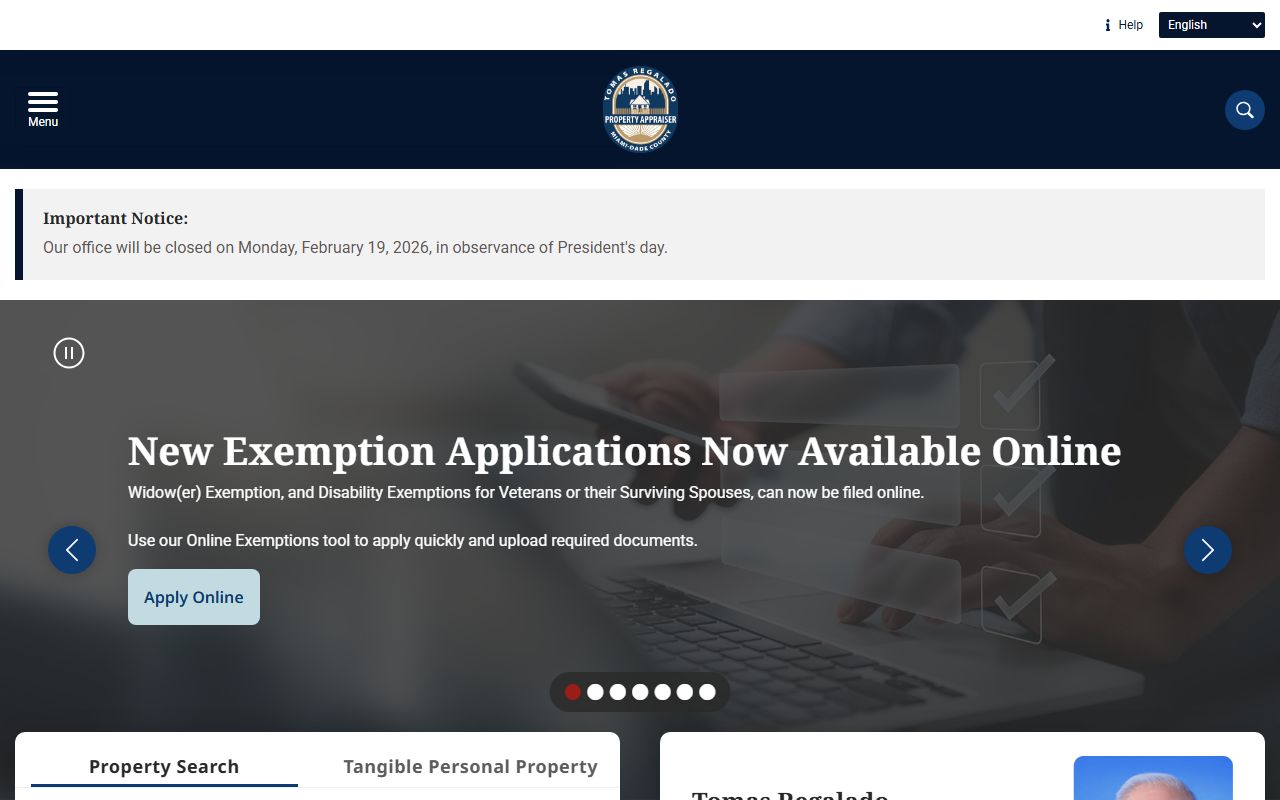
The search lets you enter a partial address or last name and returns matching parcels. Each result links to a full detail page with ownership, building data, assessed values, and sales history.
When searching for a Hialeah property by address, be aware that Hialeah uses its own street numbering system that does not always follow the Miami-Dade grid. If an address search returns no results, try using a nearby address or the folio number if you have it from a prior document.
The Miami-Dade Tax Collector's site at mdctaxcollector.gov lets you verify tax payment status and view tax bills for any parcel by folio number. If you want to see whether taxes are current on a Hialeah property, start with the Property Appraiser to get the folio, then use it on the Tax Collector site.
For tax roll information and assessed value data, the Miami-Dade Property Appraiser also publishes tax roll administration resources shown in the screenshot below.
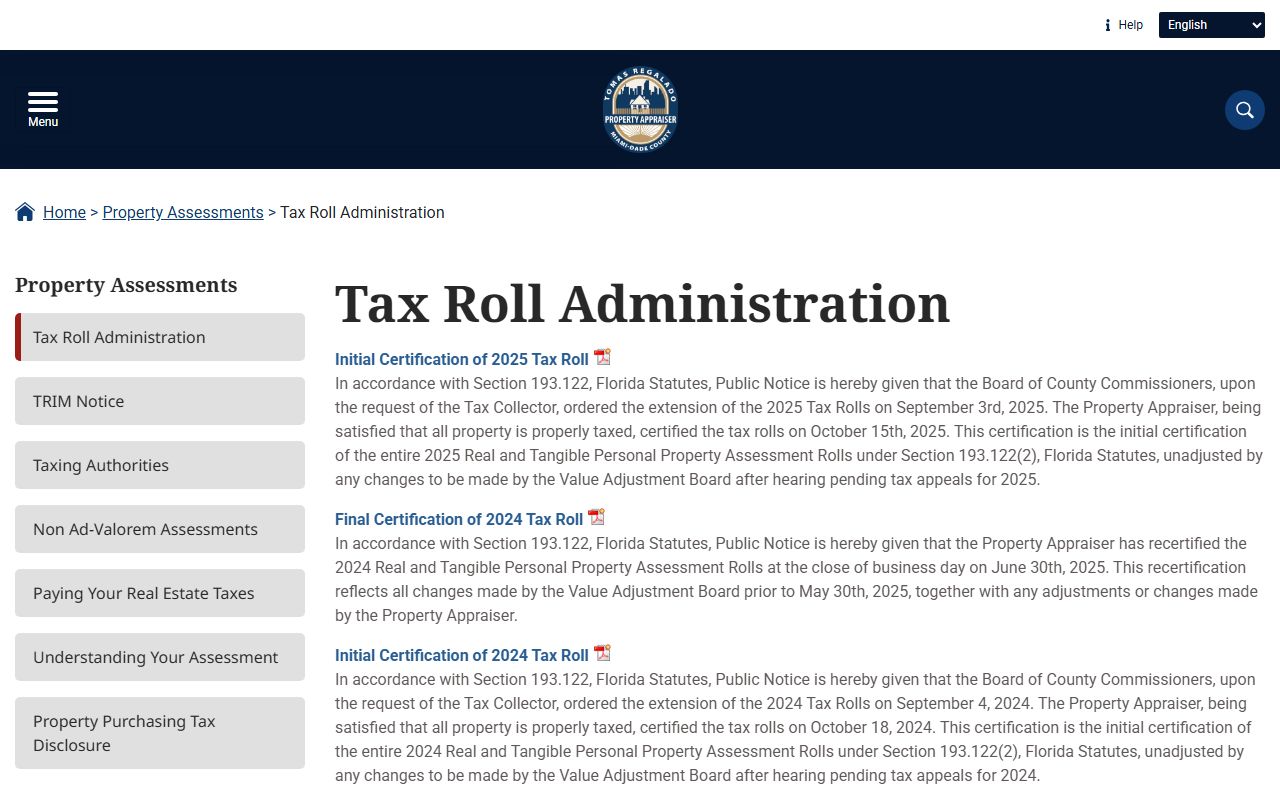
The tax roll data shows how assessed values are compiled across all of Miami-Dade County. This is useful if you want to understand how Hialeah property values compare to other areas of the county or want to access bulk assessment data.
For recorded instruments, search the Miami-Dade Clerk's Official Records at mdcclerk.gov. You can look up deeds, mortgages, and liens by grantor or grantee name. Most records are available online as free PDFs. Certified copies carry a per-page fee under Chapter 119.
What Hialeah Property Records Show
A parcel record from the Miami-Dade County Property Appraiser for a Hialeah property includes detailed information on ownership and valuation. Here is what you will typically find:
- Owner of record and mailing address
- Folio number (13-digit Miami-Dade parcel ID)
- Legal description
- Land use code and zoning
- Lot dimensions and total area
- Building data: year built, living area, total area, construction type
- Just (market) value as of January 1
- Assessed value (may be lower than just value due to Save Our Homes)
- Taxable value after exemptions
- Exemptions on file
- Full sales history with dates and prices
Hialeah is known as one of the densest cities in Florida. It has a large stock of single-family homes, duplexes, and small apartment buildings, many built from the 1950s through the 1980s. Property records often show long ownership histories for these older homes. The sales history section is particularly useful in Hialeah because it can show you whether a property has sold recently or has been in the same family for decades, which gives context to the current assessed value.
Homestead Exemption for Hialeah Residents
The Florida homestead exemption reduces taxable value by up to $50,000 for property owners who use the home as their permanent primary residence. To qualify, you must own and occupy the property as of January 1 of the tax year and be a Florida resident. The deadline to apply is March 1. Late applications will not be accepted for the current year.
Hialeah homeowners file their homestead applications with the Miami-Dade County Property Appraiser, not the city. You can apply online at miamidadepa.gov, in person at 111 NW 1st Street in Miami, or at satellite offices that Miami-Dade maintains in different parts of the county. Check the MDPA website for satellite office locations, as some are in or near Hialeah.
Once the homestead is in place, the Save Our Homes cap automatically applies starting the second year. It limits assessed value increases to 3% or the CPI rate of change, whichever is smaller. In Hialeah's real estate market, where home prices have risen sharply, long-time homeowners can have assessed values well below current market levels. When ownership transfers, the cap resets to just value.
Portability allows Hialeah residents to take their Save Our Homes savings to a new homestead in Florida. Apply for portability at the same time as the new homestead, by March 1. Other exemptions available in Miami-Dade include additional senior homestead, disability exemptions, totally and permanently disabled veterans, and surviving spouse of a veteran or first responder. Contact the Property Appraiser at 305-375-4712 for eligibility questions.
City of Hialeah Resources
The City of Hialeah operates its own municipal services including building permits, code enforcement, and planning. These are separate from the county-level property appraisal functions. Hialeah City Hall is at 501 Palm Avenue, Hialeah, FL 33010. The general city number is 305-883-5820 and the city website is hialeahfl.gov.
The Building Department is at 501 Palm Avenue, Hialeah, FL 33010. Phone is 305-883-8000. Permit information is available at hialeahfl.gov/departments/building. Building permits are public records and can be researched to see what construction or renovation work has been done on any Hialeah property. For older homes in Hialeah, permit history can reveal additions, garage conversions, or roof replacements that are not always obvious from the Property Appraiser's building data alone.
Hialeah uses its own land development and zoning code that governs what can be built inside city limits. For zoning questions about a Hialeah parcel, contact the city's planning division through the city website. The Property Appraiser's record will show the land use classification, but detailed zoning regulations and variance history require a separate inquiry with the city.
Official Records at the Miami-Dade County Clerk
The Miami-Dade Clerk of Courts is responsible for recording and indexing all Official Records documents in Miami-Dade County. Under Chapter 28, the Clerk maintains the legal record of all property transactions in the county, including those affecting Hialeah parcels. These documents establish the chain of title and identify any liens or encumbrances on a property.
Key document types in the Miami-Dade Official Records include:
- Warranty deeds and quitclaim deeds
- Mortgages and mortgage satisfactions
- Mechanic's liens and lien releases
- Judgment liens
- Lis pendens notices
- Plats and easements
You can search Official Records online at mdcclerk.gov at no cost for viewing. When you find a sale in the Property Appraiser's sales history for a Hialeah property, the OR Book and Page on that entry directs you to the exact recorded deed in the Clerk's system. That deed shows the full legal transfer terms and any conditions attached to the sale.
TRIM Notice and Property Tax Timeline
Miami-Dade County sends TRIM notices to all property owners in August. The Truth in Millage notice shows the proposed assessed value for your Hialeah parcel, any exemptions on file, and the proposed millage rates from Miami-Dade County, the City of Hialeah, the school board, and other taxing districts. Each rate is shown separately so you can see exactly which authority is proposing what levy.
The TRIM notice is not a bill. It is a preview of your estimated November tax statement. If you think the assessed value is too high, you have 25 days from the TRIM notice date to petition the Value Adjustment Board. The VAB operates independently and reviews appeals from property owners who dispute their assessments or believe exemptions were wrongly denied.
After September hearings finalize millage rates, tax bills are mailed in November. The early payment discount schedule is 4% in November, 3% in December, 2% in January, and 1% in February. Taxes must be paid in full by March 31 to avoid delinquency. After April 1, unpaid taxes accrue interest and the county moves toward a tax certificate sale under Chapter 192.
Nearby Cities
Hialeah is surrounded by other Miami-Dade municipalities. Several other qualifying cities are located in the county nearby.