
Doral Property Records Search
Property records for Doral are held by the Miami-Dade County Property Appraiser and include ownership data, assessed and taxable values, legal descriptions, exemption status, building characteristics, and sales history for every parcel within the city. Doral is a relatively young city, incorporated in 2003, and its entire property record system runs through the countywide Miami-Dade PA database. This page covers how to search those records, what to expect in them, how the homestead exemption applies to Doral residents, and where to find related documents like recorded deeds and building permits.
Doral Property Records Quick Facts
How Doral Property Records Are Managed
The Miami-Dade County Property Appraiser handles all parcel data for Doral. The main office is at 111 NW 1st Street, Suite 710, Miami FL 33128, phone 305-375-4712. General email is PAWebmail@MiamiDadePA.gov. The office website is at miamidadepa.gov. Office hours are Monday through Friday during normal business hours.
The Property Appraiser's role is to assess property values and manage exemptions. It does not set millage rates, does not send tax bills, and does not collect payments. Those functions belong to the Tax Collector and the various taxing authorities. If you have a question about your tax bill, contact the Miami-Dade Tax Collector. If you have a question about your assessed value or exemptions, the PA is the right call.
Doral parcels each have a unique folio number assigned by the county. This number is the most reliable way to pull up a specific property in the PA system. You can find the folio number on a prior tax bill, a deed, or a title search report. Once you have the folio, a search takes seconds and pulls up the full record.
The Miami-Dade County Property Appraiser's main website provides free access to all Doral property records by owner name, address, or folio number.
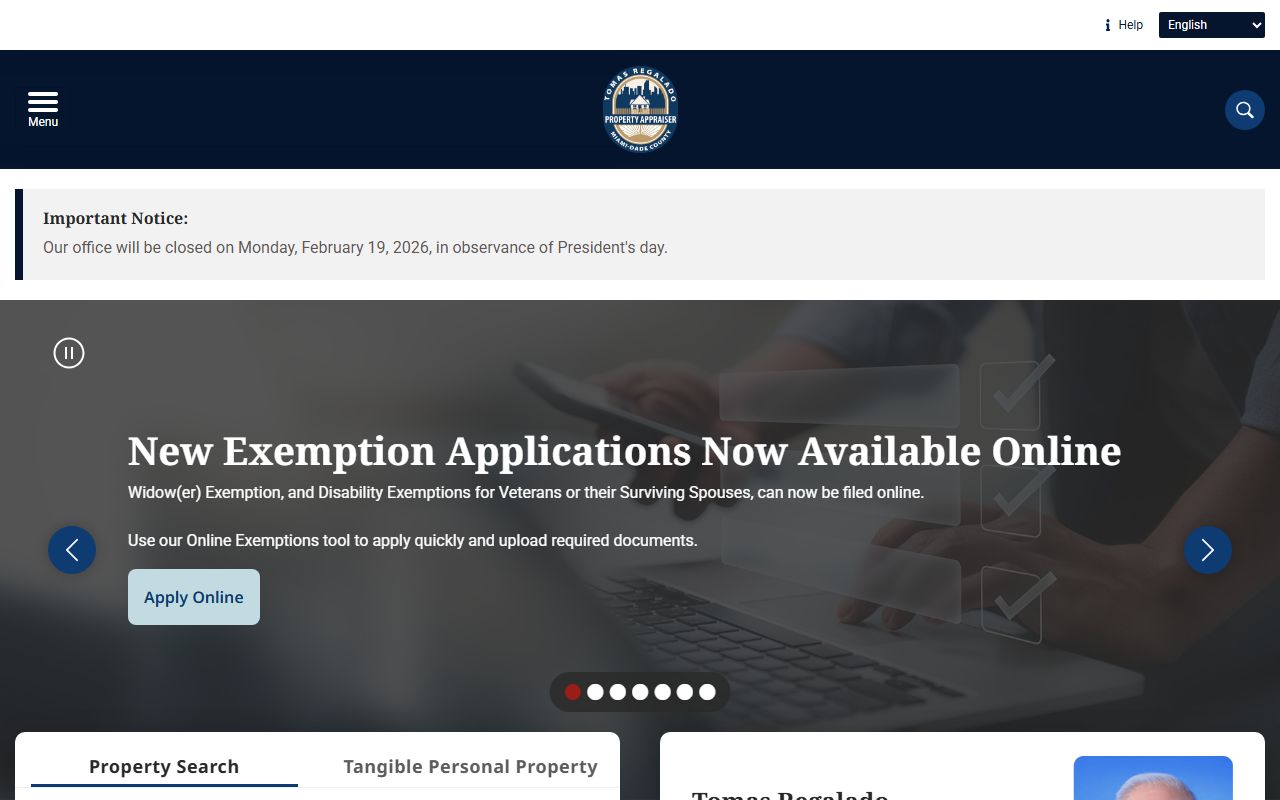
Search Doral parcels at miamidadepa.gov for current ownership, assessed values, and exemption details at no cost.
Search Doral Property Records Online
The Miami-Dade PA online portal lets you search by owner name, property address, or folio number. Each method returns a list of matching records. Clicking a record brings up the full parcel detail page, which includes all key data in a single view without needing to navigate multiple screens.
The parcel detail page shows: owner of record and mailing address, legal description, lot size, building square footage, year built, construction type, assessed value, taxable value, exemptions applied, and recent sales history. Sales history typically goes back several years. Non-arms-length transfers (gifts, family transfers) usually show a nominal price and may not reflect true market value.
Doral has a significant amount of commercial and mixed-use property. The PA system handles commercial assessments differently from residential ones. Commercial properties are assessed using income, sales comparison, and cost approaches. If you are researching a commercial parcel, the record may include additional data points related to the income approach, such as rental rates and occupancy levels used in the assessment.
All searches on the PA portal are free. No login is required. The system is available at all hours. For bulk data or formal records requests, use RecordsRequest@MiamiDadePA.gov to ask about data availability and format options.
What Doral Property Records Include
Property records in Doral contain the same standard data set as all Miami-Dade County parcels. Ownership records show the current title holder, their mailing address, and the date the property was acquired. When a sale is recorded with the Clerk of Courts, the PA updates its ownership file to reflect the new owner.
Values shown in the record include the just value (market value), the assessed value (which may be capped under Save Our Homes for homestead properties), and the taxable value after exemptions. Each taxing authority uses the taxable value to calculate its portion of the bill. The TRIM notice sent each August shows these values along with each authority's proposed rate.
Building characteristics cover the structure type, square footage, year built, number of stories, and construction quality class. Doral has a mix of newer single-family homes, townhomes, and commercial buildings, many built after incorporation in 2003. For newer properties, the building data tends to be more accurate because it comes directly from permit records rather than older field inspections.
Exemptions in the record show which tax relief programs are active for the parcel. The homestead exemption is most common for residential owners. Other exemptions include widow, widower, disability, senior, and veteran exemptions. Each reduces the taxable value by a set amount or percentage under Florida law.
Homestead Exemption for Doral Residents
Florida homestead law gives Doral homeowners who use a property as their primary residence a reduction in assessed value of up to $50,000. The first $25,000 offsets all taxing levies. The second $25,000 applies only to non-school levies. Together they lower the taxable value and reduce the total annual tax bill.
The filing deadline is March 1 each year. You must own and occupy the property as your primary Florida residence as of January 1. A Florida driver's license or ID card with the property address, voter registration, or equivalent documentation is needed to support the application. Dual homestead claims (holding exemptions in two states) are not allowed under Florida law.
Under Save Our Homes, once a homestead exemption is in place, the assessed value can rise no more than 3% per year or the CPI rate, whichever is lower. In a fast-growing market like Doral, this cap can create a large gap between market value and assessed value over time. That gap protects long-term homeowners from rapidly rising tax bills. When the property is sold without a new homestead claim, the assessed value resets to market value the following year.
Portability lets homeowners carry a Save Our Homes benefit from a prior Florida homestead to a new one. If you move within Florida, you can transfer up to $500,000 in accumulated benefit. Apply for portability at the same time you apply for the new homestead. You have up to three years from giving up the old homestead to use portability.
City of Doral Government Resources
The City of Doral's main office is at 8401 NW 53rd Terrace, Doral FL 33166, phone 305-593-6725. The city website is at cityofdoral.com. The city manages local ordinances, zoning decisions, and city-level public records. For city records requests, start with the city's main contact page.
Building permits and inspections are managed by the City of Doral Building Department, phone 305-593-6700, online at cityofdoral.com/building-department. Doral has an active development and construction market, so permit records can be particularly detailed. Building records show permit applications, inspection dates, and certificate of occupancy status for structures within the city.
These building records are public and can be searched online or in person. They are useful when evaluating a property for purchase, confirming whether recent work was permitted, or checking the status of an ongoing construction project. Always verify that permits were properly closed with final inspections rather than just pulled.
The Miami-Dade County Property Appraiser's contact page lists department-specific contacts and email addresses for Doral and all other county parcels.
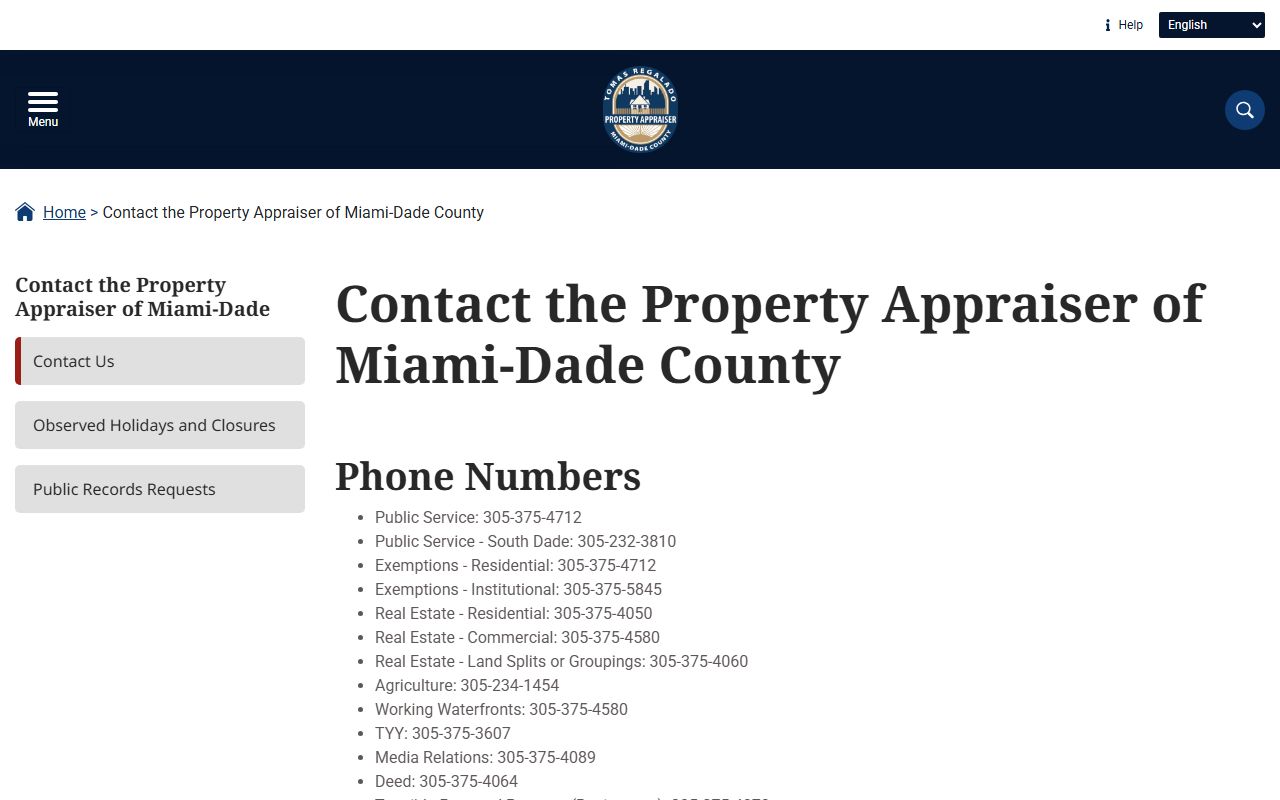
Find the right department contact for your Doral property question at miamidadepa.gov.
Official Records at the County Clerk
Recorded documents for Doral properties, including deeds, mortgages, satisfaction of mortgage, and liens, are filed with the Miami-Dade Clerk of Courts. The Clerk is the official custodian of recorded instruments under Chapter 28 of the Florida Statutes. The PA system will show you the Official Record Book and Page reference; you then search the Clerk's index to pull the actual document.
You can search Miami-Dade Clerk records online at no cost. Certified copies carry a per-page fee. These documents include warranty deeds, quitclaim deeds, lis pendens filings, judgment liens, and satisfaction of lien documents. A thorough title search on a Doral property requires reviewing the Clerk's records alongside the PA data.
Under Chapter 119, Florida's Public Records Law, these records are open to all members of the public. The law requires agencies to respond to records requests in a reasonable time and to charge only allowable fees. For property records specifically, most information is immediately accessible through the online search portals without any formal request needed.
TRIM Notice and Property Tax Calendar
Each August, the Miami-Dade Property Appraiser sends TRIM notices to all Doral property owners. The TRIM (Truth in Millage) notice shows the proposed assessed and taxable values, the proposed millage rates from each taxing authority, and the estimated tax bill based on those rates. It is not an actual bill. You can review the figures and, if you disagree with the assessed value, file a petition.
Property owners have 25 days from the TRIM mailing to petition the Value Adjustment Board. The VAB reviews evidence and issues a ruling. There is no filing fee to petition. You can appear in person or submit written evidence. If the VAB reduces your assessed value, your tax bill is adjusted accordingly before it goes out in November.
The final tax bill is mailed in November. Early payment discounts run through February: 4% in November, 3% in December, 2% in January, and 1% in February. Full payment is due by March 31. After that date, taxes become delinquent and the county may issue tax certificates. Most Doral property owners pay by November or December to capture the discount.
The full assessment cycle is governed by Chapter 192 and Chapter 193 of the Florida Statutes. These laws set how the PA assesses all real and personal property, what exemptions are allowed, and the timeline from January 1 valuation through the annual tax roll certification.
Nearby Cities
Doral is in western Miami-Dade County near several large cities with property record pages.