
Search Miami Property Records
Miami property records are handled by the Miami-Dade County Property Appraiser and the Miami-Dade Clerk of Courts. Whether you need ownership history, assessed values, deed documents, or homestead exemption status for a parcel in the City of Miami, this page shows you where to look and what you will find.
Miami Property Records Quick Facts
How Miami Property Records Are Maintained
The City of Miami is one of many municipalities within Miami-Dade County. Property records for parcels inside city limits are not kept separately by the city. They are maintained at the county level by the Miami-Dade County Property Appraiser's office. That office assigns parcel numbers, sets assessed values, and processes all exemption applications for every property in the county, including those inside Miami.
The Miami-Dade County Property Appraiser is Tomás Regalado. The main office is at 111 NW 1st Street, Suite 710, Miami, FL 33128. You can reach the office by phone at 305-375-4712 or by email at PAWebmail@MiamiDadePA.gov. The office website is miamidadepa.gov.
Assessed values in Florida are governed by Chapter 193 of Florida Statutes. The Property Appraiser must value all property at just value each year. For homesteaded properties, the Save Our Homes cap under Chapter 193 limits how much the assessed value can rise annually.
Deed recordings and other official documents are handled by the Miami-Dade Clerk of Courts under Chapter 28. The Clerk maintains the Official Records that show chain of title, mortgages, liens, and other encumbrances on any parcel.
How to Search Miami Property Records
The primary search tool is the Miami-Dade County Property Appraiser's online database. You can access it at miamidadepa.gov. The system lets you search by:
- Owner name
- Property address
- Folio number (the Miami-Dade parcel ID)
- Subdivision name
- Legal description
The Miami-Dade Property Appraiser's main search portal is shown below. This is where most property lookups begin.
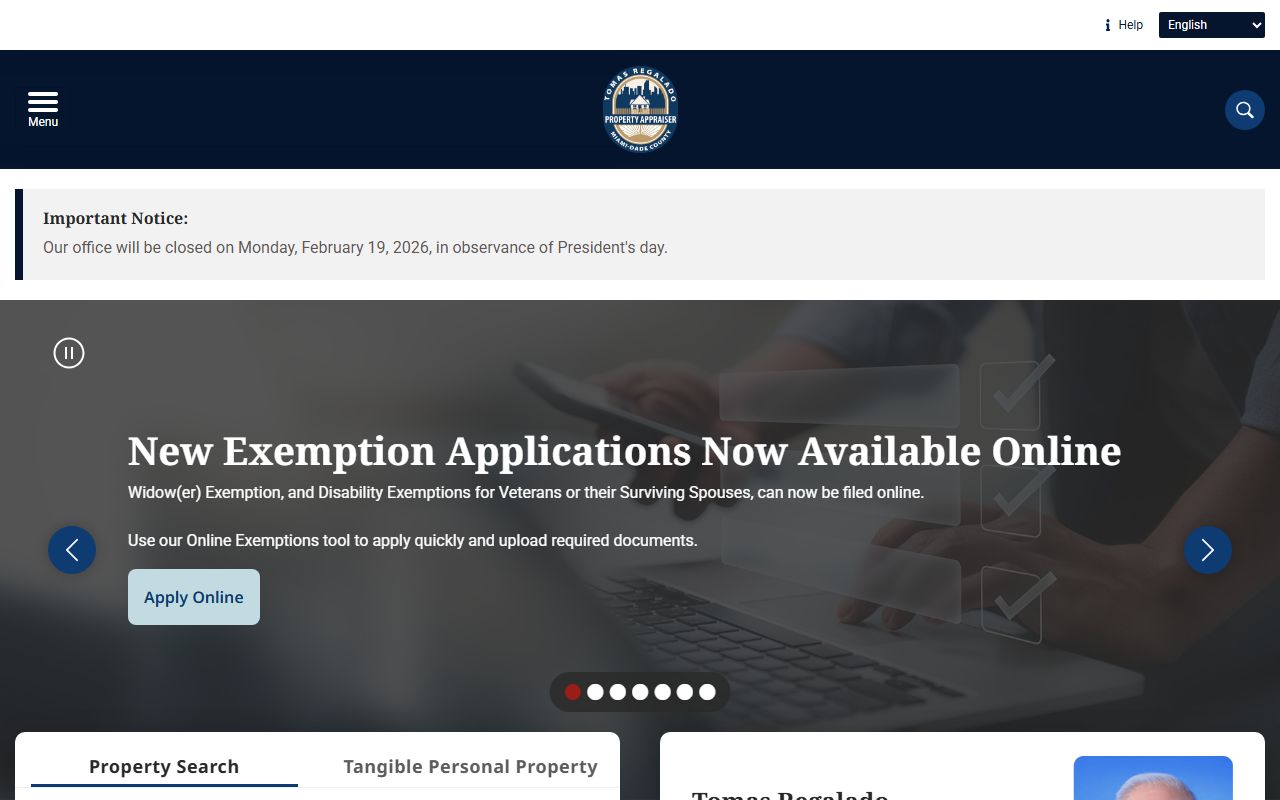
Once you enter a search and open a parcel record, you will see full detail including the owner, legal description, land size, building characteristics, all assessed values, and the full sales history for that folio number.
Miami-Dade County uses "folio number" as the parcel identifier. It is a 13-digit number that uniquely identifies each property in the county. If you have the folio, you can jump directly to a property record without searching by name or address.
For recorded documents, the Miami-Dade Clerk operates an online Official Records search at mdcclerk.gov. You can search by name, document type, or recording date. Many instruments are available as free PDF downloads. Certified copies carry a fee set under Chapter 119.
The Miami-Dade Tax Collector's website at mdctaxcollector.gov shows tax payment status. You can check whether taxes are current or delinquent for any parcel once you have the folio number.
What Miami Property Records Show
Miami-Dade property records are detailed. A standard parcel record from the Property Appraiser will show:
- Owner name and mailing address
- Folio number
- Legal description from the recorded deed
- Land use classification and zoning
- Lot size in square feet and acres
- Building details: year built, square footage, number of units, construction type
- Just (market) value
- Assessed value (capped if homesteaded)
- Taxable value after all exemptions
- Exemptions on file
- Sales history with dates and prices
The screenshot below shows the Miami-Dade Property Appraiser's contact page, which is useful if you need to reach the office for a specific parcel question or exemption inquiry.
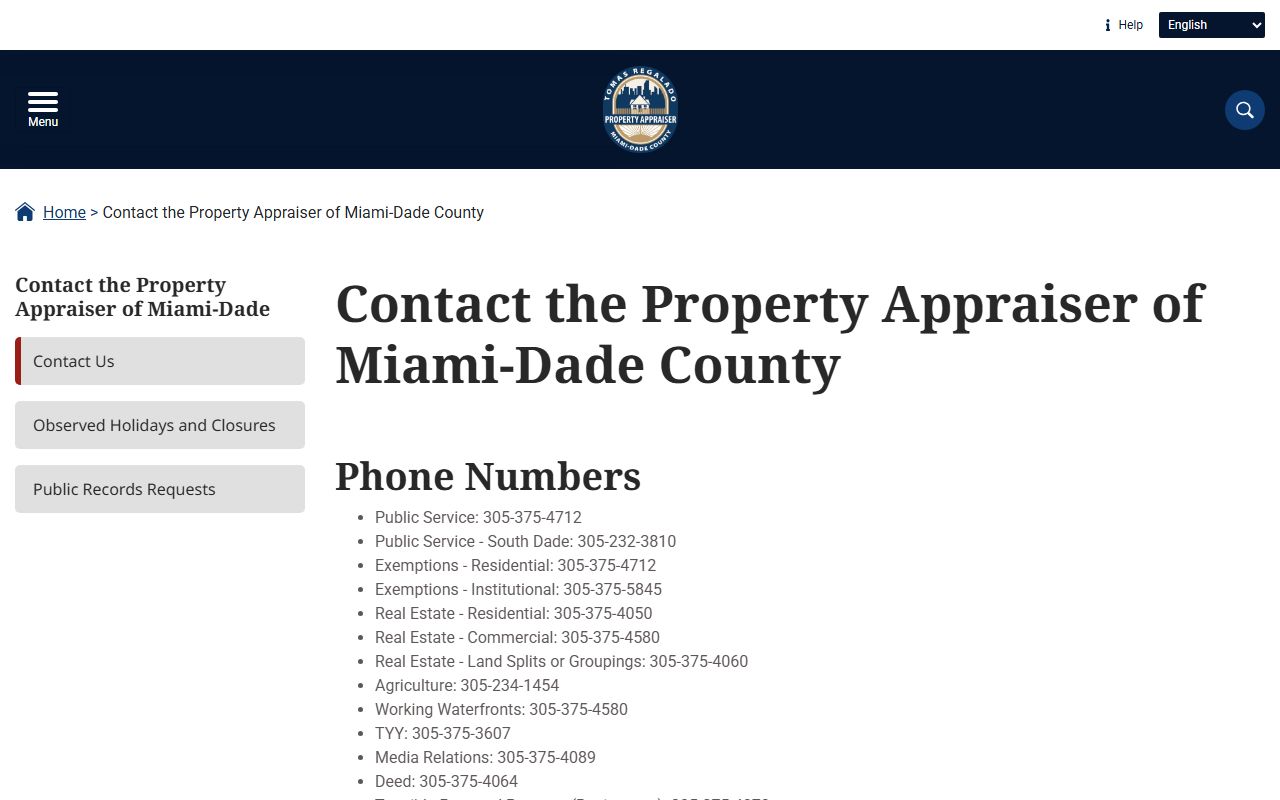
The office can answer questions about specific parcel values, exemption eligibility, and how to read your TRIM notice. For recorded document questions, contact the Clerk of Courts instead.
One important detail for Miami properties is that the city has a dense mix of residential condominiums, commercial properties, and multi-family units. For condos, the Property Appraiser assigns each unit its own folio number with its own assessed value and exemption status. You search for a condo unit the same way you search for a house, using the building address or the unit's folio number.
Homestead Exemption for Miami Residents
Florida's homestead exemption is worth up to $50,000 in taxable value reduction. The first $25,000 applies across all taxing authorities. The second $25,000 applies to assessed values between $50,000 and $75,000, but it does not reduce school taxes. Both portions must be applied for together.
To qualify for the Miami exemption, you must own the property, use it as your primary Florida residence, and be a Florida resident as of January 1 of the tax year you are claiming. You must file your application by March 1. File online through the Miami-Dade Property Appraiser portal or in person at 111 NW 1st Street, Suite 710.
The Save Our Homes benefit comes with the exemption automatically after the first year. It caps annual increases to your assessed value at 3% or the rate of change in the Consumer Price Index, whichever is lower. In Miami's real estate market, this cap can create a large gap between just value and assessed value for long-term homeowners.
Portability lets you move that accumulated savings to a new homesteaded property in Florida. You must apply for portability when you apply for your new homestead. The deadline is also March 1. Other exemptions include widow/widower, disability, totally and permanently disabled veterans, and additional senior exemptions for low-income residents. Each requires separate documentation.
City of Miami Resources
The City of Miami operates its own departments for permits, planning, and building services. These are separate from the county-level Property Appraiser functions. City Hall is at 3500 Pan American Drive, Miami, FL 33133. The general number is 305-250-5362 and the city website is miamigov.com.
The Miami Building Department is at 444 SW 2nd Avenue, Miami, FL 33130. The phone is 305-416-1400. You can find permits, inspections, and certificates of occupancy through the city's building portal at miamigov.com/Government/Departments/Building-Department. Permit history is a key part of property research because it documents what improvements were made and whether they were inspected and approved.
For zoning and land use questions, the Planning and Zoning Department is at miamigov.com/Government/Departments/Planning-and-Zoning. Miami uses a zoning code called Miami 21, a form-based code that governs what can be built throughout the city. Zoning classification shows on the Property Appraiser record, but detailed zoning maps and regulations come from the Planning Department.
Official Records at the Miami-Dade County Clerk
Deeds, mortgages, and other property documents that are legally recorded become part of the Miami-Dade Official Records maintained by the Clerk of Courts. Under Chapter 28 of Florida Statutes, the Clerk is responsible for recording and indexing all instruments related to real property.
Common documents in the Official Records include:
- Warranty deeds and quitclaim deeds
- Mortgages and satisfactions
- Mechanic's liens and releases
- Judgment liens
- Lis pendens filings
- Plats and easements
You can search Official Records online at mdcclerk.gov. The public access system is free for viewing. Printed or certified copies cost a per-page fee. Certified copies are the standard for legal and title transactions. If you need a certified copy of a deed, the Clerk's office can provide one either in person or by mail request.
TRIM Notice and Property Tax Timeline
Miami property owners receive a TRIM notice each August. The Truth in Millage notice shows your proposed assessed value, any exemptions applied, and the proposed tax rates from Miami-Dade County, the City of Miami, the school board, and other taxing bodies. It also shows what your estimated tax bill will be if all proposed rates are adopted.
The TRIM notice gives you 25 days to file a petition with the Value Adjustment Board if you believe the assessed value is wrong or an exemption was denied in error. The VAB process is open to all property owners. Filing fees are small. You can hire a licensed property tax agent to represent you, or you can appear yourself.
Final millage rates are set in September after public hearings. Tax bills go out in November. You get a 4% discount for paying in November, 3% in December, 2% in January, and 1% in February. Full payment by March 31 keeps the property current. Unpaid taxes become delinquent on April 1 and the county begins the certificate sale process under Chapter 192.
Nearby Cities
Several other qualifying cities are located within Miami-Dade County near the City of Miami.