
Miami Gardens Property Records
Miami Gardens property records are maintained by the Miami-Dade County Property Appraiser and the Miami-Dade County Clerk of the Courts. This guide covers how to search ownership data, assessed values, sales history, homestead exemptions, and recorded instruments for any parcel in Miami Gardens, one of the largest cities in Miami-Dade County by population.
Miami Gardens Property Records Quick Facts
How Miami Gardens Property Records Are Managed
Miami Gardens is located in Miami-Dade County, and all property assessment records for the city are managed at the county level. The Miami-Dade County Property Appraiser is Tomás Regalado. The main office is at 111 NW 1st Street, Suite 710, Miami, FL 33128. The phone is 305-375-4712 and the email is PAWebmail@MiamiDadePA.gov. The website is miamidadepa.gov.
Miami Gardens is the largest majority-Black city in Florida and was incorporated in 2003. The city lies in the northern part of Miami-Dade County, roughly bordered by Broward County to the north and Opa-locka to the south. All parcels within city limits fall under Miami-Dade County's property tax and assessment jurisdiction. There is no separate city assessor; the county office handles everything.
Miami-Dade County is one of Florida's most populous counties. The Property Appraiser's office manages a very large parcel inventory covering dozens of municipalities and unincorporated areas. Searches are county-wide, so when you use the online tool, you can narrow results by address or parcel number to find Miami Gardens properties specifically.
Florida law under Chapter 193 requires the Property Appraiser to assess all real property at just value each January 1. That annual assessment drives the values you see in the parcel database. Recorded instruments like deeds and mortgages are filed separately with the Miami-Dade County Clerk under Chapter 28.
How to Search Miami Gardens Property Records
The Miami-Dade County Property Appraiser's search portal at miamidadepa.gov is free and open to the public. To find any Miami Gardens parcel, search by:
- Owner name
- Property address
- Folio number (Miami-Dade's parcel identifier)
- Subdivision name
- Condo name and unit number
Search results show the current owner of record, the mailing address, the legal description, property classification, land area, building data, year built, and all value fields including just value, assessed value, and taxable value. The full sales history is also available, showing all recorded transfers with dates and prices.
The Miami-Dade County Property Appraiser's homepage is the main search portal for all Miami Gardens parcel records and exemption information.
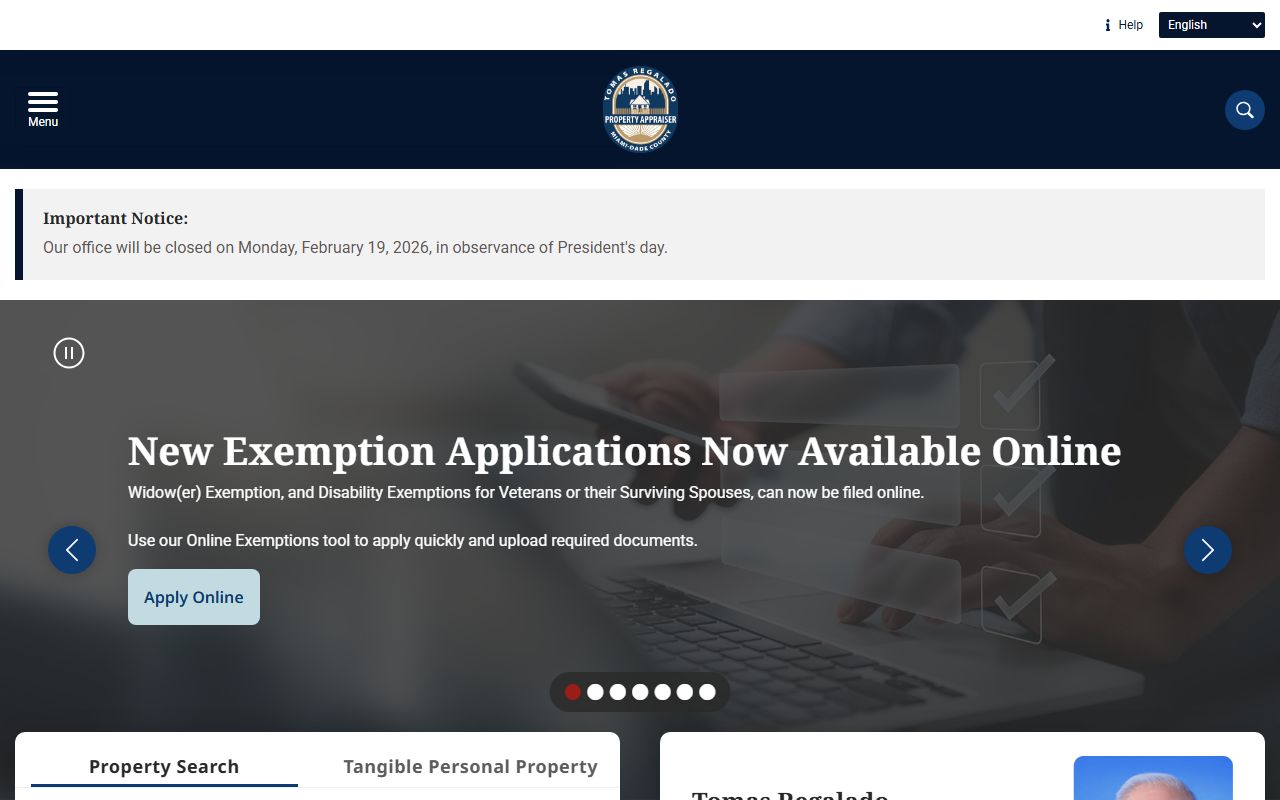
The portal gives access to the parcel search, exemption filing, the GIS map tool, and sales data. The map view is particularly useful for Miami Gardens searches because the city's grid can be dense and address verification through the map confirms you have the right parcel before pulling the full record.
For recorded documents in Miami-Dade County, the Clerk of the Courts operates a public search portal for the Official Records index. Many documents can be viewed online without charge. Certified copies carry per-page fees set by Florida law.
What Miami Gardens Property Records Show
When you pull a parcel record for a Miami Gardens address through the Miami-Dade Property Appraiser, here is what the record typically contains:
- Owner name and mailing address - current legal owner and where tax notices go
- Folio number - Miami-Dade County's unique parcel identifier
- Legal description - derived from the recorded deed
- Property use code - residential, commercial, condo, vacant, etc.
- Land area and building square footage
- Year built and construction type
- Just value - the annual market value estimate
- Assessed value - may be capped below just value for homesteaded properties
- Taxable value - just value minus exemptions
- Active exemptions - homestead, senior, disability, veteran
- Sales history - past transfers with sale dates and prices
Miami Gardens is a largely residential city. The majority of parcels are single-family homes. Many have been owner-occupied for years, so a significant portion carry the homestead exemption and the Save Our Homes cap. Buyers should note that when a property sells, the Save Our Homes cap resets and the new owner's taxable value will reflect just value, not the prior owner's lower assessed value. This can result in a noticeably higher tax bill in the first full year after purchase.
Homestead Exemption for Miami Gardens Homeowners
Florida's homestead exemption reduces taxable value on a primary residence by up to $50,000. The first $25,000 applies to all taxing authorities. The second $25,000 applies to the assessed value between $50,000 and $75,000 and is exempt from all levies except the school board. Combined, these two layers provide meaningful tax relief for qualifying Miami Gardens homeowners.
To qualify, you must own the property and occupy it as your permanent primary residence as of January 1. You must be a Florida resident. The deadline to file is March 1 each year. The Miami-Dade County Property Appraiser's exemptions section is available through miamidadepa.gov. Applications can be filed online, by mail, or in person at the main office at 111 NW 1st Street, Suite 710, Miami. Phone the office at 305-375-4712 or email PAWebmail@MiamiDadePA.gov with questions.
The Miami-Dade County Property Appraiser's contact page is the best place to find current office hours, phone numbers, and email contacts for exemption-related questions.
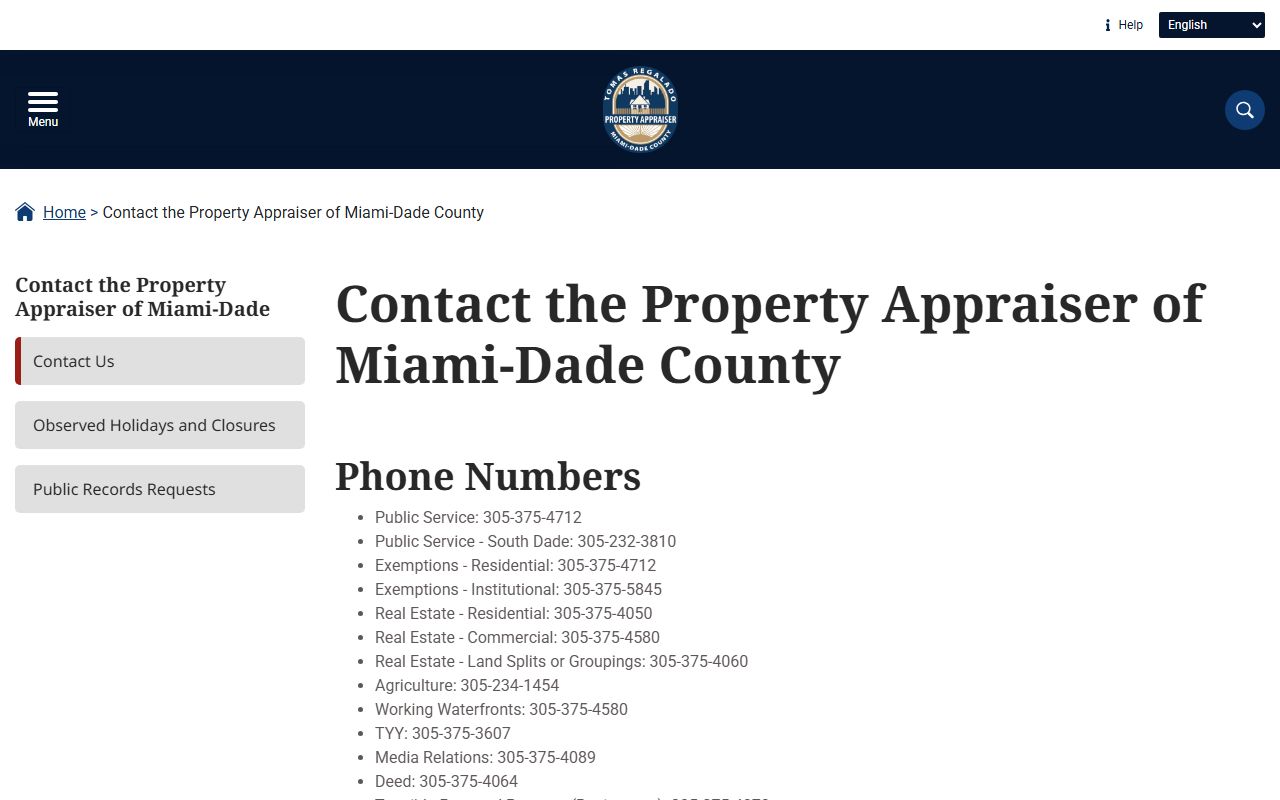
The contact page lists department-specific contacts, including the exemptions team. If you need help with an exemption application, renewal, or portability transfer, reaching out through the contact page connects you with the right staff.
Once you have the homestead exemption in place, the Save Our Homes cap under Section 193.155 limits annual increases in your assessed value to 3% or the CPI, whichever is lower. This benefit accumulates over time and can be transferred to a new Florida home through portability. You must apply for portability by March 1 of the year after you move. Additional exemptions available in Miami-Dade County include low-income senior, disability, widow or widower, and veterans exemptions.
City of Miami Gardens Government Resources
Miami Gardens City Hall is at 18605 NW 27th Avenue, Miami Gardens, FL 33056. The general city phone is 305-622-8000. The city website is miamigardens-fl.gov. City departments handle zoning, code compliance, permits, and other municipal services for property owners within city limits.
Building permits in Miami Gardens are handled through the city's building and code compliance functions. For current permit information, contact City Hall directly at 305-622-8000 or visit the city website for department listings. Permit records show what construction work was done legally on a property and whether all required inspections passed. Checking permit history before a purchase is worthwhile because open permits or code violations can affect a property's sale.
Miami Gardens also uses Miami-Dade County's 311 system for some service requests and information. The county's interactive map tools can supplement city resources when you need zoning or flood zone information that crosses jurisdictional boundaries.
Official Records at the Miami-Dade County Clerk
Recorded property documents in Miami Gardens are filed with the Miami-Dade County Clerk of the Courts. Under Chapter 28 of Florida Statutes, the Clerk maintains the Official Records index. For Miami Gardens properties, this includes:
- Warranty deeds and quitclaim deeds
- Mortgages and mortgage satisfactions
- Mechanic's liens and lien releases
- Lis pendens filings
- Judgment liens
- Easements and plats
The Clerk's online portal allows searches by party name, document type, and recording date range. Many documents can be viewed online at no cost. Certified copies carry fees set under Chapter 119 of Florida Statutes. The Clerk's main office is in downtown Miami. Miami-Dade County also has branch offices throughout the county that may be more convenient depending on where you are located.
TRIM Notice and Tax Calendar
Each August, Miami-Dade County mails a TRIM notice to all property owners of record. TRIM stands for Truth in Millage. The notice is not a tax bill. It shows your proposed assessed value for the upcoming tax year, any exemptions the Property Appraiser has on file for your parcel, and proposed millage rates from each taxing authority covering your property.
If you disagree with the assessed value shown on your TRIM notice, or you believe an exemption is missing, you have about 25 days from the notice date to file a petition with the Miami-Dade County Value Adjustment Board. The VAB is independent of the Property Appraiser and holds formal hearings where property owners can present evidence for a lower value or a denied exemption. Many petitions are resolved without needing an attorney.
Final millage rates are set by each taxing authority in September at public hearings. Tax bills go out in November. You save 4% by paying in November, 3% in December, 2% in January, and 1% in February. Taxes paid by March 31 are on time. After April 1, taxes become delinquent and Miami-Dade County initiates the tax certificate process under Chapter 192.
Nearby Cities
Miami Gardens is in the northern part of Miami-Dade County. Several other qualifying cities are in the same county or nearby.