
Homestead Property Records
Property records for the City of Homestead are maintained by the Miami-Dade County Property Appraiser and cover every parcel within city limits, showing ownership details, assessed and taxable values, legal descriptions, building characteristics, exemptions, and sales history. Because Homestead sits in the southern part of Miami-Dade County, all parcel data flows through the county system. This page explains how to search those records, what they contain, how the homestead exemption works for local property owners, and where to find related documents like deeds, liens, and permits.
Homestead Property Records Quick Facts
How Homestead Property Records Are Managed
The Miami-Dade County Property Appraiser is the agency responsible for all property assessment records in Homestead. The office is led by Tomás Regalado and is located at 111 NW 1st Street, Suite 710, Miami FL 33128. The main phone is 305-375-4712. General email inquiries go to PAWebmail@MiamiDadePA.gov. The office website is at miamidadepa.gov.
For tangible personal property matters, there is a separate email: TPP@MiamiDadePA.gov. If you need to submit or request records formally, use RecordsRequest@MiamiDadePA.gov. These separate contacts help route your request to the right team without delay.
The Property Appraiser's office does not set tax rates or collect taxes. It only determines assessed values and manages exemptions. Tax bills go out through the Miami-Dade Tax Collector once the Property Appraiser certifies the tax roll. Understanding this split helps you contact the right office for any given question.
The Miami-Dade County Property Appraiser's homepage lets you search all Homestead parcels by owner name, address, or folio number.
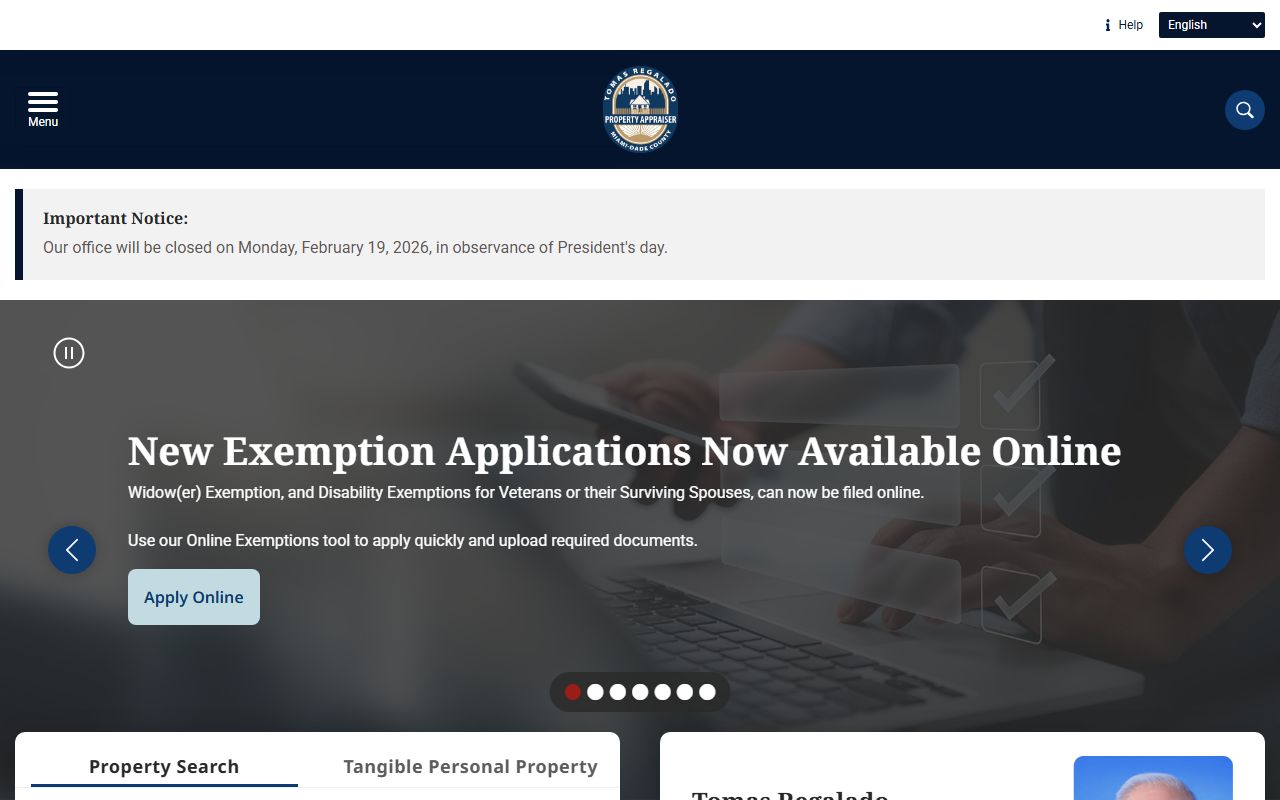
Use miamidadepa.gov to pull up ownership data, assessed values, and exemption status for any Homestead parcel.
Search Homestead Property Records Online
The Miami-Dade PA online portal lets you search by owner name, property address, or folio number. The folio number is a unique parcel identifier used throughout Miami-Dade County. If you have the folio number, it is the fastest way to pull up a specific parcel. You can find the folio on a prior tax bill, a deed, or a prior search result.
Each property record page shows the owner of record, mailing address, legal description, lot size, year built, building square footage, assessed value, taxable value, exemptions applied, and recent sales. Sales history goes back several years and includes the sale price and date for each recorded transfer.
The portal also shows any exemptions tied to the parcel. If a homestead exemption is active, you will see it listed along with the assessed value cap under Save Our Homes. This is useful when evaluating how much of the current value is sheltered from full market reassessment.
Searches are free. No account or registration is needed. The online system is available around the clock, which makes it convenient for title researchers, lenders, buyers, and homeowners who want to verify their own records. For copies of the official tax roll data, contact RecordsRequest@MiamiDadePA.gov.
What Homestead Property Records Include
Property records in Homestead cover several categories of information. Ownership records list the current owner of record, the owner's mailing address, and the date the current owner acquired the property. When a property sells, the new ownership gets recorded with the Miami-Dade Clerk of Courts and then updated in the Property Appraiser's system.
Assessment data shows two key values: assessed value and taxable value. The assessed value reflects what the appraiser sets as the property's market or non-homestead value. The taxable value is lower if exemptions apply. Both figures appear on the annual TRIM notice, which is the official notice of proposed property taxes sent each August.
Building characteristics include the number of bedrooms and bathrooms, total living area, construction type, year built, and any noted improvements. This data comes from field inspections and permit records. It is not always perfectly up to date, especially after recent renovations, but it gives a solid baseline for any property.
Sales history shows every recorded arm's-length transaction for the parcel. Foreclosure sales, estate transfers, and transfers between family members may be listed with a nominal price (often $100 or $10), which does not reflect true market value. Look for market sales when comparing sold prices.
Homestead Exemption for Homestead Residents
Florida's homestead exemption reduces the assessed value of a primary residence by up to $50,000. The first $25,000 applies to all property tax levies. The second $25,000 applies to non-school levies only. Both portions combined can produce meaningful savings on your annual tax bill, especially in a high-value market like Miami-Dade County.
To qualify, you must own the property and use it as your primary, permanent residence as of January 1 of the tax year. You cannot claim a homestead exemption in Florida and in another state at the same time. You also need a Florida driver's license or ID with the property address, or similar proof of primary residence.
The filing deadline is March 1 each year. If you bought your home after January 1, you can still apply before March 1 of the same year for that year's exemption. Miss the deadline and you will need to wait until next year. Apply through the Miami-Dade PA website or in person at the main office.
The Save Our Homes cap limits annual increases in the assessed value of a homestead property to 3% or the Consumer Price Index, whichever is lower. Over time this can create a significant gap between the assessed value and the full market value, which benefits long-term homeowners. When you sell and the new owner does not claim homestead, the assessed value resets to full market value in the following year.
Portability lets you transfer some or all of that Save Our Homes benefit to a new homestead property in Florida. You have up to three years from the date you gave up your old homestead to apply for portability. File the portability application at the same time you apply for your new homestead exemption.
The Miami-Dade PA tax roll administration page explains how assessments are set and how the annual tax roll is certified for the county, including Homestead parcels.
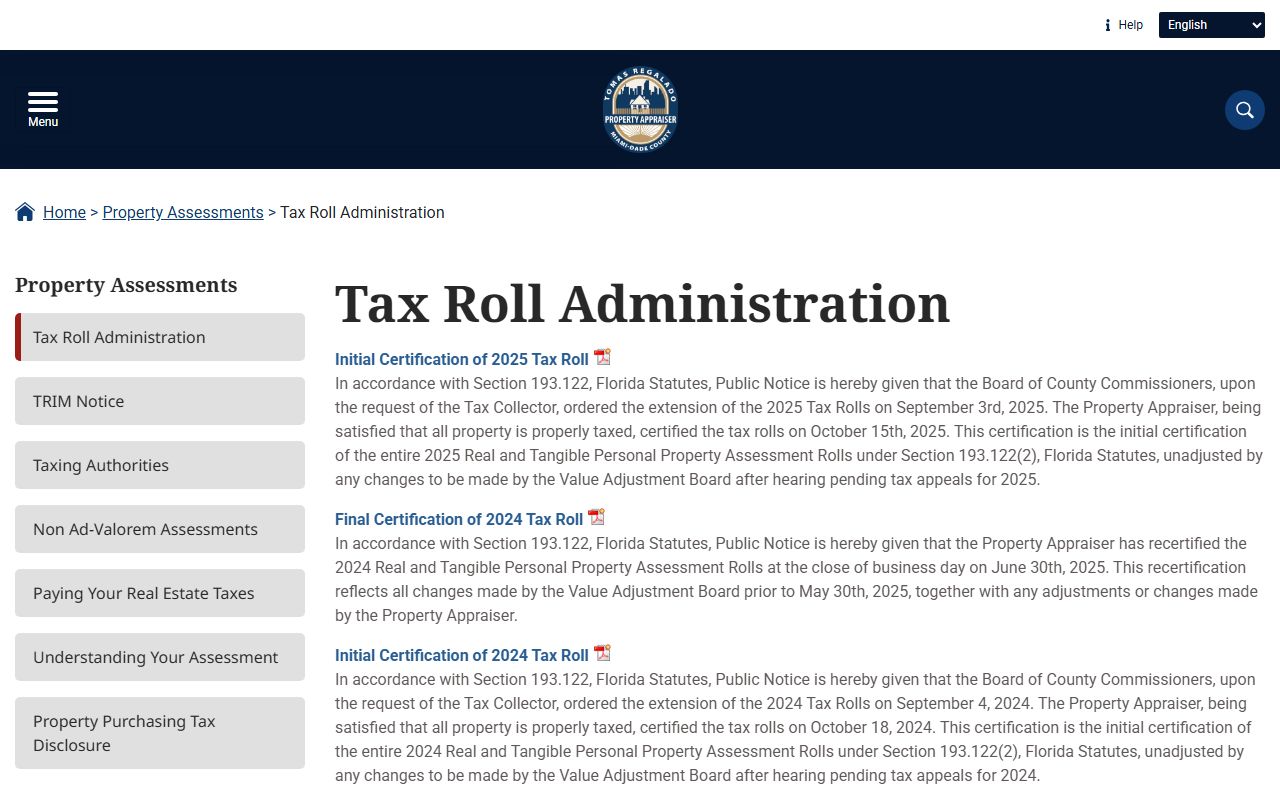
Learn more about how assessed values are calculated and certified at miamidadepa.gov.
City of Homestead Government Resources
The City of Homestead's main office is at 7900 N Homestead Boulevard, Homestead FL 33030, phone 305-224-4400. The city website is at cityofhomestead.com. City Hall handles local services, zoning matters, and public records requests related to city-level government documents.
Building permits and inspections are handled by the City of Homestead Building Department, reachable at 305-224-4500. Their page is at cityofhomestead.com/building-department. Building records are public, and permit searches can help you find out about work done on a property. This is particularly useful before buying, as unpermitted work can create liability for the new owner.
The building department tracks permit applications, inspection results, certificates of occupancy, and code enforcement actions. These records are distinct from Property Appraiser data but are used alongside it by lenders, appraisers, and buyers doing due diligence.
Official Records at the County Clerk
Deeds, mortgages, liens, and other recorded documents are not held by the Property Appraiser. They are filed with the Miami-Dade Clerk of Courts. Under Chapter 28 of the Florida Statutes, the Clerk maintains the official records index for all recorded instruments in the county.
You can search the Miami-Dade Clerk's official records online at the Clerk's website. Searches are free and open to the public. When you find a record, you can view it online or order a certified copy. Certified copies carry a fee set under Chapter 28. These documents include warranty deeds, quitclaim deeds, mortgage satisfactions, lis pendens filings, and judgment liens.
Property records and clerk records work together. When you search the Property Appraiser's system, you will often see a reference to the Official Record Book and Page where the deed was recorded. That Book and Page number lets you pull the actual document from the Clerk's index. This is useful when you need the full legal description or want to review the exact terms of a deed or lien.
Under Chapter 119, Florida's Public Records Law, these documents are open to the public. The law sets rules for access, response times, and allowable fees. Most routine requests are filled quickly and at low cost.
TRIM Notice and Property Tax Calendar
Each August, the Miami-Dade Property Appraiser mails the TRIM notice (Truth in Millage) to every property owner. The notice shows the proposed assessed value, the proposed tax rates set by each taxing authority, and the estimated tax bill. It is not the actual tax bill. It is a chance to review the figures before they become final.
If you disagree with the assessed value on your TRIM notice, you have 25 days from the mailing date to file a petition with the Value Adjustment Board. The VAB is an independent body that hears appeals. Filing is free. You do not need an attorney to petition, though some property owners choose to hire a tax agent or lawyer.
Tax bills go out in November and are due by March 31 of the following year. Early payment discounts apply: 4% in November, 3% in December, 2% in January, and 1% in February. Paying in November or December is the most common strategy to save on the bill. Properties with unpaid taxes after March 31 enter the tax certificate process under Florida law.
The full property tax calendar runs from January 1 (assessment date) through the following March 31 (payment deadline). Key dates include the March 1 exemption filing deadline, the August TRIM mailing, and the November tax bill. Keeping these dates in mind helps you stay current with your property records and tax obligations.
Nearby Cities
Homestead is located in southern Miami-Dade County, near several other cities with property record pages.