
Search Miami Beach Property Records
Miami Beach property records are maintained by the Miami-Dade County Property Appraiser and cover all parcels on Miami Beach and the barrier islands within city limits, showing ownership data, assessed and taxable values, legal descriptions, exemption status, building characteristics, and transaction history. Miami Beach is a separate city from Miami but shares the same county-level property records system. This page explains how to search those records, what information they include, how homestead exemptions work for Miami Beach residents, and where to find related recorded documents through the county clerk.
Miami Beach Property Records Quick Facts
How Miami Beach Property Records Are Managed
The Miami-Dade County Property Appraiser is the agency that holds and manages all property records for Miami Beach parcels. The main office is at 111 NW 1st Street, Suite 710, Miami FL 33128, phone 305-375-4712. The general contact email is PAWebmail@MiamiDadePA.gov. For ADA-related inquiries, use ADA@miamidadepa.gov. The full office website is at miamidadepa.gov.
If you need to report an ownership change, the dedicated email is OwnershipChanges@MiamiDadePa.gov. Ownership updates happen after a deed is recorded with the Miami-Dade Clerk of Courts. The PA then processes the change and updates the parcel record. This process typically takes a few weeks after recording, so there may be a short lag between when a deed is recorded and when the PA system reflects the new owner.
The Property Appraiser's job is to value property and manage exemptions. It does not issue tax bills or collect payments. For questions about your tax bill or payment, contact the Miami-Dade Tax Collector. For questions about your assessed value, exemptions, or property data, the PA is the right contact.
The Miami-Dade County Property Appraiser's main portal lets you search any Miami Beach parcel by owner name, address, or folio number for free.
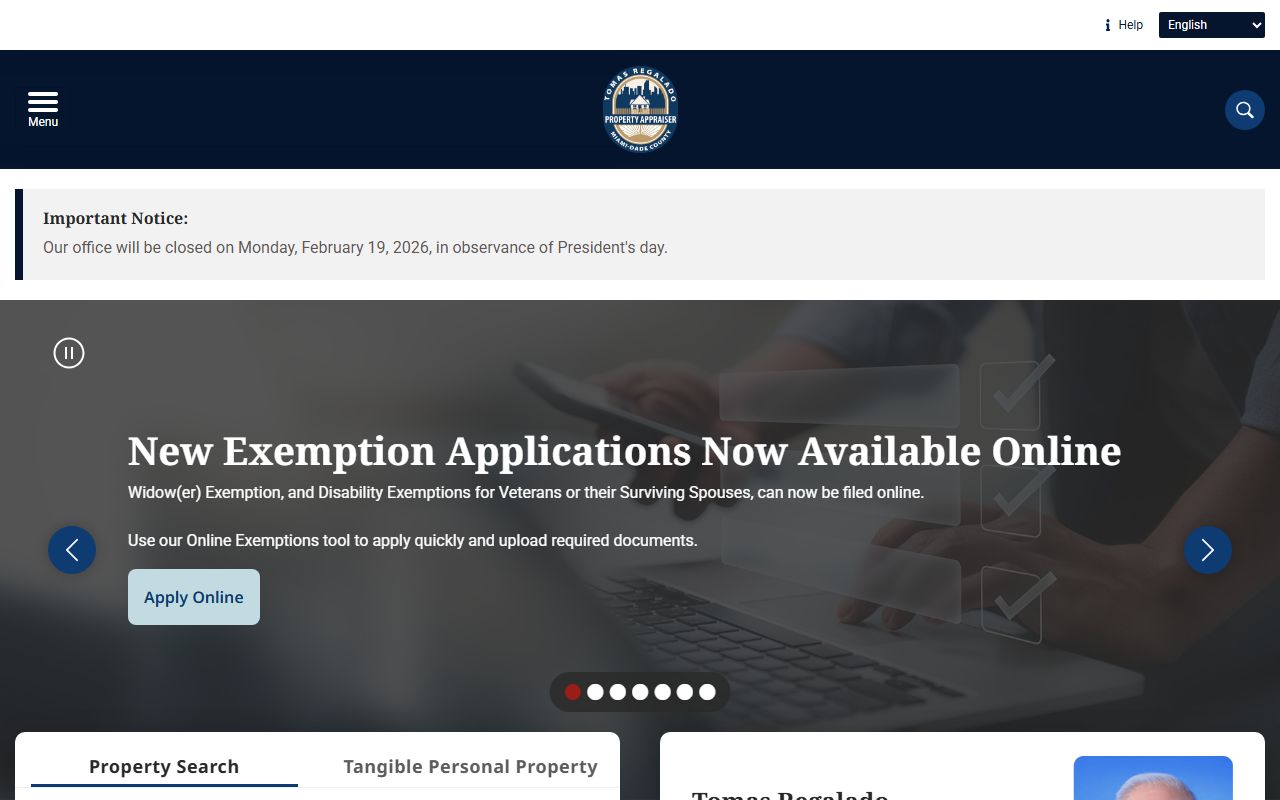
Go to miamidadepa.gov to find current ownership, assessed values, and exemption data for any Miami Beach property.
Search Miami Beach Property Records Online
The Miami-Dade PA online search portal is the fastest way to look up Miami Beach property data. You can search by owner name, full property address, or folio number. The folio number is the unique parcel identifier assigned by the county. Once you find the parcel, the detail page shows all current records in a single view without extra steps.
Miami Beach has a wide mix of property types: single-family homes, condominiums, multi-family buildings, commercial properties, and historic structures. The PA system handles all of these, though condo records differ slightly. For condos, each unit has its own folio number, and the record shows the unit's individual assessed value and ownership rather than the building as a whole. The condo association's common areas are assessed separately under a different folio.
Sales history is visible for each parcel and typically shows the last several years of transfers. Each entry includes the sale date, recorded price, and the Official Record Book and Page number where the deed was filed. You can use the Book and Page to find the actual deed in the Clerk's online index. Non-arms-length transactions (family transfers, gifts, corporate transfers) often show a nominal sale price and do not reflect fair market value.
All parcel searches on the PA portal are free and open to the public. You do not need an account or any special access. For formal bulk data requests or certified records, contact RecordsRequest@MiamiDadePA.gov or the PA's main office.
What Miami Beach Property Records Include
Miami Beach parcel records show several categories of information. Ownership data lists the current title holder and their mailing address. When a property changes hands, the deed is recorded with the Clerk, and the PA updates its file. The owner of record is the person or entity shown on the most recently recorded deed.
Value data includes the just value (closest to market value), the assessed value (which may be lower due to homestead caps), and the taxable value after all exemptions. These figures are the basis for calculating your annual property tax. The assessed value and taxable value are what appear on your TRIM notice each August.
Building data covers the property type, year built, total area, number of units, construction type, and quality class. Miami Beach has many historic and art deco structures, which may have unique classification codes in the PA system. Newer condominiums typically have complete and accurate data because permit records feed directly into the system after construction.
Land data shows the lot dimensions, lot size, zoning designation, and any waterfront or view designations. In Miami Beach, waterfront parcels often carry premium values, and the PA record will note the water frontage type. This data is used in appraisals and is relevant when comparing similar sales in the area.
Homestead Exemption for Miami Beach Residents
Florida law gives homeowners who use their Miami Beach property as a permanent primary residence an exemption of up to $50,000 off the assessed value for property tax purposes. The first $25,000 applies to all taxing levies. The second $25,000 applies to non-school levies only. In a market like Miami Beach where property values are high, this exemption can result in meaningful annual tax savings.
To qualify, you must own the property and live in it as your primary Florida residence as of January 1 of the tax year. You need a Florida driver's license or ID with the Miami Beach address, or other qualifying proof of primary residence. You cannot claim a homestead exemption in Florida and in another state at the same time.
The deadline to apply is March 1 each year. If you bought your home in the prior year and missed the deadline, you can still apply for the following year. Applications can be filed online through the Miami-Dade PA website, by mail, or in person at the main office. Contact PAWebmail@MiamiDadePA.gov or call 305-375-4712 with questions about eligibility or the application process.
The Save Our Homes assessment cap limits annual growth in your homestead property's assessed value to 3% or the CPI, whichever is lower. Miami Beach has seen significant market appreciation over the years, so long-term homestead holders may have assessed values well below current market levels. This cap resets to market value when the property is sold and the new owner does not claim homestead.
Portability allows you to bring a Save Our Homes benefit from a previous Florida homestead to a new one in the state. The benefit can transfer up to $500,000. File the portability application at the same time as your new homestead application. The window to use portability is up to three years from abandoning the prior homestead.
City of Miami Beach Government Resources
The City of Miami Beach's main office is at 1700 Convention Center Drive, Miami Beach FL 33139, phone 305-673-7000. The city website is at miamibeachfl.gov. The city manages local ordinances, zoning approvals, code enforcement, and city-level public records. Records requests for city documents start at the city's main contact page.
The Building Department handles permits, inspections, and certificates of occupancy for properties within city limits. Contact them at 305-673-7610 or online at miamibeachfl.gov/building-department. Miami Beach has active construction and renovation activity, so permit records can be particularly detailed. Permit history is public and searchable through the city's online system.
Building records are separate from Property Appraiser data. The PA shows assessed values and ownership. The building department shows what work was done, when it was permitted, and whether inspections passed. Checking both systems gives a more complete picture of a property's condition and compliance history.
Official Records at the County Clerk
Deeds, mortgages, liens, and other recorded instruments for Miami Beach properties are filed with the Miami-Dade Clerk of Courts. The Clerk is the legal custodian of official records under Chapter 28 of the Florida Statutes. The PA system shows you a Book and Page reference for each deed or transfer. Use that reference to find the document in the Clerk's official records index.
The Clerk's online system lets you search by grantor or grantee name, instrument type, or Book and Page number. Searches are free. Viewing most documents online is free. Certified paper copies carry a per-page fee as set by Chapter 28. Uncertified copies are cheaper and often sufficient for research purposes.
Public access to these records is protected under Chapter 119, Florida's Public Records Law. The law ensures that property ownership records, liens, and mortgages remain open to anyone who wants to look them up. No special reason or standing is needed to access these records.
The Miami-Dade PA tax roll page explains how assessed values are certified each year for Miami Beach and all other county parcels, including how the annual roll is submitted to state authorities.
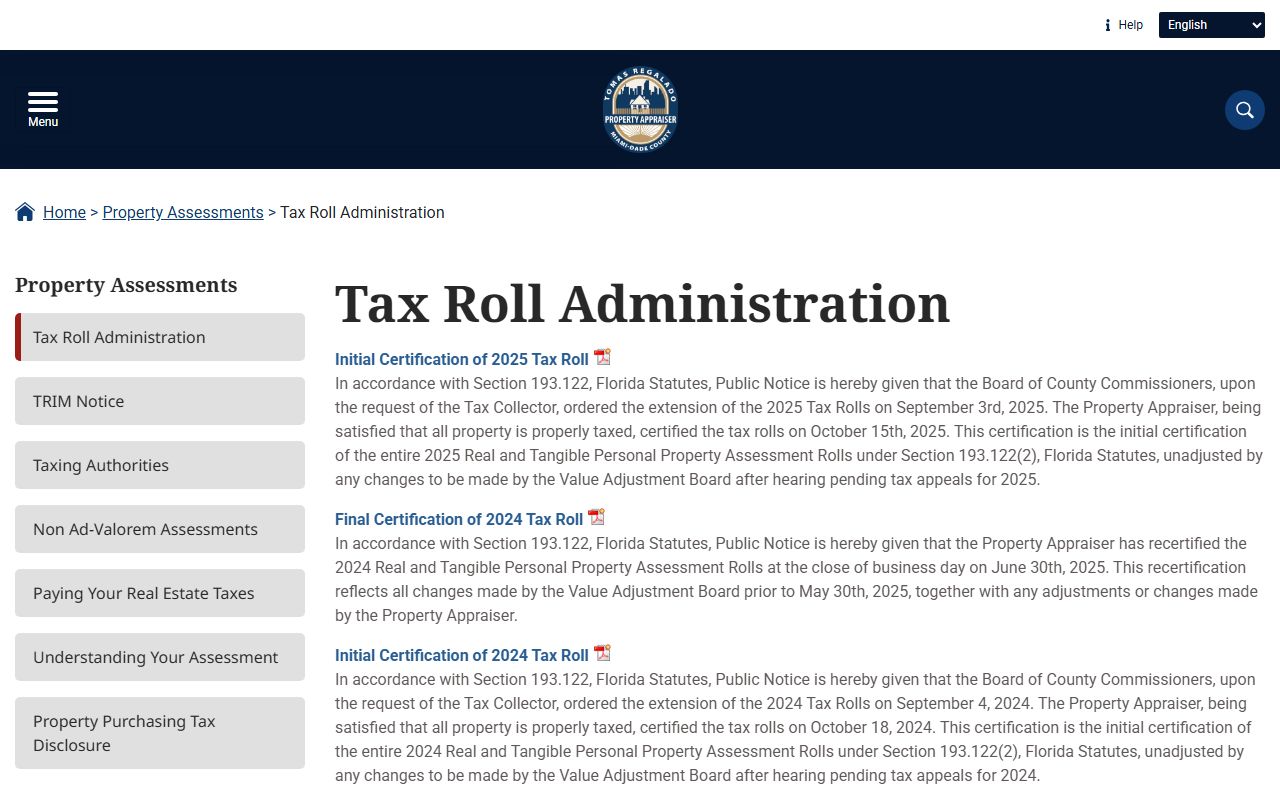
Learn how Miami Beach assessed values are set and certified at miamidadepa.gov.
TRIM Notice and Property Tax Calendar
The Miami-Dade Property Appraiser sends TRIM notices to all Miami Beach property owners each August. The TRIM notice shows the proposed assessed value, the proposed millage rates from each taxing authority (city, county, school board, and special districts), and the estimated tax bill. It is not a bill. It is a notice giving you 25 days to petition if you believe the value is wrong.
To challenge your assessed value, file a petition with the Miami-Dade Value Adjustment Board within 25 days of the TRIM mailing. The petition process is free and does not require a lawyer. The VAB schedules a hearing, reviews evidence, and issues a ruling. If the ruling reduces your value, your November tax bill reflects the lower amount.
Tax bills are mailed in November. Florida's early payment discount schedule: 4% off for November payment, 3% for December, 2% for January, 1% for February. Full payment is due by March 31. After that, taxes are delinquent. The county will then issue a tax certificate, which carries interest and can lead to a tax deed sale if left unpaid for several years.
The full cycle runs from January 1 (the valuation date) through March 31 of the following year (the payment deadline). The key dates to track: March 1 exemption deadline, August TRIM mailing, 25-day VAB petition window, November tax bill, and March 31 payment deadline. All of these are set by Chapter 192 and Chapter 193 of the Florida Statutes.
Nearby Cities
Miami Beach is in eastern Miami-Dade County, connected by causeways to several other large cities with property record pages.