
Brevard County Property Records Lookup
Brevard County property records cover more than 250,000 parcels along Florida's Space Coast, from Titusville in the north to Palm Bay and Micco in the south. The Brevard County Property Appraiser's Office (BCPAO) maintains these records and provides online access to ownership data, assessed values, exemption status, sales history, and building characteristics. Whether you are verifying a purchase, researching a neighbor's parcel, or tracking tax history, the BCPAO database is the primary source for all Brevard County property data.
Brevard County Property Records Quick Facts
Brevard County Property Appraiser (BCPAO)
The Brevard County Property Appraiser's Office (BCPAO) is headquartered at 400 S Street in Titusville, FL 32780. The main phone number is 321-264-6700. The BCPAO website at bcpao.us is the main online resource for property searches, exemption applications, forms, and contact information for all BCPAO locations across the county.
The BCPAO provides accurate valuations of property located within Brevard County and works to produce and publish the most current and accurate information possible. Under Florida Statutes Chapter 193, the office must assess all real and tangible personal property each year at just value. Brevard is one of Florida's larger counties by land area, stretching about 72 miles along the Atlantic coast, so the office manages a broad and varied range of property types.
The BCPAO website is one of the better-equipped property appraiser portals in the state, offering detailed parcel data, GIS mapping tools, and a full suite of exemption resources. The office strives to keep the data current as new sales close and new construction is completed throughout the year.
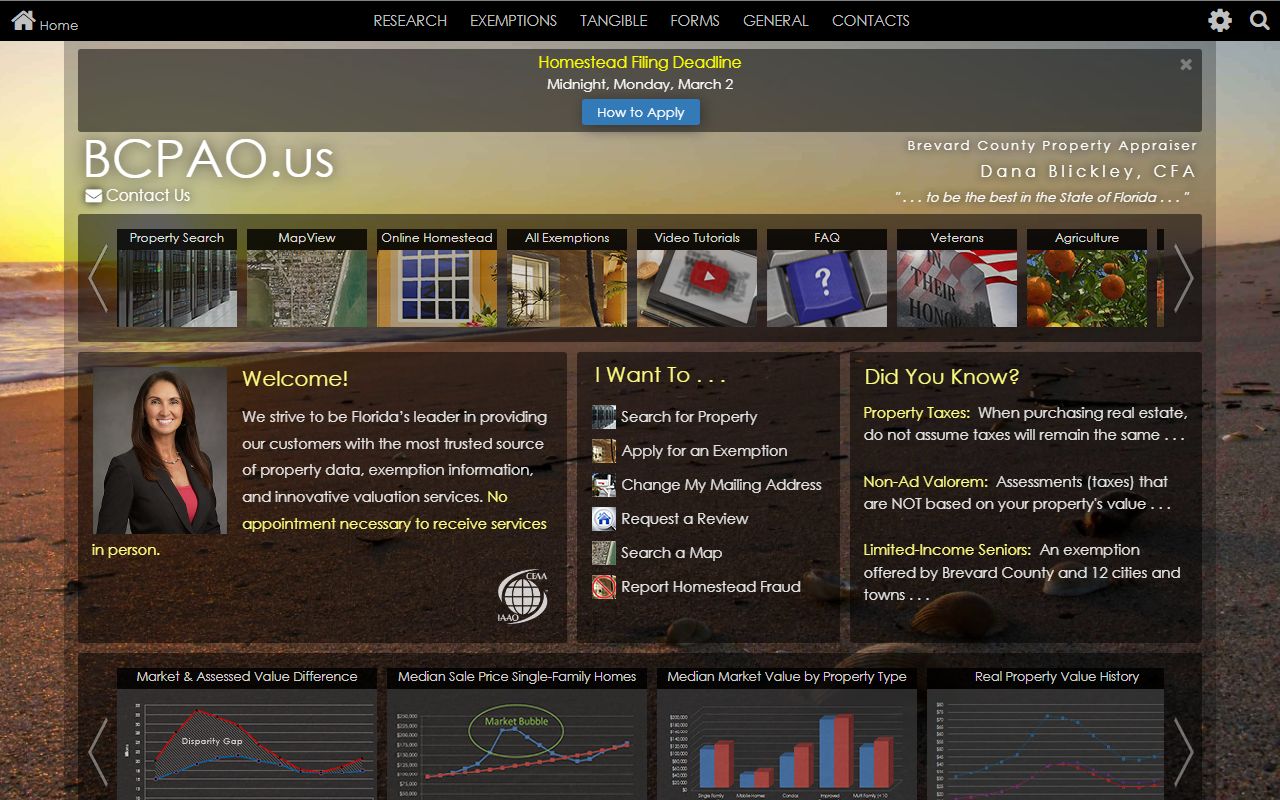
The BCPAO homepage at bcpao.us provides direct access to the property search tool, exemption pages, forms, and contact information for all Brevard County office locations.
How to Search Brevard County Property Records
The BCPAO's online property search portal is at bcpao.us/PropertySearch. By clicking through to the property research section on the left side of the website, you can search by owner name, legal description, tax account number, or property address. Once you locate the property, the full record includes the Parcel ID, property address, tax account number, owner information, legal description, value summary, land data, sales history, extra features, and current year tax information.
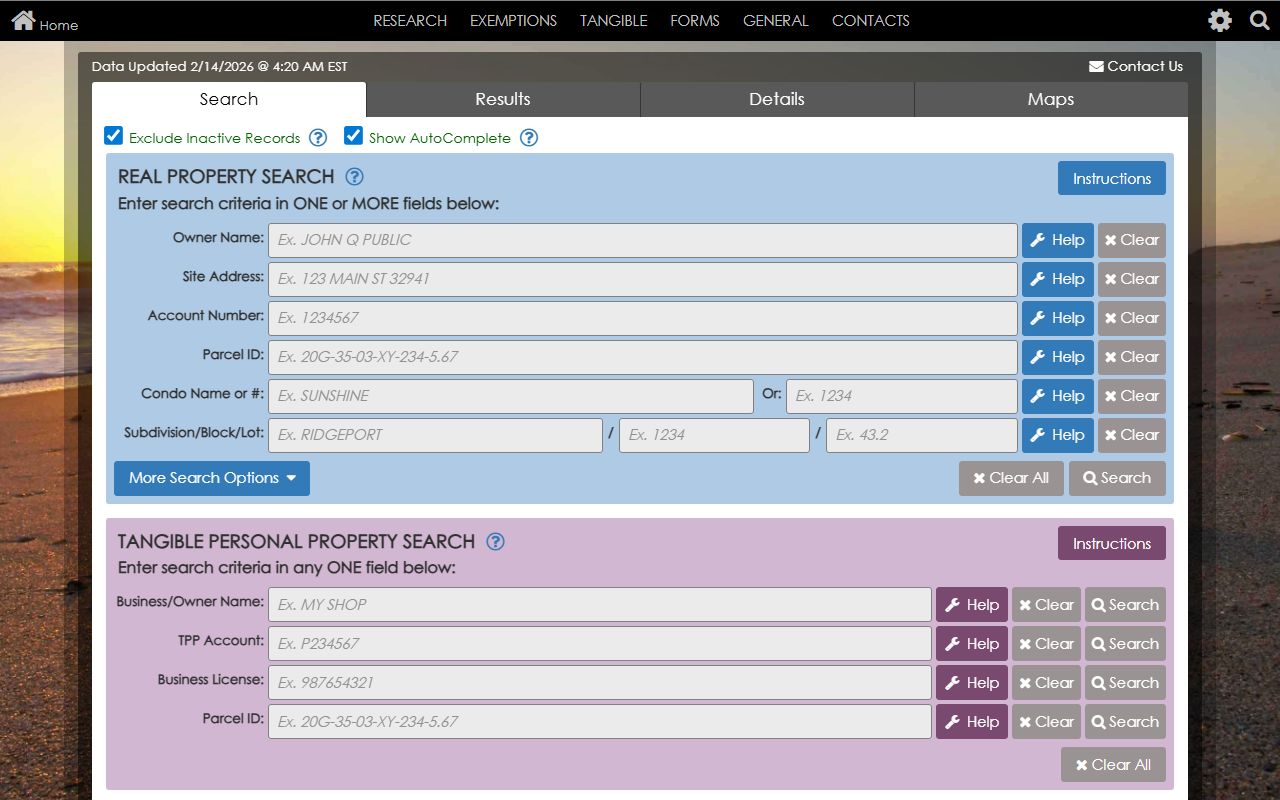
The property search at bcpao.us delivers a comprehensive parcel record that includes value history, ownership details, and tax data in a single view.
In-person searches are available at the main Titusville office and at satellite offices the BCPAO maintains in other parts of the county. For large and complex counties like Brevard, satellite offices help reduce travel time for residents in Melbourne, Palm Bay, and other areas far from the county seat. Bring a parcel ID, address, or owner name when visiting. Staff are equipped to assist with both current-year lookups and historical record research.
Deed records, mortgages, and other instruments affecting title are recorded at the Brevard County Clerk of Courts, not the BCPAO. The clerk's records are public under Chapter 119, and the clerk's indexing duties are governed by Chapter 28. For title research, the clerk's official records system is the authoritative source.
Note: Tax account numbers used by the BCPAO and the Brevard County Tax Collector may differ from the parcel ID number. When searching across systems, use the parcel ID as the consistent identifier to avoid confusion.
What Brevard County Property Records Show
A full BCPAO property record is one of the more detailed parcel records available from any Florida county appraiser. The value summary shows just (market) value, assessed value after any applicable cap, and taxable value after exemptions. Each of these three numbers is shown separately so you can understand exactly how your tax bill is calculated. For homestead properties with a long history of Save Our Homes protection, the gap between just value and assessed value can be substantial.
Sales history shows every recorded transaction for the parcel going back through the database. Each entry lists the date of sale, the sale price, the type of deed, and the deed book and page reference. This data is invaluable for buyers and appraisers who need to understand how a property's value has trended. Brevard County's coastal market, with its mix of waterfront homes, manufactured housing communities, and Kennedy Space Center area properties, can have wide variation in value trends even within short distances.
Land data shows the acreage, zoning, land use classification, and in some cases the soil designation or flood zone. Extra features such as pools, docks, screen enclosures, barns, and storage buildings are listed separately with their own square footage and value contribution. Building data includes year built, square footage of heated and unheated areas, construction type, and condition grade. All of this feeds into the just value calculation under Chapter 192.
Homestead Exemption in Brevard County
The homestead exemption reduces taxable value by up to $50,000 for Brevard County homeowners who use their property as a primary permanent residence. The standard breakdown applies: the first $25,000 reduces value for all taxes, and the second $25,000 (covering values between $50,000 and $75,000) reduces value for non-school taxes only.
Applications for the homestead exemption are available at bcpao.us/Exemptions. The page lists all available exemptions, eligibility requirements, and the documents you will need to submit. You must apply by March 1 for the exemption to take effect for that tax year.
Once you have homestead status, the Save Our Homes cap under Florida Statutes Section 193.155 limits annual increases in your assessed value to 3% or the rate of inflation change from the prior year, whichever is lower. In Brevard County, where the market has moved significantly in recent years, this cap has provided meaningful protection for long-term homeowners. If you are a new buyer purchasing from someone who had a large accumulated cap benefit, be aware that the cap resets on sale, which means your first year's assessed value will be much closer to market value than the previous owner's was.
Portability allows you to transfer a cap benefit from a prior Florida homestead to your new Brevard County property. The application for portability is filed at the same time as the new homestead exemption application. Other exemptions available through the BCPAO include those for seniors, veterans, first responders, widows and widowers, and people with disabilities. The exemptions page at bcpao.us walks through each one.
Brevard County Property Tax Process
Brevard County's property tax year begins with the appraiser's valuation work throughout the spring and summer. By August 1, the BCPAO certifies the tax roll. Then TRIM notices go out to all property owners in August. Each notice shows the proposed values, the proposed millage rates from each taxing district, and the scheduled dates of public budget hearings.
Brevard County has several overlapping taxing authorities: the county government, the school board, each city or municipality, hospital districts, fire districts, and others. Each sets its own millage rate. Your TRIM notice shows each rate separately so you can see exactly where your tax dollars are going. The total rate multiplied by your taxable value gives you the proposed tax amount.
If the proposed assessed value seems too high, you can contact the BCPAO informally to discuss it. If the appraiser doesn't adjust it, you can file a petition with the Brevard County Value Adjustment Board. The VAB is independent from the appraiser and holds evidentiary hearings. You must file before the petition deadline shown on your TRIM notice, which is typically in mid-September.
Tax bills are mailed by the tax collector in November. Discounts run 4% in November, 3% in December, 2% in January, 1% in February. Full payment is due March 31. Delinquent taxes after April 1 result in tax certificates being sold at public auction in June. Property owners have two years to redeem those certificates before the certificate holder can apply for a tax deed and potentially take ownership of the property.
Official Records at the Brevard County Clerk
Deeds, mortgages, liens, and all other instruments affecting title to real property in Brevard County are recorded and maintained by the Clerk of the Circuit Court. This office is the keeper of the official record books that form the chain of title for every parcel in the county. When you record a deed or mortgage in Brevard County, it becomes part of the public record under Chapter 119 and is indexed by the clerk under the requirements of Chapter 28.
The Brevard County Clerk maintains an online access system for official records. Searches can be done by grantor name, grantee name, instrument type, or recording date. Certified copies of recorded documents carry a clerk's seal and are used for legal transactions, title insurance, and court filings. Uncertified copies are fine for research and reference.
Brevard County's mix of residential, commercial, and coastal properties means a wide variety of instruments pass through the clerk's recording office. Mechanic's liens from construction projects, homeowner association liens, code enforcement liens, and judgment liens all appear in the official records and can affect a property's title. Before buying any property in the county, a thorough search of the clerk's records is standard procedure to confirm clear title.
Cities in Brevard County
Brevard County has two cities that meet the population threshold for dedicated pages on this site. Palm Bay is the most populous city in the county, and Melbourne is the second largest. Other municipalities such as Titusville, Cocoa, Rockledge, and Merritt Island are smaller and do not have separate city pages here.
Nearby Counties
Brevard County borders four other Florida counties. Each has its own property records system and independently elected property appraiser.