
Okeechobee County Property Records
Okeechobee County property records are maintained by the Okeechobee County Property Appraiser at 307 NW 5th Avenue in the city of Okeechobee, covering all parcels in this south-central Florida county along the northern shore of Lake Okeechobee. You can search ownership history, assessed values, exemptions, and sales data online through the appraiser's website at okeechobeepa.com, or contact the office by phone at 863-763-2151.
Okeechobee County Property Records Quick Facts
Okeechobee County Property Appraiser Office
The Okeechobee County Property Appraiser office is located at 307 NW 5th Avenue, Okeechobee, FL 34972. The office phone is 863-763-2151. The public website at okeechobeepa.com provides a free parcel search tool along with exemption information, forms, and links to other county services. The appraiser's primary duty is to assess all real property in Okeechobee County at just value each year and to maintain the official tax roll that the Tax Collector uses to generate tax bills.
Okeechobee County is one of Florida's smaller counties by population but covers a significant land area in south-central Florida. It is bordered on the south by Lake Okeechobee, the largest freshwater lake in Florida and the second largest in the contiguous United States. The county's economy is heavily influenced by agriculture and ranching, and the property appraiser manages a high proportion of agricultural parcels compared to many other Florida counties.
The appraiser's homepage provides direct access to the parcel search, exemption applications, and contact information.
The Okeechobee County Property Appraiser website is the main public-facing resource for Okeechobee County property records, exemption filings, and assessment data.
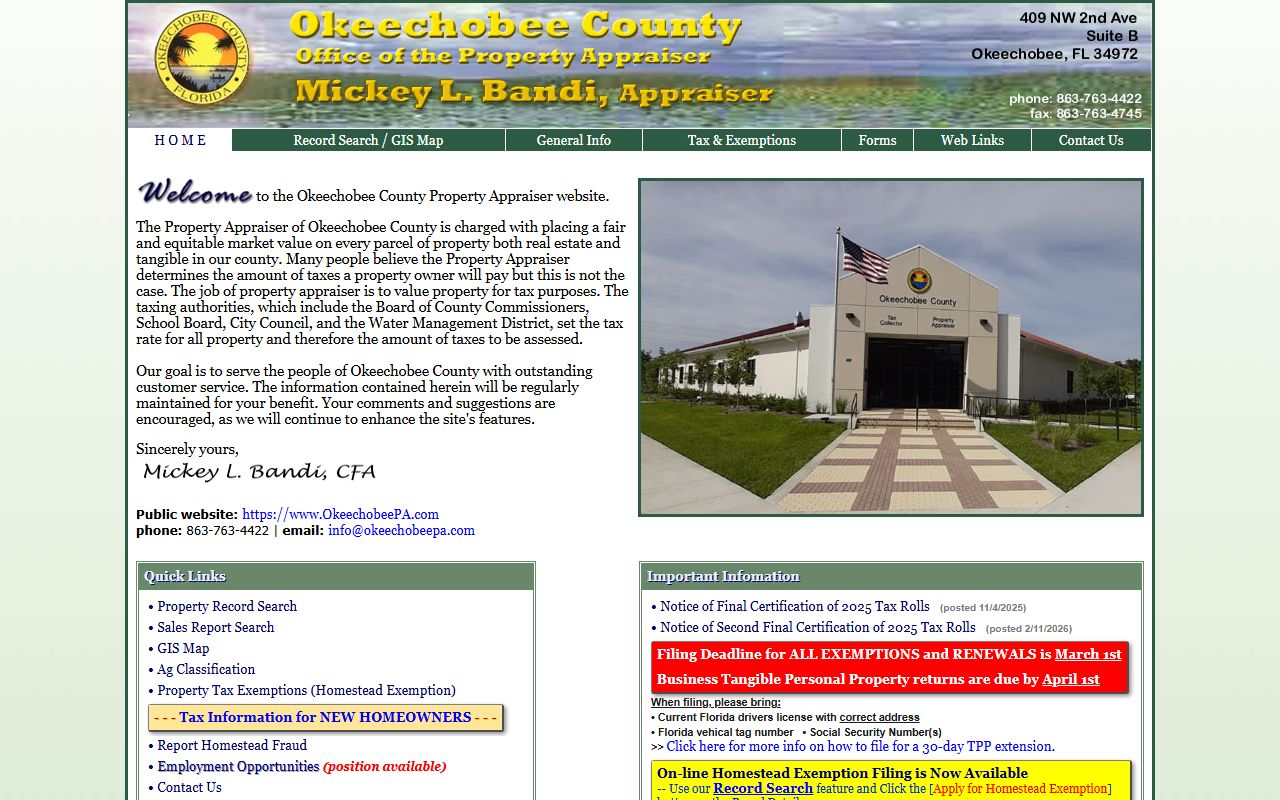
The portal gives you direct access to parcel searches, property maps, exemption details, and the tax roll data that underlies the county's property assessment process.
Note: The Property Appraiser does not set tax rates or send tax bills. Contact the Okeechobee County Tax Collector for payment and delinquency information.
How to Search Okeechobee County Property Records
The Okeechobee County Property Appraiser's website gives you free access to all parcel records in the county. You can search by owner name, parcel ID number, or property address. Each result shows the current owner, the mailing address, the legal description, the land use classification, and all valuation data including just value, assessed value, and taxable value. Active exemptions are displayed on the record, and sales history shows prior transfers with dates, prices, and deed recording references.
Because Okeechobee County has a large number of agricultural parcels, the search results often include land use codes specific to farming, ranching, and timber production. If you are looking up a rural parcel, the legal description may reference a range and township rather than a subdivision plat. The parcel ID search is usually the most reliable method for agricultural and large-tract properties.
The Florida Department of Revenue's Local Officials directory can help you confirm contact information for the Okeechobee County Property Appraiser and related county officials.
The Florida DOR's Find County Officials page lists the property appraiser, tax collector, and Value Adjustment Board contacts for Okeechobee County and every other Florida county.
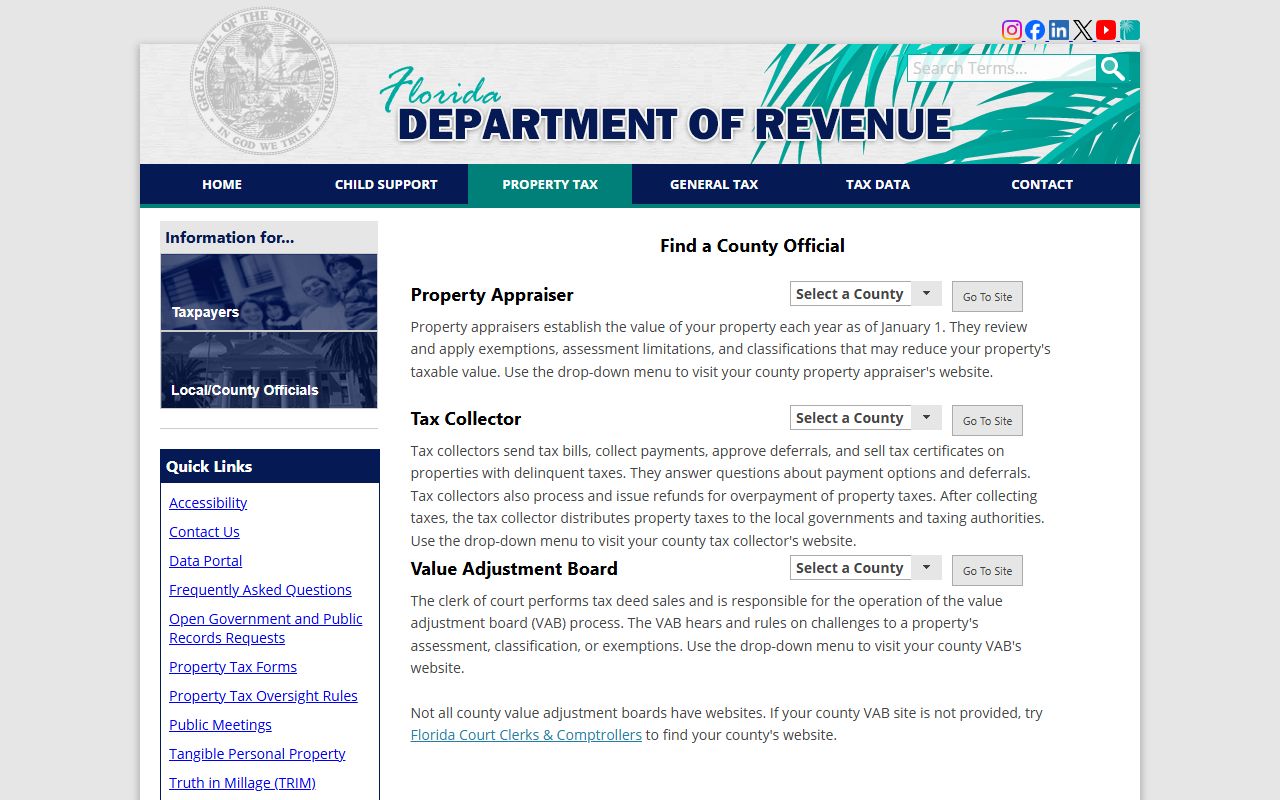
This resource is useful if you need to reach a specific office or want to confirm the current elected appraiser's name before mailing a formal request.
What Okeechobee County Property Records Contain
Each Okeechobee County parcel record includes the owner's name and mailing address, the physical address of the property, the legal description, the parcel identification number, and the land use or zoning classification. Valuation fields show just value, assessed value with any Save Our Homes cap applied, and taxable value after exemptions. Any active exemptions appear on the record, including homestead, agricultural classification, and any disability or veteran-related exemption.
Residential records show the year the home was built, the heated living area, the number of bedrooms and baths, and details about the structure's construction. In Okeechobee County, many residential properties are on large lots or acreage, and the record may list both a residential improvement value and a separate land value based on acreage.
Agricultural parcels make up a significant share of Okeechobee County's tax roll. These records show the land type (cropland, pasture, specialty farms, citrus, etc.), the total acreage, and any agricultural exemption or classification that has been applied. Florida allows agricultural land to be assessed at its current use value rather than market value if the owner can demonstrate a genuine agricultural purpose. This often results in a much lower assessed value for farm and ranch land compared to residential land of similar acreage.
Sales data is part of every parcel record, showing each transfer with the date, sale price, deed type, and official records instrument number. Okeechobee County has a smaller transaction volume than more urban counties, so the sales data for any given parcel may show fewer transfers over time, but the data that exists is still useful for understanding ownership history and value trends.
Homestead Exemption and Agricultural Classifications
Okeechobee County residents who own and occupy their home as a primary residence can apply for the homestead exemption. The exemption reduces the assessed value by up to $50,000: the first $25,000 applies to all property taxes, and the second $25,000 applies to all levies except school taxes. You must file with the Okeechobee County Property Appraiser by March 1 of the year in which you want the exemption. Applications require proof of Florida residency, such as a Florida driver's license and voter registration showing the property address.
The Save Our Homes cap limits annual increases in a homesteaded property's assessed value to 3% or the rate of inflation, whichever is lower. In Okeechobee County, where many homes are on larger lots or rural parcels, this cap provides meaningful protection when land values rise due to regional growth or agricultural land price increases.
Agricultural classification is a separate benefit from the homestead exemption. A property owner can apply to have their land assessed at agricultural use value rather than market value if the land meets the legal criteria for bona fide agriculture under Florida law. The appraiser reviews agricultural classification applications each year and may conduct site visits to verify that the land is genuinely being used for farming, ranching, or other qualifying agricultural purposes. Agricultural classification can result in a significant reduction in the land's assessed value.
Additional exemptions in Okeechobee County include those for widows and widowers, persons with disability, veterans with service-connected disabilities, and senior citizens who meet income limits. The appraiser's office website lists all available exemptions and the documentation required for each.
TRIM Notices and the Okeechobee County Tax Calendar
In August, Okeechobee County property owners receive a Truth in Millage (TRIM) notice. The notice shows the proposed assessed value, all current exemptions, and the proposed tax rates from each taxing authority covering the property. In Okeechobee County, taxing bodies include the county board of county commissioners, the Okeechobee County School Board, the City of Okeechobee for parcels within city limits, and various special districts including water control districts.
If your TRIM notice shows an assessed value that seems too high, start by calling or visiting the appraiser's office for an informal review. This is the quickest way to resolve errors, especially for simple issues like an incorrect property characteristic or a missed exemption. If the informal review does not resolve the dispute, you can file a formal petition with the Okeechobee County Value Adjustment Board within 25 days of the TRIM mailing date.
After taxing authorities adopt final millage rates, the Okeechobee County Tax Collector mails actual tax bills in November. You can earn a discount by paying early: 4% in November, 3% in December, 2% in January, and 1% in February. Full payment is due by March 31 to avoid late penalties and potential tax certificate sale.
Official Records and Florida Property Law
The Okeechobee County Clerk of Circuit Court records all official instruments that affect real property in the county, including deeds, mortgages, satisfactions, and liens. These records are public under Chapter 28, Florida Statutes. The clerk's office indexes all documents by grantor and grantee name, document type, and recording date. Most recent official records are searchable online through the clerk's website.
Property assessment in Okeechobee County follows Chapter 192 and Chapter 193, Florida Statutes. Chapter 192 sets the definitions and general rules; Chapter 193 sets the specific procedures for assessing different property types, including the agricultural use assessment that is especially important in Okeechobee County.
Public access to all property records is guaranteed by Chapter 119, Florida Statutes. Any person can inspect or copy records held by the appraiser or clerk. The Florida Department of Revenue monitors Okeechobee County's assessment practices and provides statewide oversight to ensure just value standards are met each year.
Cities in Okeechobee County
The city of Okeechobee is the county seat and the only incorporated municipality in Okeechobee County. Its population is roughly 6,000, well below the 100,000 threshold for a dedicated city page on this site. All Okeechobee County property records, whether for parcels in the city or the unincorporated county, are available through the county property appraiser's online search tool at okeechobeepa.com.
Nearby Counties
Okeechobee County sits at the center of south Florida and borders six other counties.