
Find Property Records in Collier County
Collier County property records are kept by the Collier County Property Appraiser and are available to the public at no cost through the office's online search portal. Whether you are researching a parcel in Naples, Marco Island, Immokalee, or any other part of Collier County, you can find ownership data, assessed values, sales history, and more using the tools described on this page.
Collier County Property Records Quick Facts
Collier County Property Appraiser
The Collier County Property Appraiser office is located at 3295 Tamiami Trail E, Naples, FL 34112. The phone number is 239-252-8141. The office manages the assessment roll for all real property in Collier County, which includes a wide range of land types: high-value waterfront residential, commercial corridors, agricultural land in the eastern parts of the county, and conservation areas. The appraiser's website at collierappraiser.com is the primary tool for online record searches.
All assessments in Collier County are governed by Florida Statute Chapter 193. That law requires the Property Appraiser to assess all property at just value, which is the fair market value of the property as of January 1 of each tax year. The appraiser must inspect every property in the county at least once every five years, as required by Florida law.
The screenshot below is from the Collier County Property Appraiser's homepage at collierappraiser.com, which is the main access point for online parcel searches.
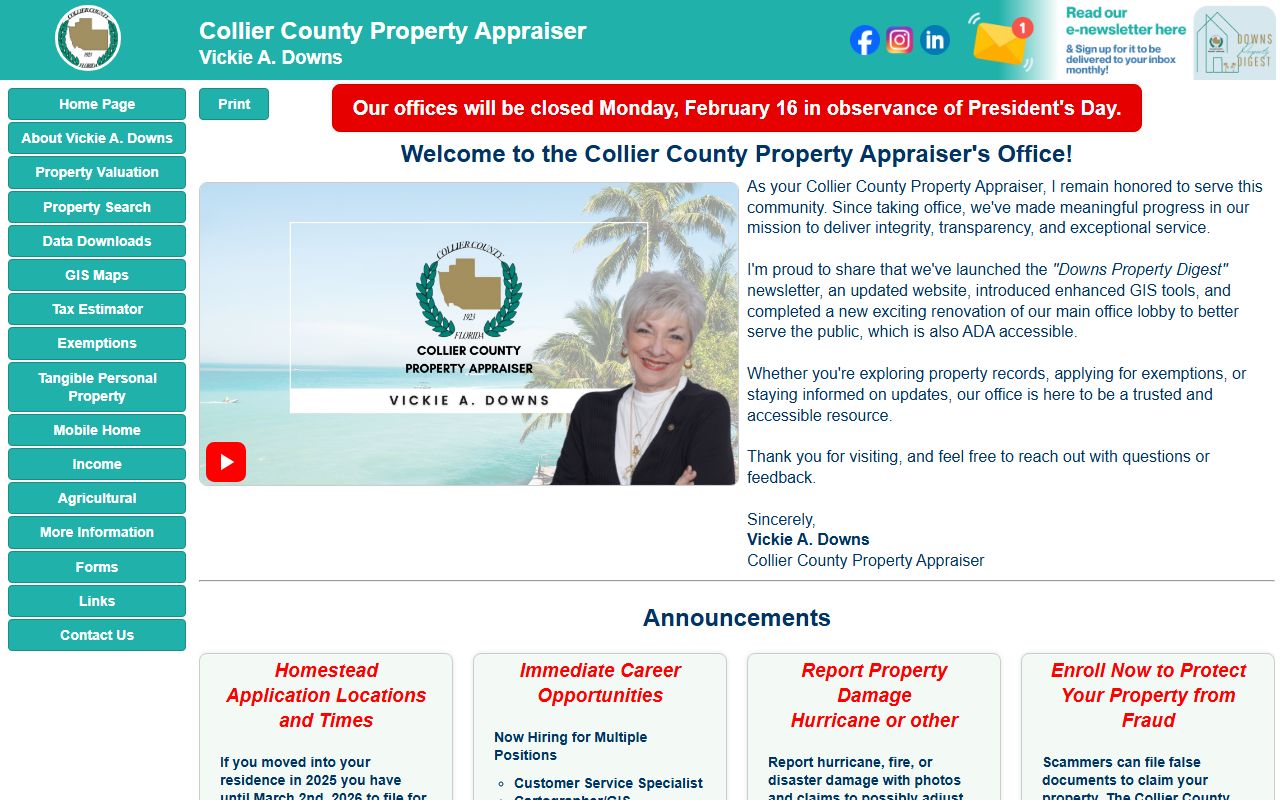
The site provides both a real property search and a tangible personal property search, along with exemption applications and assessment data downloads.
How to Search Collier County Property Records
Searching Collier County property records online is free. The collierappraiser.com portal allows searches by owner name, parcel ID, street address, and legal description. Results include the current owner of record, the property's legal description, land use classification, lot size, building square footage, year built, and just and assessed values for the current year and recent prior years.
Sales history is available for most parcels and shows prior transactions with dates and sale prices. This data helps buyers and real estate professionals verify ownership history and gauge fair market value. The portal also shows the breakdown of assessed value into land value and improvement value, which is useful when disputing an assessment or planning a transaction.
In addition to the local database, the Florida Department of Revenue data portal maintains statewide property tax data including Collier County figures. The DOR portal is a good resource for comparing county-level statistics and finding links to official local offices. It does not replace the Collier County appraiser's own database but adds useful statewide context.
Note: Aerial imagery available through the appraiser's mapping tools does not always reflect the actual boundaries of a parcel and should not be relied upon when making purchasing decisions.
Public Records Law and Property Data Access
All Collier County property records are public under Florida Statute Chapter 119. This law gives everyone the right to inspect and copy public records maintained by government agencies in Florida. There is no requirement to explain why you want a record or prove you have a legal interest in it. You simply ask, and the agency must respond within a reasonable time.
The Public Records Law covers assessment data held by the Property Appraiser as well as deed records held by the Collier County Clerk of Courts. Both types of information are freely accessible. The Clerk's records are organized under Florida Statute Chapter 28, which governs what the Clerk must record, how documents are indexed, and what fees may be charged for copies.
Homestead Exemption and Assessment Caps
Collier County property owners who use their home as their primary residence can apply for Florida's homestead exemption, which cuts up to $50,000 from the assessed value for tax purposes. To qualify, you must own the property and live there as of January 1. Applications must be filed with the Collier County Property Appraiser by March 1. Late applications are not accepted for the current tax year.
Along with the homestead exemption, qualifying homesteaded properties in Collier County benefit from the Save Our Homes assessment cap. Under this cap, the assessed value of a homesteaded property can increase by no more than three percent per year or the rate of inflation, whichever is lower. Given that some parts of Collier County have seen steep market value increases in recent years, the cap provides meaningful tax relief for long-term residents whose market values have risen far above their capped assessed values.
If you sell your Collier County home and buy a new Florida home, you may be able to take your accumulated Save Our Homes benefit with you through a process called portability. The Collier County Property Appraiser's office can walk you through the portability application process. The Florida DOR's taxpayer information page also covers portability rules in detail.
Other exemptions available in Collier County include those for widows and widowers, veterans with service-connected disabilities, totally and permanently disabled persons, and low-income senior citizens who meet income thresholds. Each exemption has specific documentation requirements. Contact the appraiser's office at 239-252-8141 with questions about eligibility.
Deed Records and the Collier County Clerk
Recorded documents in Collier County, including warranty deeds, quitclaim deeds, mortgages, and liens, are maintained by the Collier County Clerk of Courts. The Clerk's Official Records go back many decades and are searchable online through the Clerk's website. Copies of recorded documents can be obtained in person or by mail for a fee set by Florida law under Chapter 28.
When buying property in Collier County, your title company or real estate attorney will search the Clerk's Official Records to confirm clean title. This search covers the chain of ownership, any encumbrances on the property, and any recorded judgments or liens that could affect the transaction. Doing this search yourself is possible using the Clerk's online portal, though a professional title search is recommended for any actual purchase.
The Florida DOR local officials directory lists contact information for the Collier County Clerk of Courts and other property-related offices across the state. This is a useful reference if you need to reach the Clerk's office directly.
Note: Recording a deed in Collier County does not transfer property rights by itself; the underlying transaction must be legally valid, and the document must meet Florida's formal requirements to be accepted for recording.
Property Tax Bills in Collier County
The Collier County Tax Collector sends property tax notices each November. The tax amount is based on the taxable value set by the Property Appraiser and the millage rates set by each taxing authority with jurisdiction over the parcel. Taxing authorities in Collier County include the county government, the school board, fire districts, water management districts, and other special districts.
Taxes are due by March 31 of the year following the notice. Early payment discounts run from four percent in November down to one percent in February. Property that remains unpaid after March 31 becomes delinquent and is subject to a tax certificate sale, through which investors can pay the outstanding taxes in exchange for a lien on the property.
The Florida Department of Revenue property page provides general guidance on how the property tax process works in Florida, including how assessed values translate to tax bills and what options are available if you disagree with your assessment.
Tangible Personal Property Records
Businesses in Collier County must file a Tangible Personal Property return with the Property Appraiser by April 1 each year. This return covers equipment, furniture, machinery, computers, and other business assets that are not permanently attached to real property. The first $25,000 of value is exempt, but a return must still be filed to claim the exemption. Penalties apply for late filing.
The Collier County Property Appraiser processes thousands of tangible personal property returns each year given the size and diversity of the county's business community. If you operate a business in Naples, Marco Island, Immokalee, Bonita Springs, or anywhere else in Collier County, check with the appraiser's office about your filing obligations.
Cities in Collier County
Collier County includes several communities. Naples is the county seat. Marco Island, Everglades City, Immokalee, Bonita Springs, and Golden Gate are other well-known areas. None of these cities currently qualify for a dedicated city page based on the population threshold used for this site, but property records for all of them are maintained through the Collier County Property Appraiser at 3295 Tamiami Trail E, Naples.
Nearby Counties
Collier County borders six other Florida counties. If a property is near a county boundary, records may need to be checked in more than one jurisdiction. Each neighboring county has its own property appraiser and clerk of courts.